deutsche Version
Bachelor’s thesis projects
at the University Observatory
Bachelor’s thesis topics of the Extragalactic Astronomy Group
on machine learning, instrumental and observational (Wendelstein) projects,
stars and planets, galaxies, gravitational lensing and cosmology
can be found
→ here.
Please also check out the master’s thesis projects, and let us know which
would interest you, because they may in part be split and downgraded
to fit into a bachelor’s thesis.
1. Instrumentation and observational projects
2. Stars and planets
3. Galaxies and AGN
All galaxies are magnetized. Where do galactic magnetic fields come
from, how are they maintained and how are they structured? These are
the questions we wish to answer. In this project we will develop
a model for the amplification of galactic magnetic fields based on
analytic calculations.
Project 3.2:
Propagation of cosmic rays in the Galaxy
(H. Lesch lesch@usm.lmu.de)
Cosmic rays represent a small but high-pressure part of the
interstellar medium. Through their pressure on the magnetic fields,
cosmic rays contribute considerably to the galactic dynamo. In this
project we will analyse the properties of Galactic cosmic rays and
their impact on gamma-ray emission.
Project 3.3:
Single tidal disruption events around Supermassive Black Holes (literature-based)
(P.D. Dr. Roberto Saglia saglia@mpe.mpg.de)
Stars passing too near the central supermassive black holes of
galaxies can be tidally disrupted, causing a brightening of the
centers, followed by a declining light curve with characteristic
shapes and time scales measurable at different wavelenghts, from
X-rays to UV and the optical bands, depending on masses of the BHs.
Project 3.4:
Recurrent tidal events around Supermassive Black Holes (literature-based)
(P.D. Dr. Roberto Saglia saglia@mpe.mpg.de)
A subclass of tidal events around Supermassive Black Holes are recurrent:
the brightening of the measured light curve repeats on quasi-periodic time
scales. This happens every time a star orbiting a SMBH hits its accretion
disk.
Project 3.5:
High-redshift galaxies, Little Red Dots and Black Holes (literature-based)
(P.D. Dr. Roberto Saglia saglia@mpe.mpg.de)
Thanks to the James Webb Space Telescope 'primordial' galaxies can be
detected up to very high redshifts. Some of them are identified as
'Little Red Dots', characterized by high stellar masses and possibly
large amounts of dust, small sizes, V-shaped spectra. Their broad
emission lines point to the presence of accreating supermassive black
holes. They probe models of galaxy formation and evolution and play an
important role in defining the epoch of reionization.
4. Cosmology, large-scale structure, and gravitational lensing
Project 4.1:
Distances to supernovae in various cosmological models
(J. Weller weller@usm.lmu.de)
The student will derive the correlation between distance and red shift
for different Friedmann Models. Boundary conditions to cosmological
parameters will be derived by comparison with supernova data. These
analyses are made with the aid of so-called Monte Carlo Markov chains.
If there is enough time, the analysis can be extended to models with
extra dimensions.
Projects in the Astrophysics, Cosmology, and Artificial Intelligence Group
(Daniel Grün et al.)
Projects in the Physical Cosmology Group
(Jochen Weller et al.)
5. Computational and theoretical astrophysics
Research in the Computational Astrophysics Group (CAST) ranges from
the theoretical investigation of star and planet formation to studies
of processes on cosmological scales.
A variety of different, well-known numerical codes (such as Ramses,
Gadget, Sauron, Gandalf, Mocassin, and others) are used.
Primary investigations regard the formation, the structure, and
the evolution of protoplanetary disks, the formation of planetary
building blocks and planets, the relation between turbulence and phase
transitions in the multiphase interstellar medium (ISM), energetic
feedback processes, molecular cloud and star formation in galaxies, as
well as cosmological structure and galaxy formation and the interplay
between feedback processes, AGN, and galaxy evolution and their imprint
on the intergalactic medium (IGM) or the intercluster medium (ICM).
Thus, our group studies astrophysical processes on length scales
covering more than 14 orders of magnitude, from gigaparsec scales
of cosmological structures all the way down to sub-AU scales of dust
grains within protoplanetary disks.
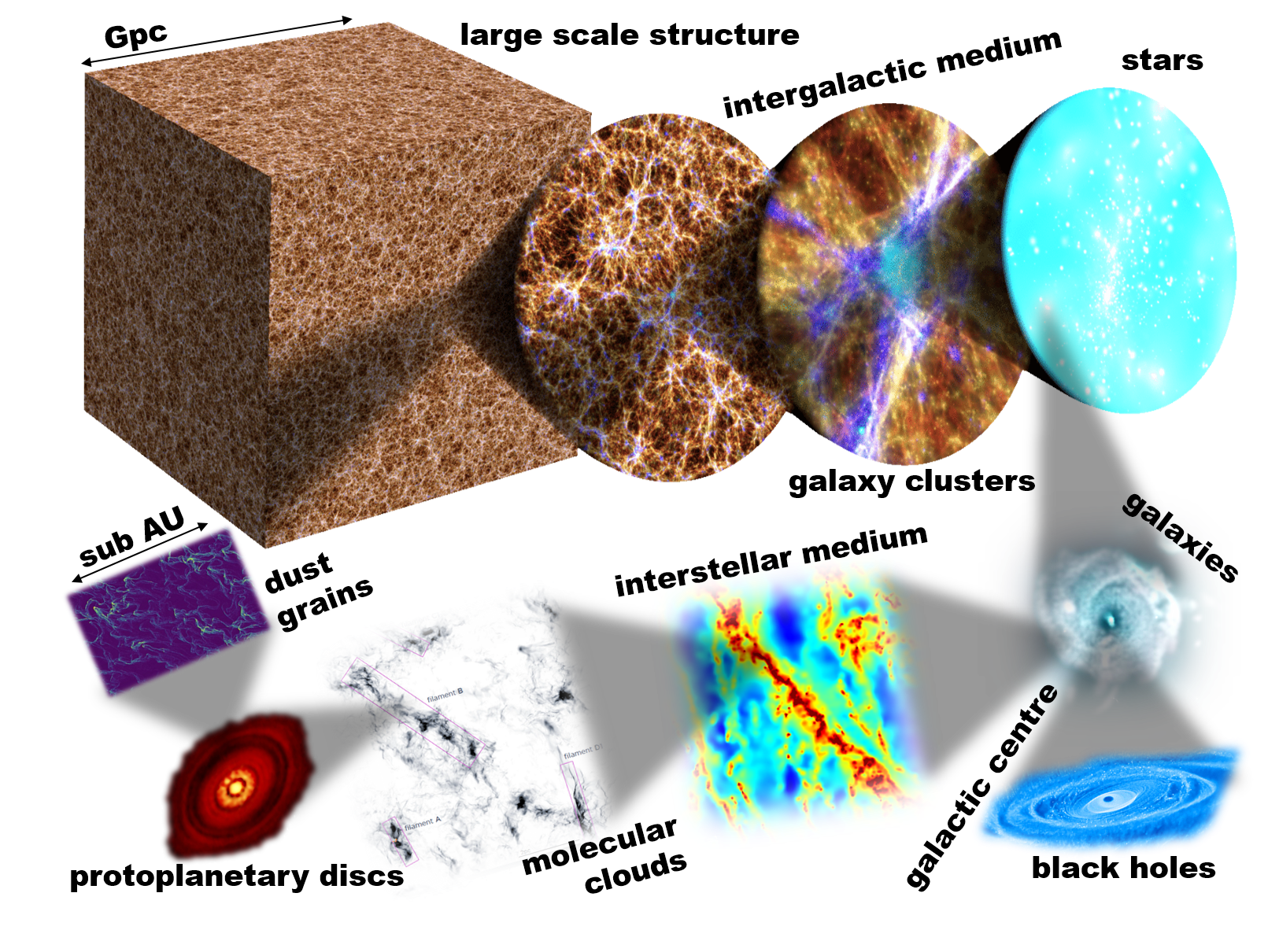
It is now clear that small-scale processes like the condensation
of molecular clouds into stars, magnetic fields and the details of
heat transport as well as large-scale processes like gas infall from
the cosmic web into galaxies and environment are intimately coupled
and have to be investigated in a concerted effort.
The various past and ongoing projects within the CAST group cover
a link between the various scales and contribute to our understanding
of crucial aspects of the formation and evolution of stars and
protoplanetary disks, central black holes and AGNs, star-forming
regions and the ISM, galaxies and their IGM, galaxy clusters and the
ICM as well the large-scale structures in the universe.
They also also drive the continuous effort to develop and to apply
new numerical methods and the next generation of multi-scale codes
within the framework of numerical astrophysics.
Past and ongoing Bachelor’s and Master’s thesis projects
were always offered with respect to the individual strengths and
interests of the students and cover various areas in the field of
computational and theoretical astrophysics:
- Formation of large-scale cosmological structures (dark-matter
halos, galaxies, clusters of galaxies, role of black holes, magnetic
fields and non-thermal particles)
- Evolution and structure of the turbulent interstellar medium
(ISM physics, self-regulating star formation, formation of molecular
clouds, magnetic fields)
- Physics of galactic centers (active galactic nuclei, origin and
nature of the gas cloud G2 near the Galactic center)
- Formation of planets, stars, and stellar clusters (stars and
their influence on the surrounding protoplanetary disc, interstellar
matter, radiative transfer, dynamics of particles and planets in
protoplanetary disks)
- Application and development of numerical tools on parallel
CPUs and GPUs and visualization (particle-based
SPH/N-body, grid-based,
moving-mesh or meshless methods)
More detailed information on
ongoing and finished projects
as well as more detailed information on ongoing research can be
found on the web pages of the
Computational Astrophysics Group.
6. High-energy astrophysics
X-ray and gamma-ray observations have been instrumental in enabling
scientists to study some of the most extreme cosmic sources in the
Universe.
The utilisation of data obtained through X-ray and imaging atmospheric
Cherenkov telescopes facilitates the comprehension of physical
processes in these extreme environments and the tracing of their
evolution.
This provides opportunities to study processes at the frontier of
known physics.
The research undertaken by our group encompasses a broad spectrum
of enquiry into astrophysics and fundamental physics, including the
investigation of cosmic-ray acceleration processes and the quest to
comprehend the nature of Dark Matter.
Those interested in pursuing this field are invited to get in touch.
|
![[LMU logo]](/graphics/lmulogoboxes.png)
![[USM logo]](/graphics/usmlogo.png)
![[LMU seal]](/graphics/lmusiegelbox.png)