
Christoph "Haley" Ries Astrophotography Gallery!
Clicking in the CinemaScope image above is worthwile!
New images can be viewed here, here, here and here. There are also direct links to a few, partly new regions on this page: Supernovae 2014, Supernovae and images 2013, Supernovae 2012, Supernovae 2011, Supernova 2008 and further imaging, Milky way panoramic view, M81 and M82, comparison between old and new, astroimaging from southern Spain, summer objects 2007, supernovae 2007 , The first EOS images, Orion nebula, M57 and M51, or right here, now with new images, southern sky highlights , galaxies mostly older pictures, galaktic nebula , galaxies in M44, also with direct link and astroimages from the ITT. Rummaging is always worthwhile, there are more images online.
All Astro images can be viewed this way .

A further look into the Astro imaging archive opens behind these two links:
 Planetary observing with Haley's telescopes:
 |
Haleys Comet gallery: |
|---|
 |

|
|---|
Supernovae in the year 2014:
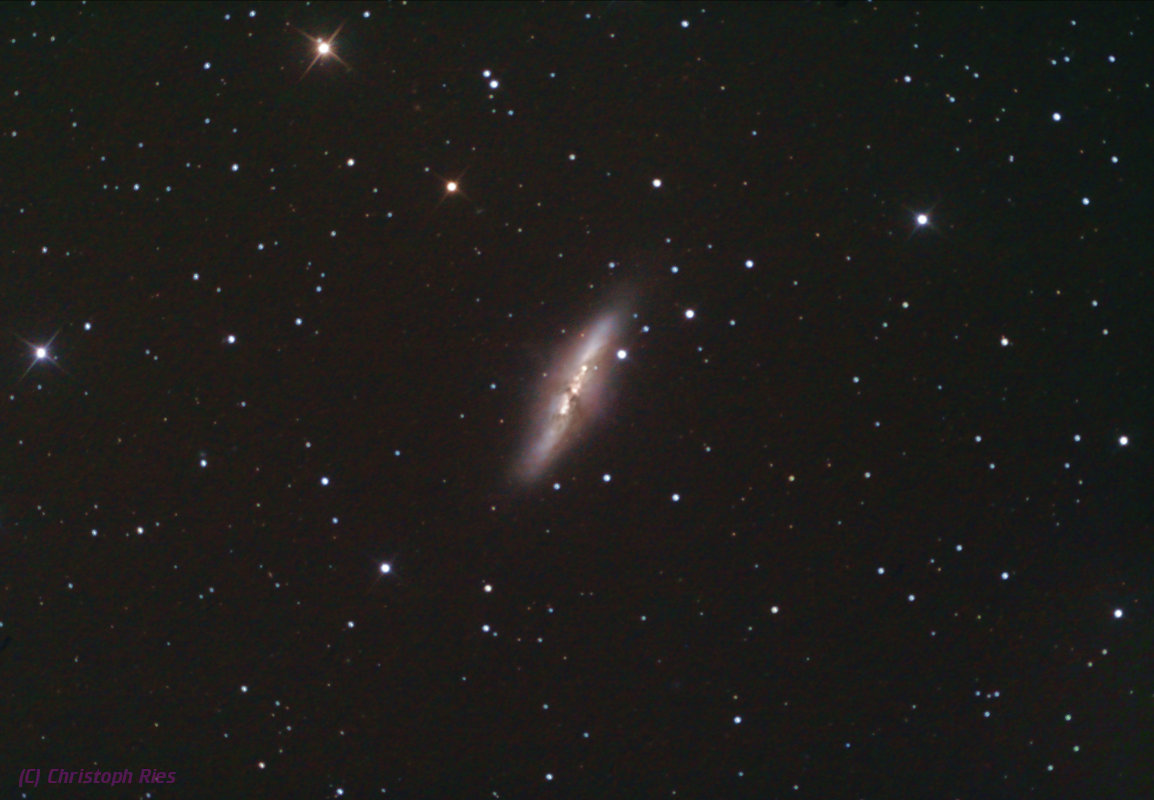
Two of the Supernovae of this year I've got on photographs, SN 2014L in M99, gained about 15mag and the spectacular SN 2014J in M82. This one was pretty bright with about 10mg. The SN 2014J has also been observed intensively with the 16inch cassegrain of the Mt. Wendelstein Observatory. At the Mt. Wendelstein Observatory page you'll find at "Aktuelles" more informations about this bright Supernova (Actually in german only). Both objects showed here have been shot through the Bismarck Telescope at March 9th. M99 has undergone a new image processing because I was a bit unhappy with the first result:
M99 with SN 2014L: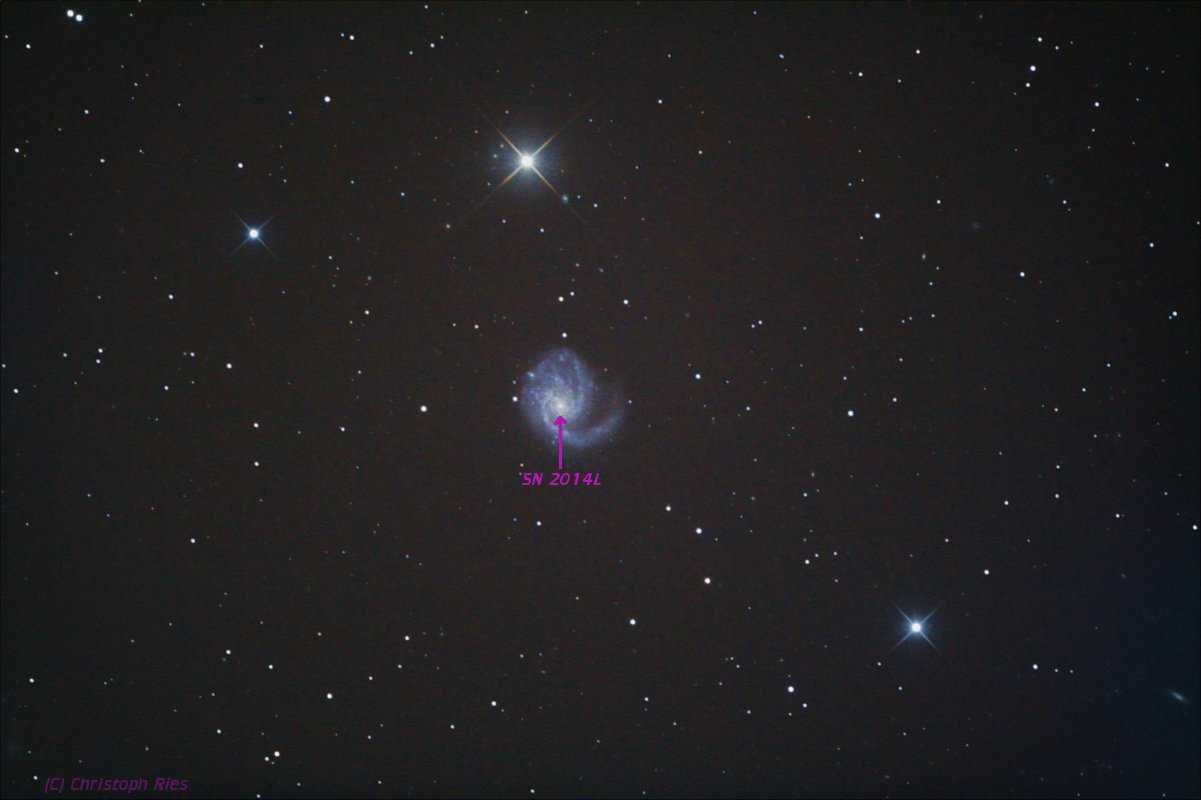 |
M82 with SN 2014J: |
| 21 frames stacked with improved flat. Total exposure time 63 minutes. | 15 frames stacked with Deep Sky Stacker. Total exposure time 45 minutes. |
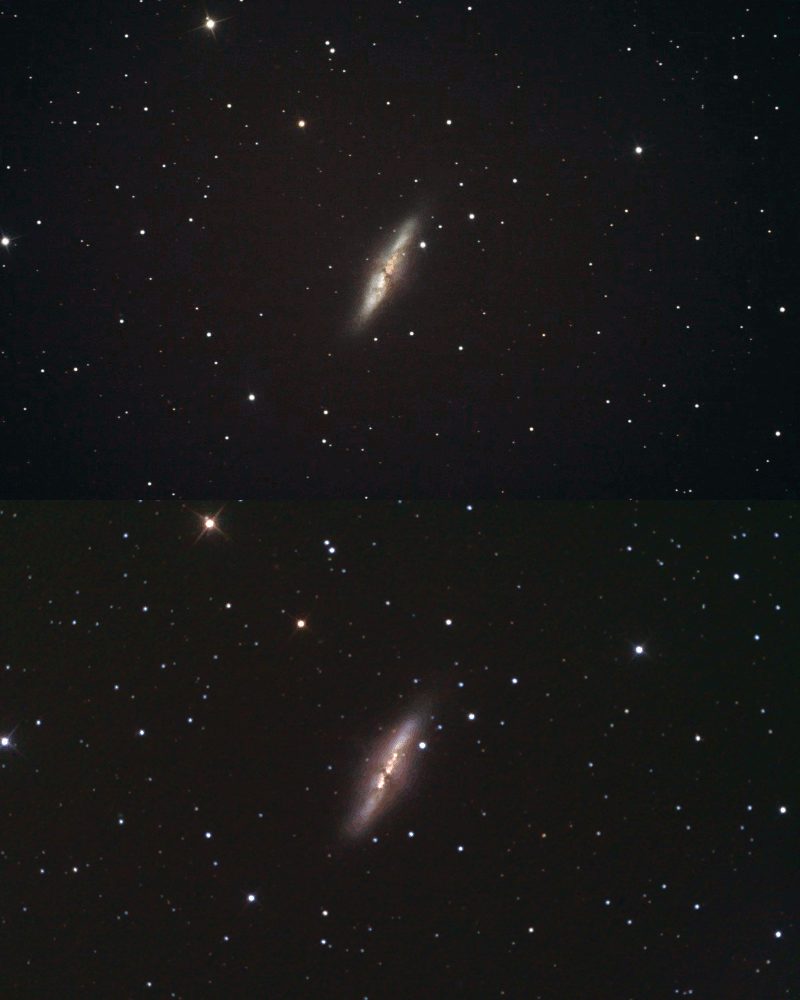
There is also an existing version without labeling of both pictures: here from M99 and here from M82. I have done a pretty nice image of M82 earlier. This is ideal for creating a Gif animation to show the comparison with and without Supernova.

Supernovae and deep sky in the year 2013:
2013 I managed it to expose Supernovae in two prominent galaxies: M74 and M65. Also a few other impressions, e.g. the coma cluster, have been created this year. The images from M74 have been done at August 2nd, the ones from M66 an M65 at April 15th. The comparison of this years image of M66 and M65 with a picture taken 2007 through Schdoffal from southern Spain, off course with much more shorter exposure time, is also interesting:
M74 with SN 2013ej: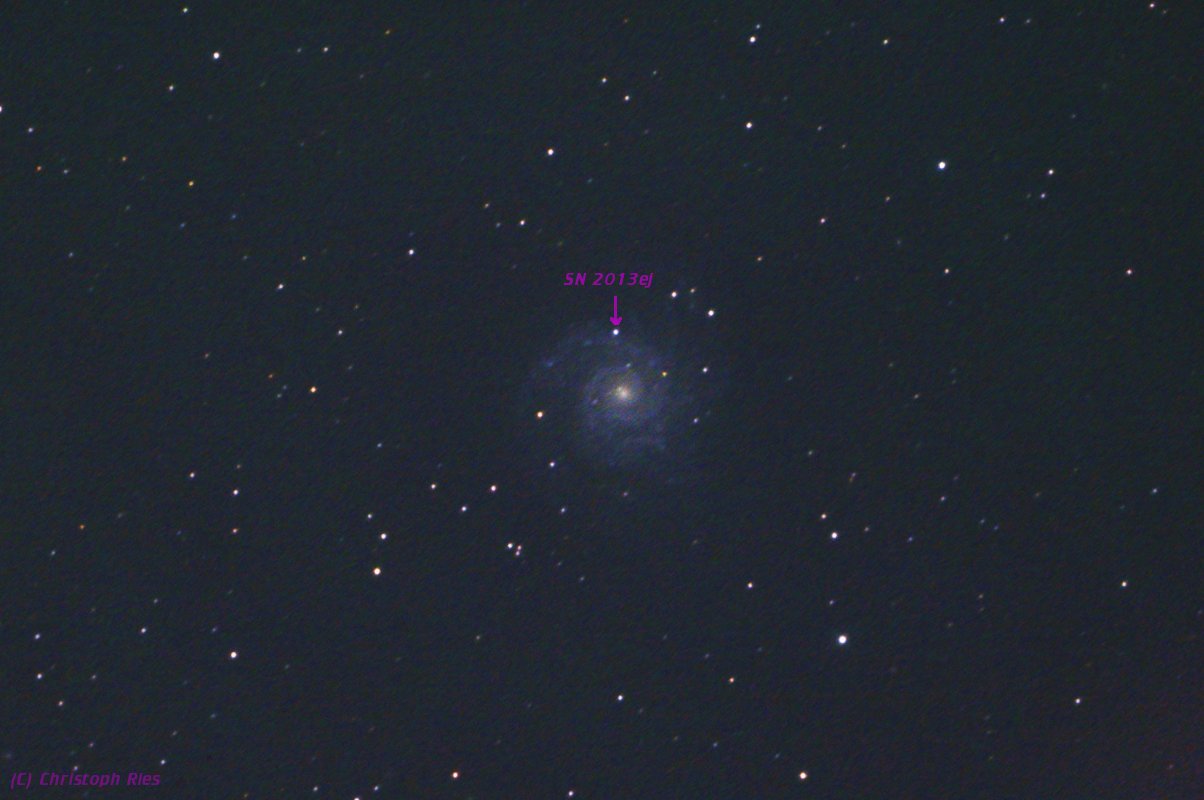 |
M66, M65 with SN 2013am: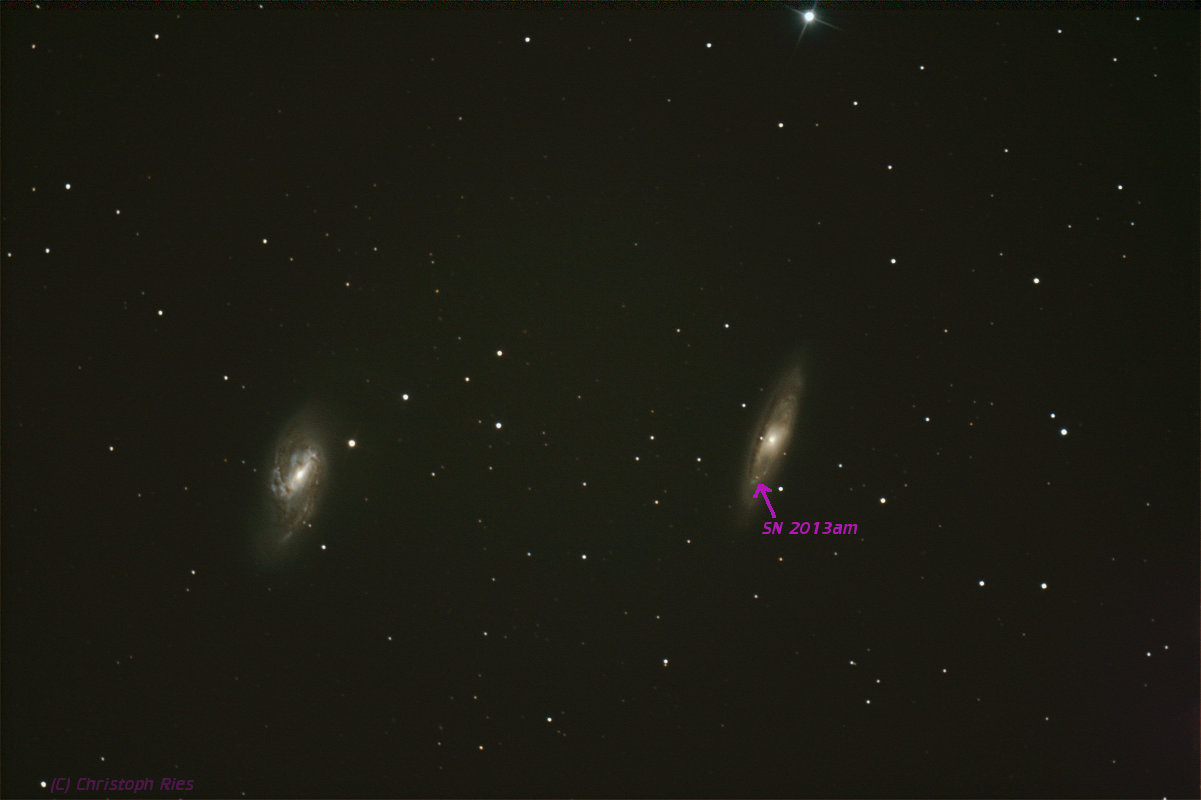 |
| 13 frames, 60secs each have been stacked with Deep Sky Stacker. Flat and dark correction, Bismarck focal. Object stood already pretty low. | 22 frames 176secs each have been stacked after dark and flat correction with Registax. The Supernova had only maximum 15mag brightness. But no problem for the Bismarck Telescope. |
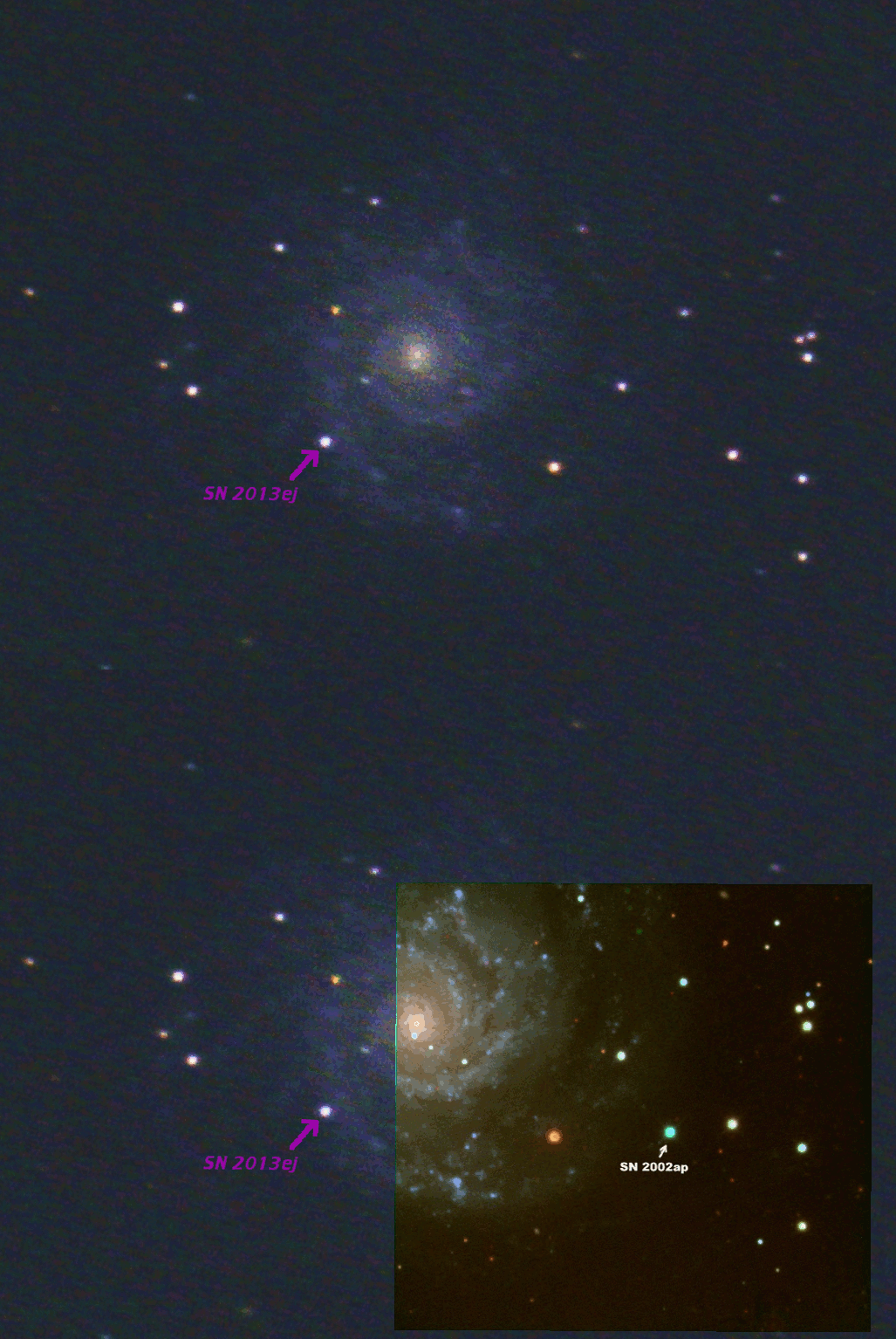
This was the 2nd observable Supernova between a few years in M74. Yet in 2002 there was the SN 2002ap, which was also observation program with the 32inch telescope of the Mt. Wendelstein Observatory. This animation is showing both Supernovae in M74 in a direct comparison with an additional Mt. Wendelstein image. I was also involved in the creation of this shot. You can read more about this at the image gallery of the 32inch telescope (actually only in german). Please scroll down to M74.
The next row of images is showing three frames containing an image I am often calling "Haleys little deep field", a deep view into the Coma cluster around NGC 4874 and NGC 4889. The M97 image was a result from the year before but the result of newer image processing:
Coma galaxy clusgter: |
Summer Milky Way: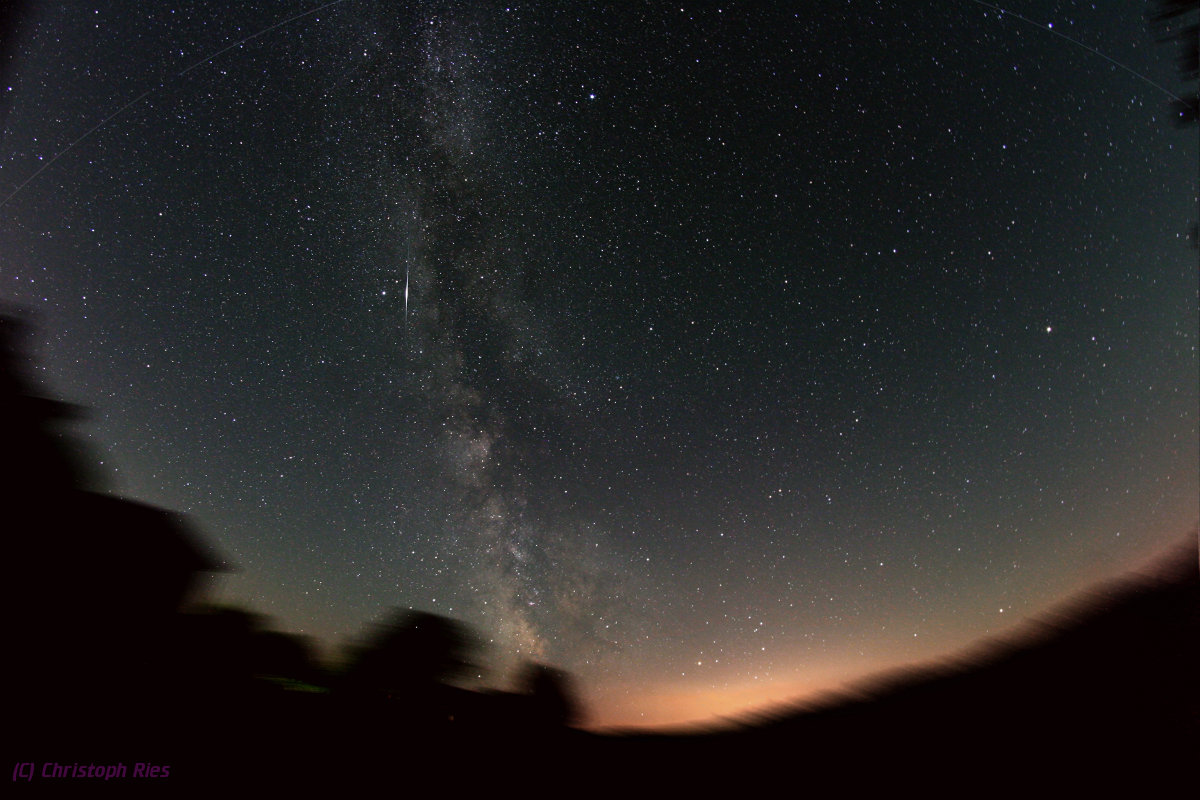 |
Planetary nebula M97: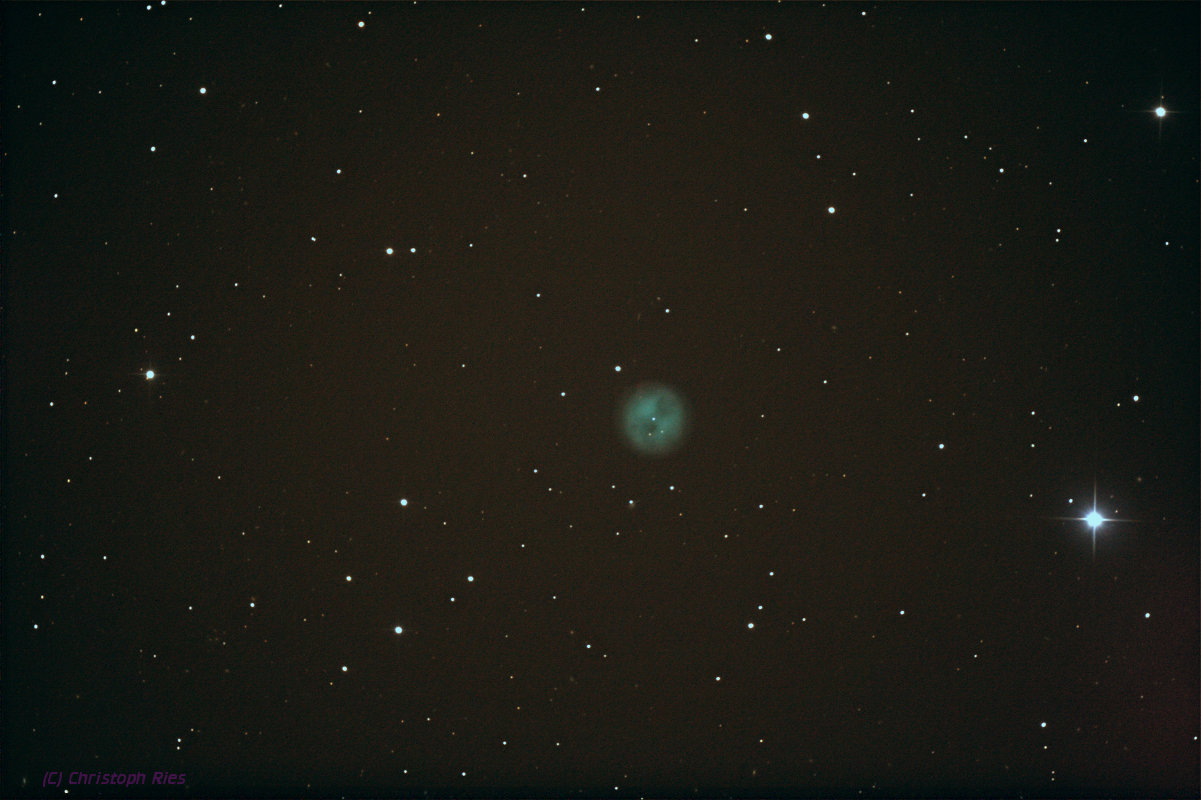 |
| 21 Bismarck fokal shots stacked with Registax. Total exposure time 63 minutes. NGC 4874 is left from the middle, NGC 4889 at the right side. The big spindle right below is NGC 4895, the little spiral above and to the right is NGC 4907. | 9 frames through the 8mm Walimex fisheye have been stacked. Total exposure time 27 minutes. There is also an Iridium flare and the path of ISS visible at this image. | 14 have been stacked here. Total exposure time 41 minutes. The processing was difficult due to poor image capture conditions. |
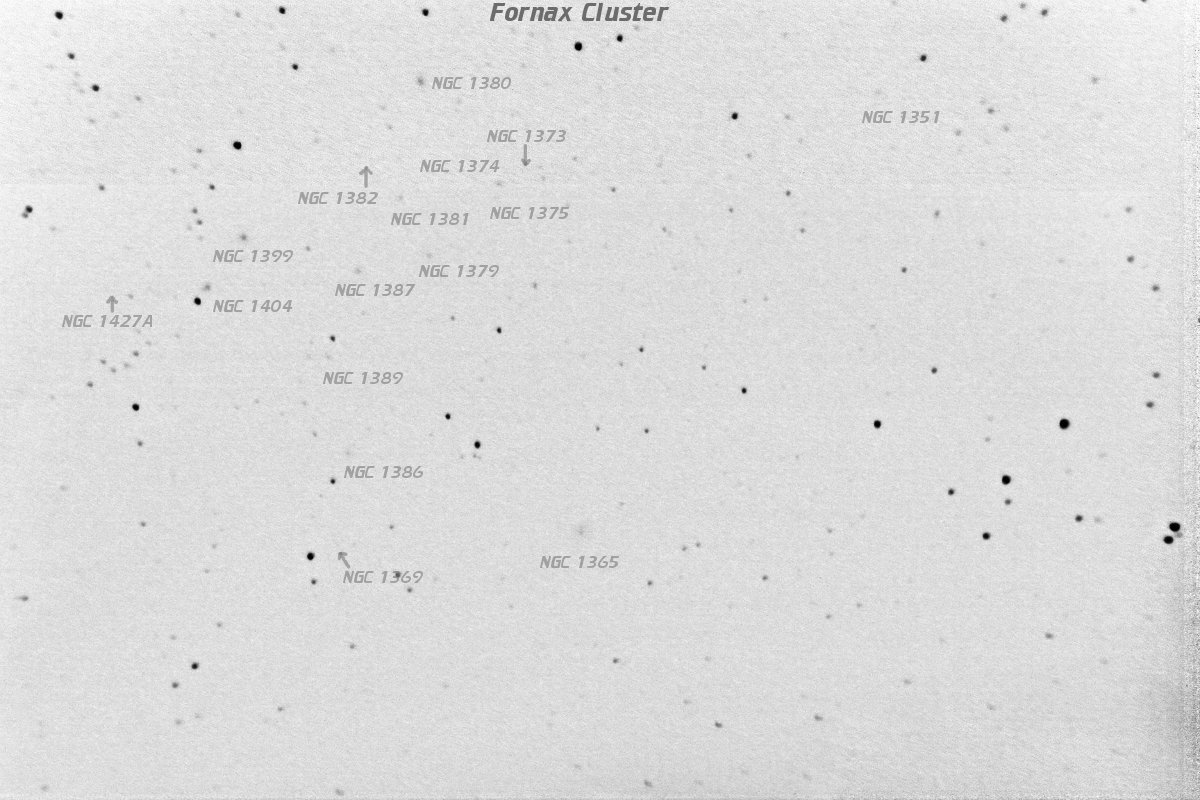
I was again engaged with the theme Fornax cluster in fall 2013, now at the Edelweißspitze at Mt. Glockner before 29th ITT at the Emberger Alm. At this link there are more images from that action. The visual impression of this galaxy cluster was pretty spectacular for middle european conditions, the cluster just had an elevation of only a few degrees above the horizon. I took the 30secs exposures through Christina without guiding, this resulted in poor raw images but there was enough information to be retrieved. The first image of this row has been stacked with Deep Sky Stacker, smoothed and contrast amplified with The Gimp. One year later I worked again with the material, now stack after flat correction with Registax. It's a matter of personal taste which version is looking better. Due to the low elevation of the cluster a refraction correcture with the red and blue channel was also necessary during processing of the images. For the identification of the objects these finding chart I've made the year before can be useful:
NGC 1365: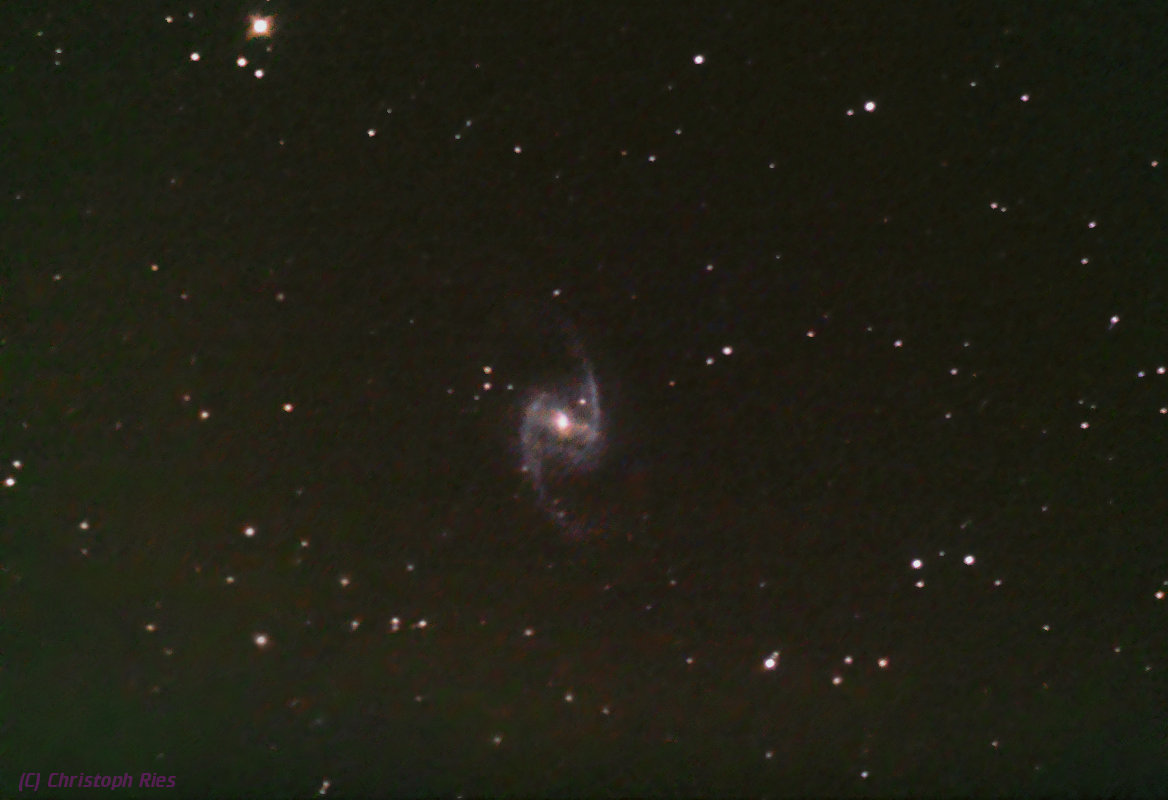 |
Fornax cluster: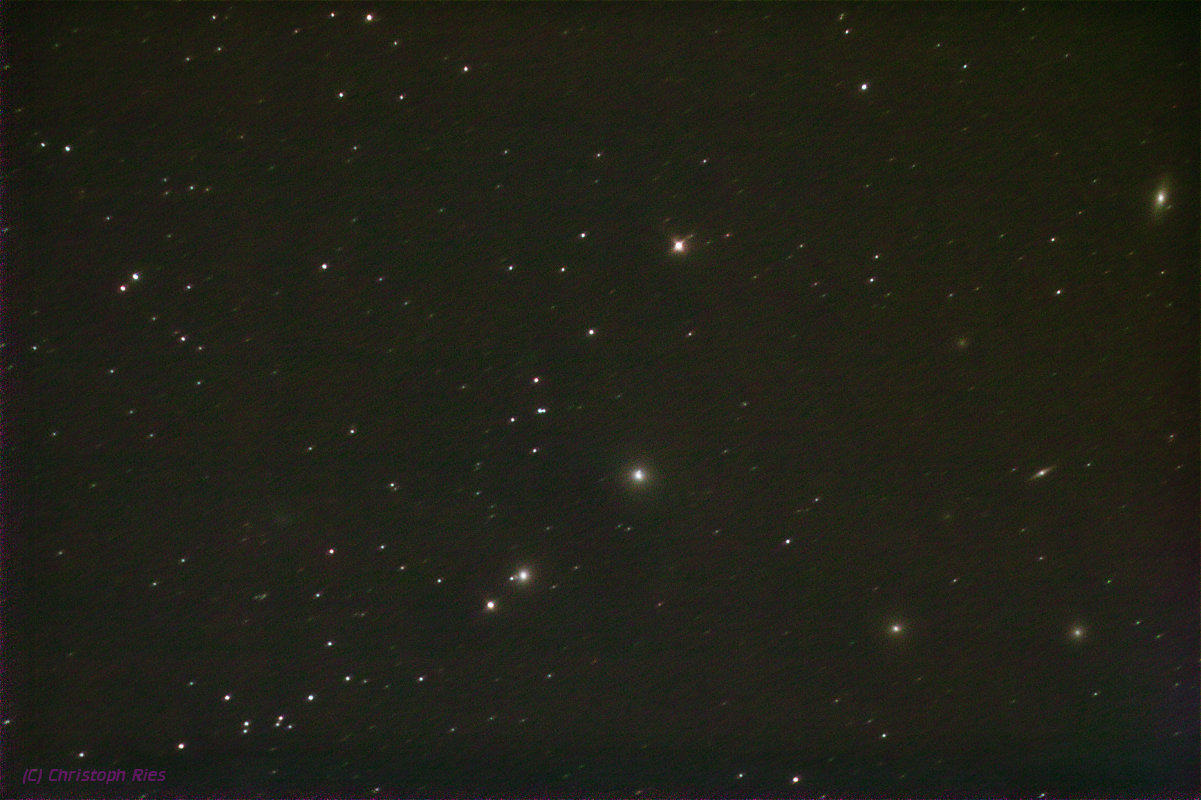 |
NGC 1365: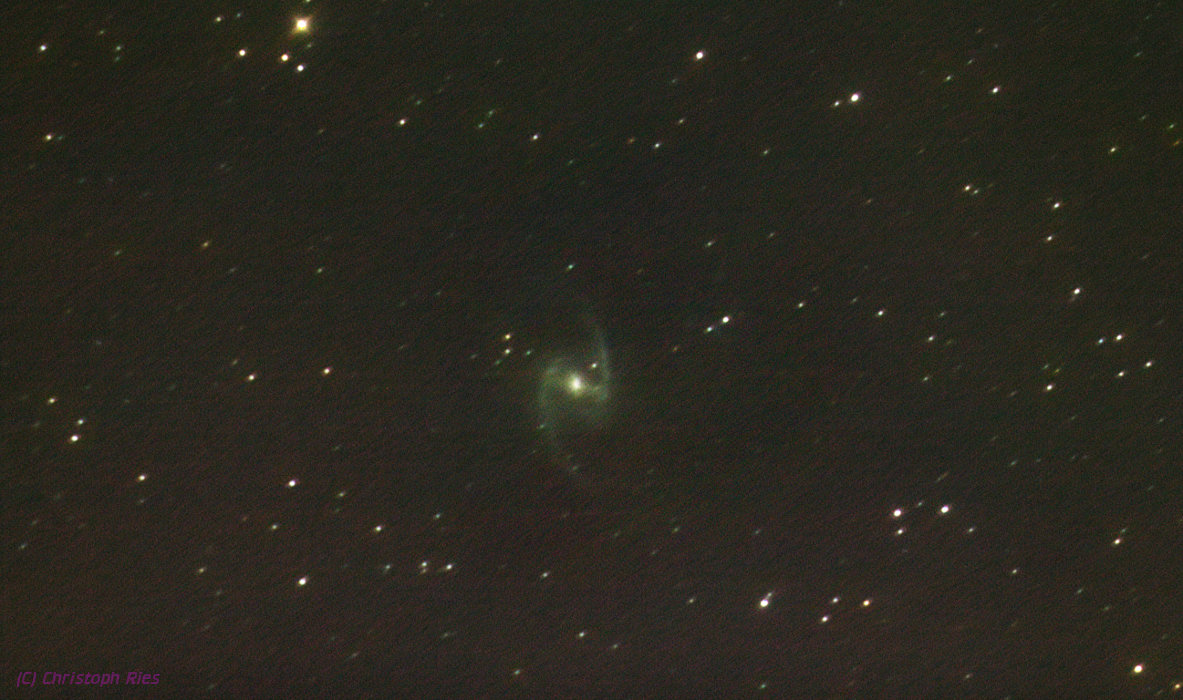 |
| Stack out of 21 Frames, total exposure time 10 minutes. Manually smoothed and contrast amplified. Slight crop for centering the galaxy in the middle of the field. | The center of the Fornax clusters, 5 minutes total exposure time. NGC 1399 and NGC 1404 are in the middle of the field. | Similar processing out of all 21 frames like in the image of the clusters core. Very fine structures seems to be a bit more detailled. Slight crop for centering the galaxy in the middle of the field. |
Supernovae in the year 2012:
In 2012 two nice star explosions in popular galaxies happened. In spring the SN 2012aw in M95 reached more than 12mag. At March 28th I kept an eye on it with the Bismarck telescope. By experimentation with frame editing two versions have been created. In early fall I've tested the 8mm Fisheye lens the first time at the starry sky and it got the opportunity to take a 16 minute ride at the Bismarck telescope. Shortly after the ITT stargazing towards NGC 1365 with the supernova 2012fr, located deeply in the south, was possible. The creation of an usable image was pretty difficult at the Allgaeu, the object had an elevation of only 2 degrees. At November 21st I got more familiar with this object.
M95 with SN 2012aw - Version 1: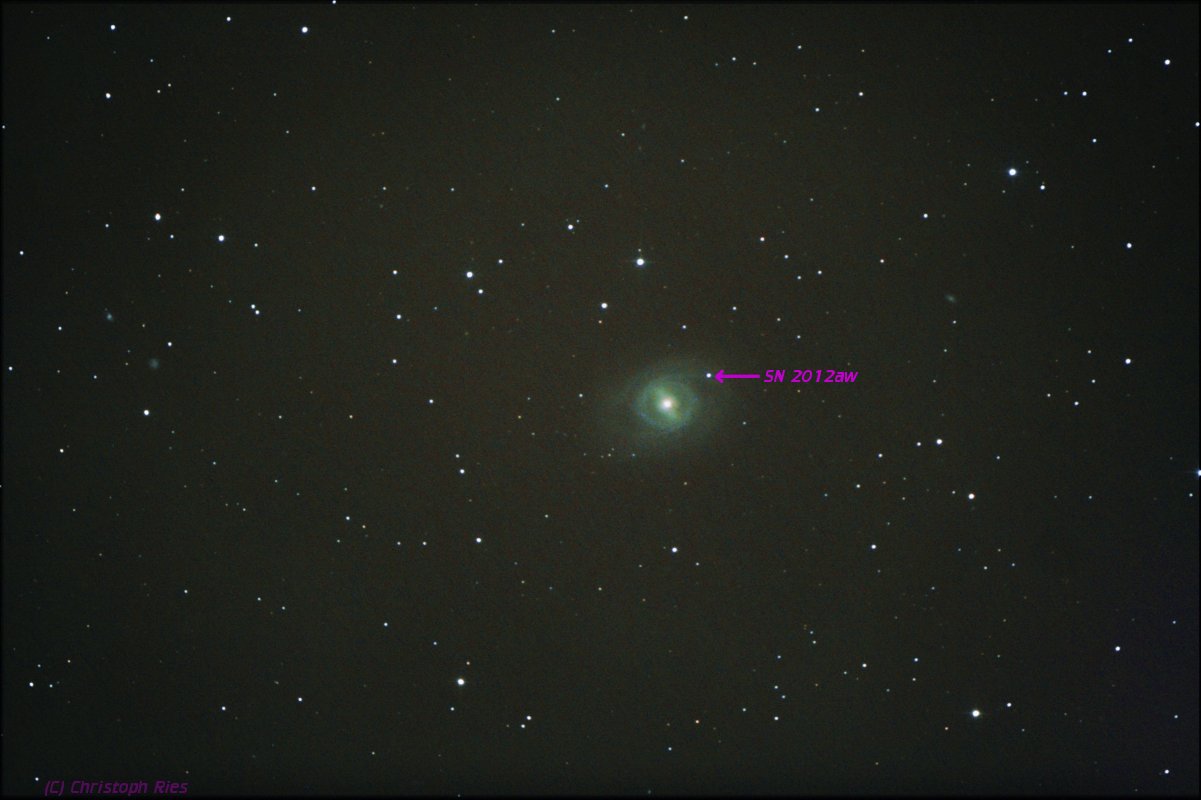 |
M95 with SN 2012aw - Registax: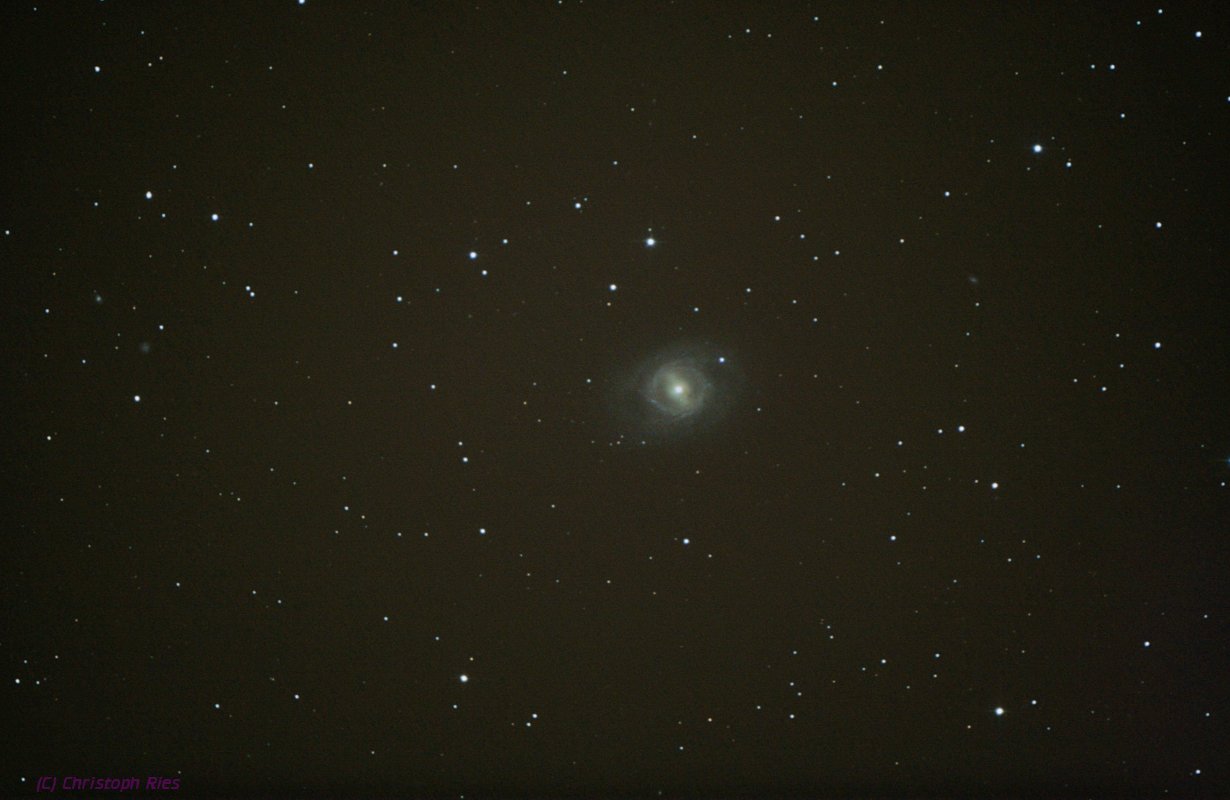 |
Bismarck with summer milky way: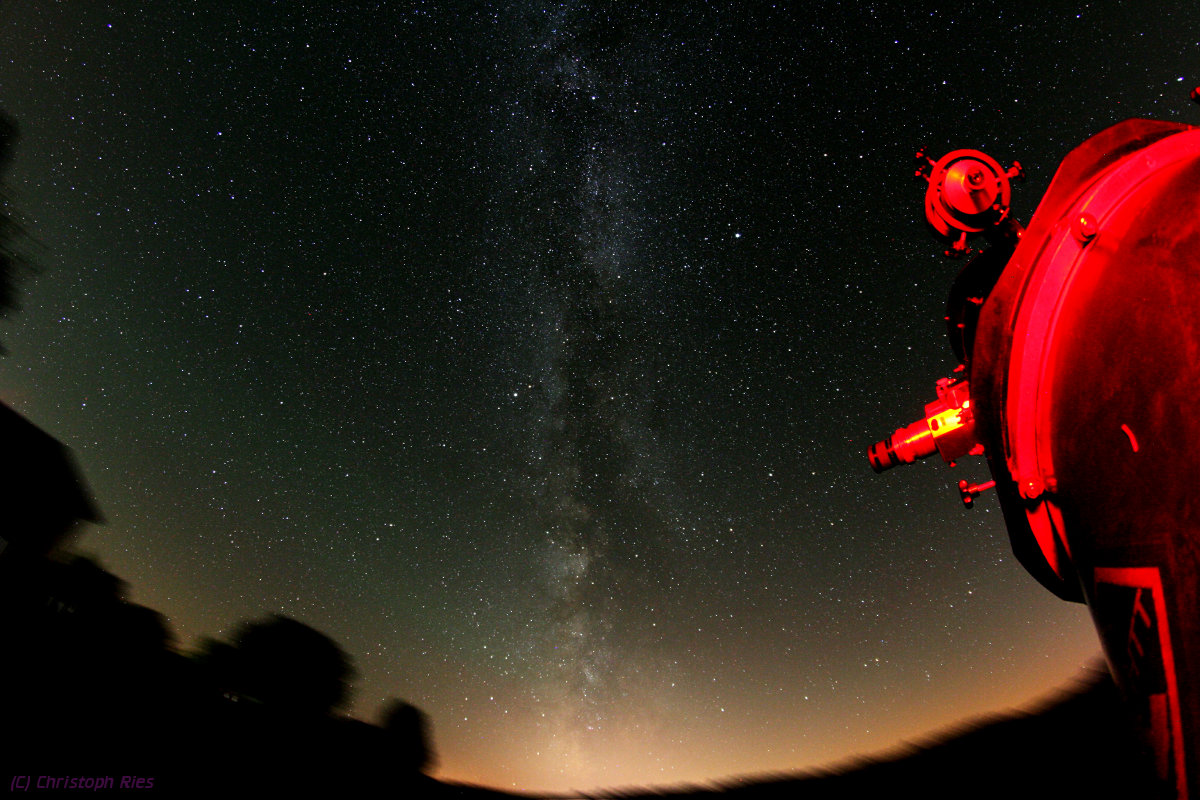 |
Fornax and NGC 1365 with SN 2012fr: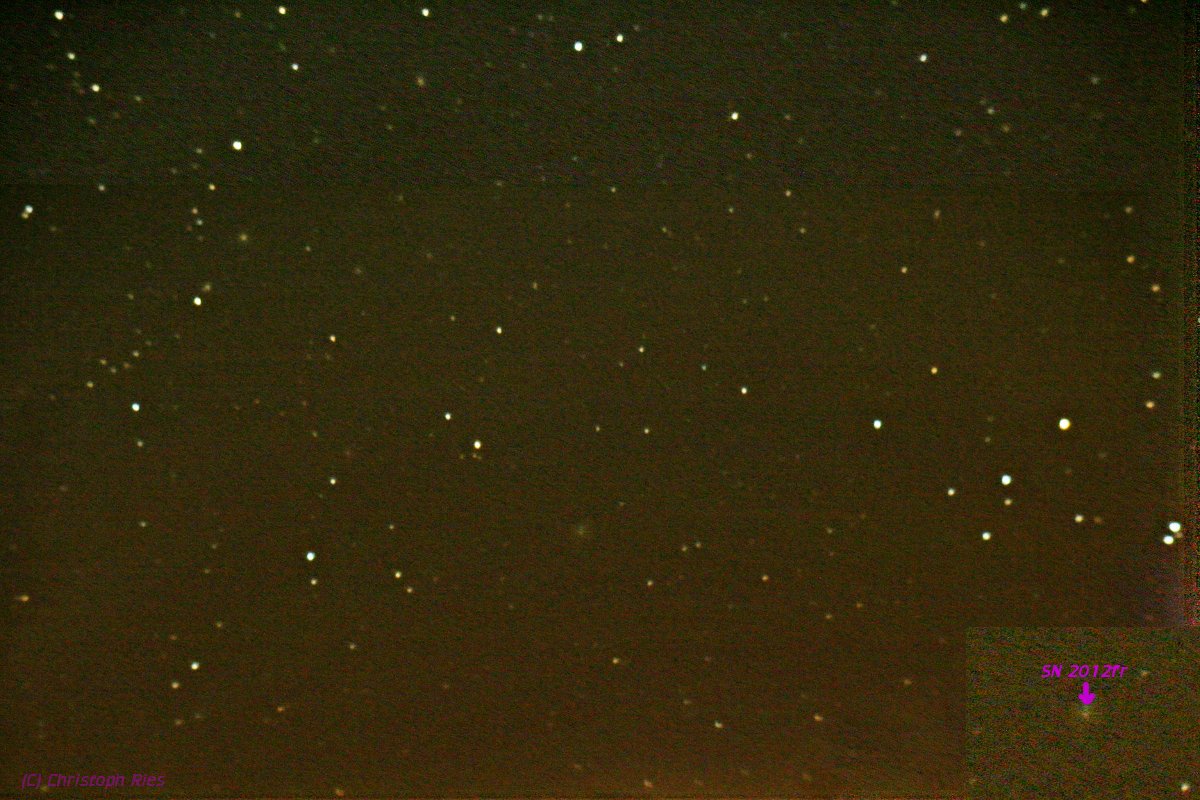 |
| Stack out of 10 frames 176secs each with Deep Sky Stacker. Correction of guide errors after stacking with The Gimp and artificial flat. | In this Version 11 frames have been stacked with Registax. The single frames have been edited with The Gimp in advance. Total exposure time 30mins. | Stack out of 8 frames 120secs each with Deep Sky Stacker. Piggyback at the Bismarck telescope. | Beside NGC 1365 with the supernova this image is showing the whole Fornax galaxy cluster. It has been stacked with the 66mm f/6 refractor "Wilhelmine" out of 10 frames completely manually with The Gimp. Total exposure time 9mins. |
The creation of the Fornax picture was a bit adventurous. Due to the position very close to the horizon only short single frames without guiding could be made. Beside guide errors a strong gradient of the sky background was sadly a fact. Only by using The Gimp a relatively acceptable result could be reached. The form of a barred spiral can be guessed already. 16 galaxies of the Fornax cluster could be identified, there are marked in this image. Additional an inverted black and white version has been done. It is optimal as a finding chart of the cluster, also as printable version because so close to the horizon the single galaxies normally could be identified not so easily. Another interesting fact is the comparison of this exposure of NGC 1365 with an image of this galaxy, taken in the year 1994 at the chilenean Altiplano through "Christina".

Pictures and supernovae from the year 2011:
This year two prominent galaxies showed up with supernovae: M101 and M51. Both star explosions could be seen pretty well in medium telescopes and looked relatively spectacular in Bismarck and Christina. The supernova 2011fe in M101 has been observed at the Mt. Wendelstein one year long. Its maximum brightness was about 9.25mag. At the page of the Mt. Wendelstein Observatory under the point "actual" there are more images and informations about this bright supernova. The images at the following row have been created at the 27th. ITT at the Emberger Alm. It is also interesting to compare them with older images from an earlier ITT, the 15th wich happened in 1999:
M51 with SN 2011dh: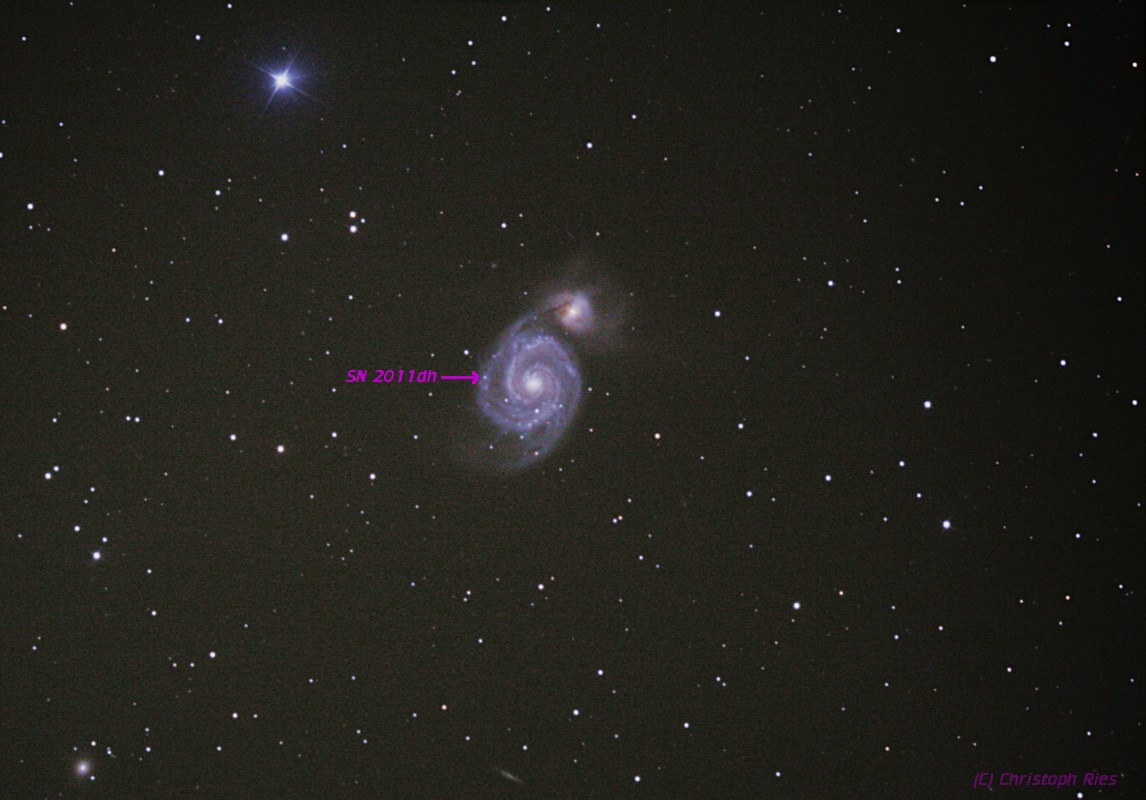 |
Helix nebula - NGC 7293: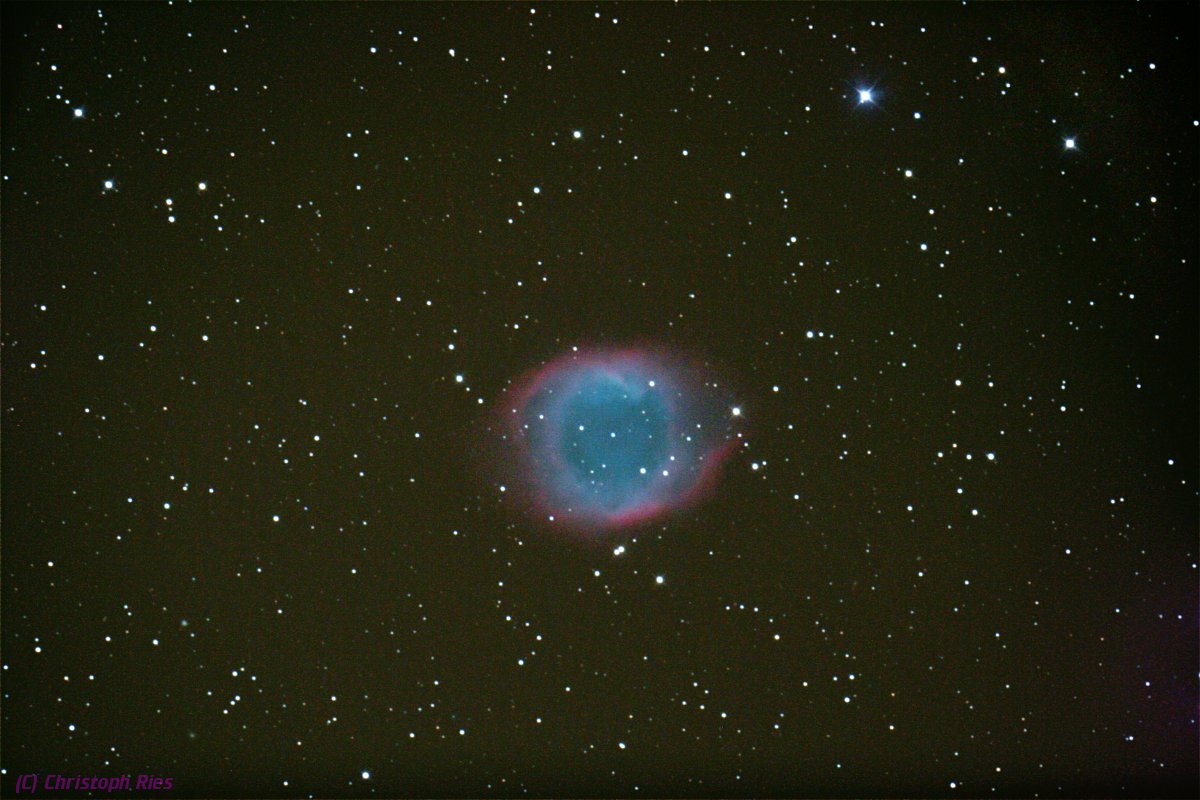 |
M101 with SN 2011fe: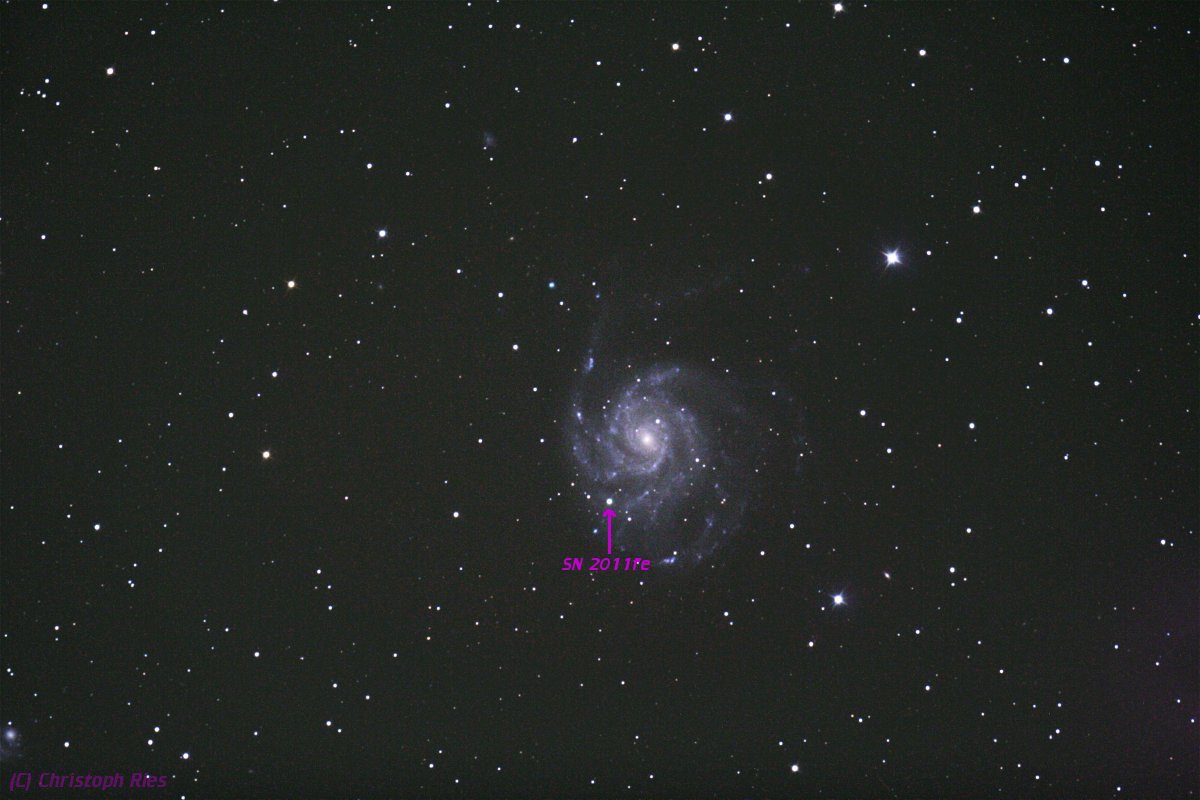 |
| At the date of the exposure the supernova still got 14.5 magnitudes. Stack out of 5 frames, Christina focal shot with coma corrector. Total exposure time 19m32s. Slight crop for better alignment of the object. | The Helix nebula, a relatively southern object, shines pretty impressive at the carinthian sky. Stack out of 4 frames, 27mins total exposure time. Christina focal shot with coma corrector. | Supernova with about 10mag in brightness, stack out of 4 frames, 17mins total exposure time. Christina focal shot with coma corrector. Besides there is another version without marking of the supernova. |
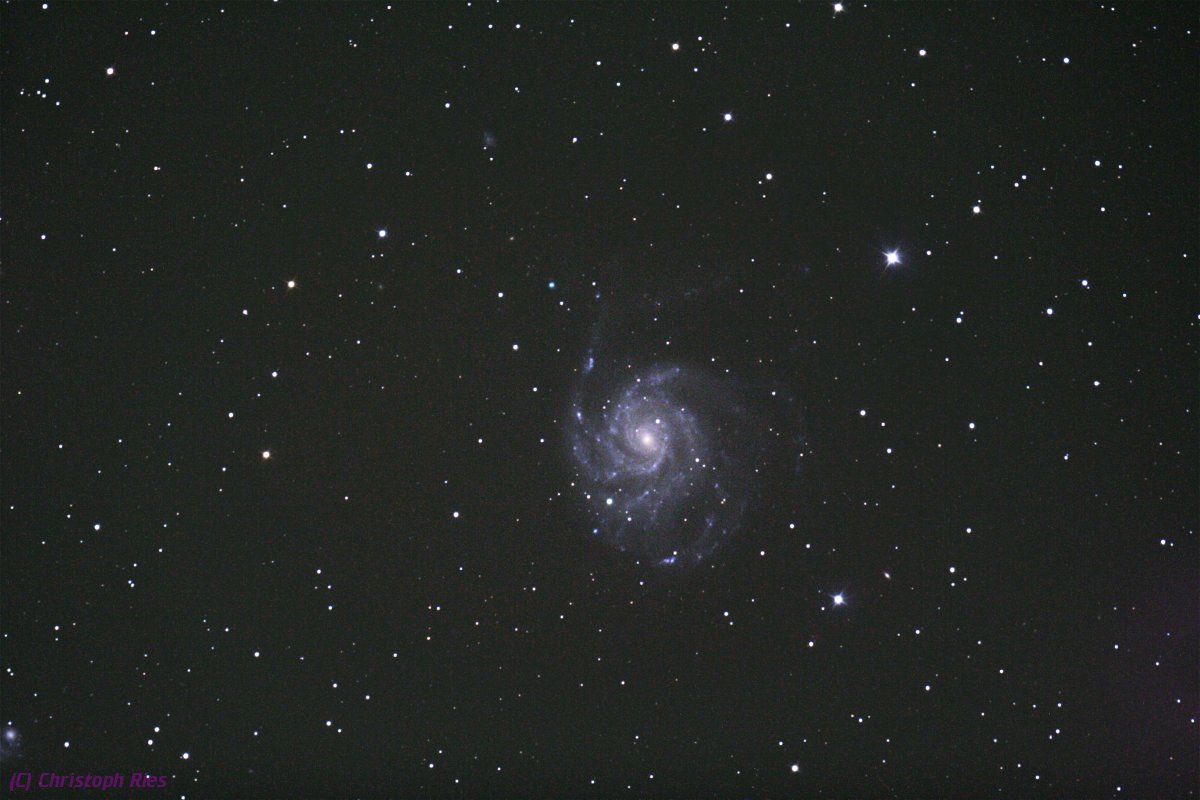
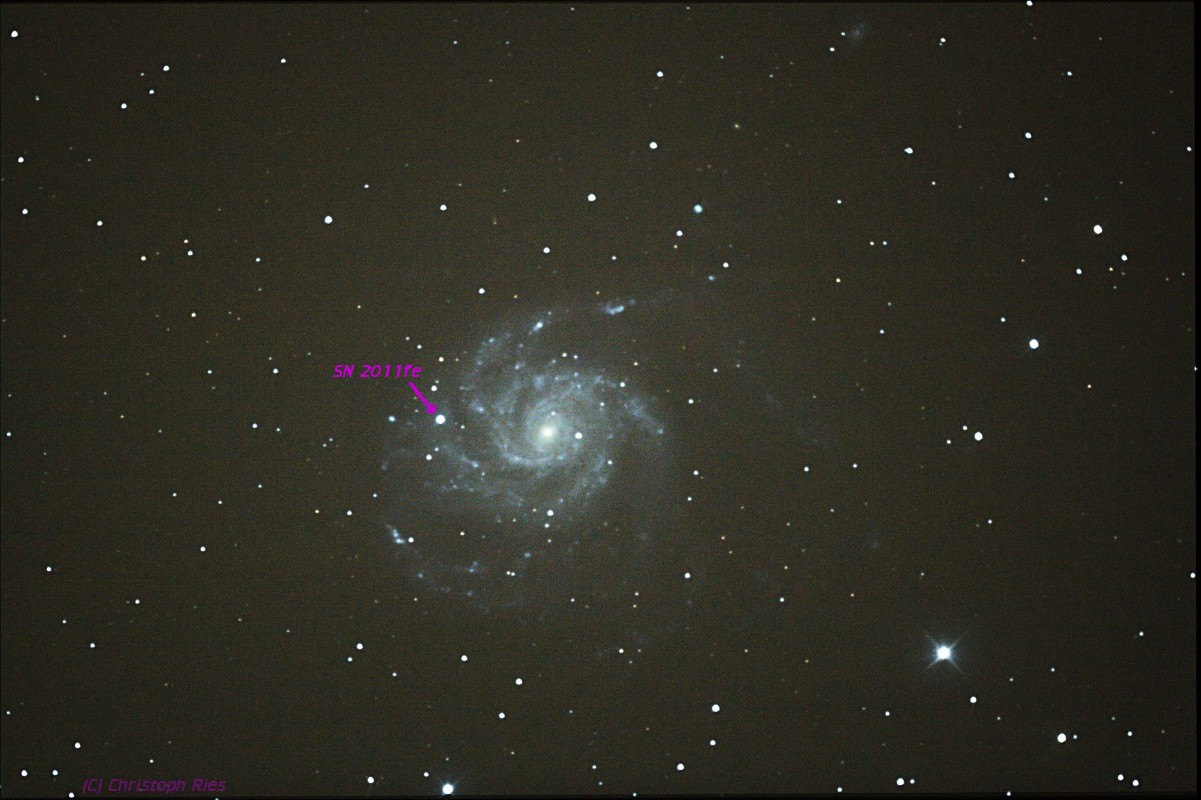
This M51, for a change withoud marked supernova, as well as further new images from M51 and M57, from the Mt. Wendelstein also, you'll find at their own M51 and M57 page. At September 21st 2011 I've take a shot of M101 with the Bismarck also. At home the object stood already very low so only a stack out of 5 frames with a complete exposure time of 15m42s could be made. In addition the raw material had poor quality and I've done two version out of the raw material wit the Deep Sky Stacker. For correcting guide failures The Gimp was helpful:
M101 - Allstack version: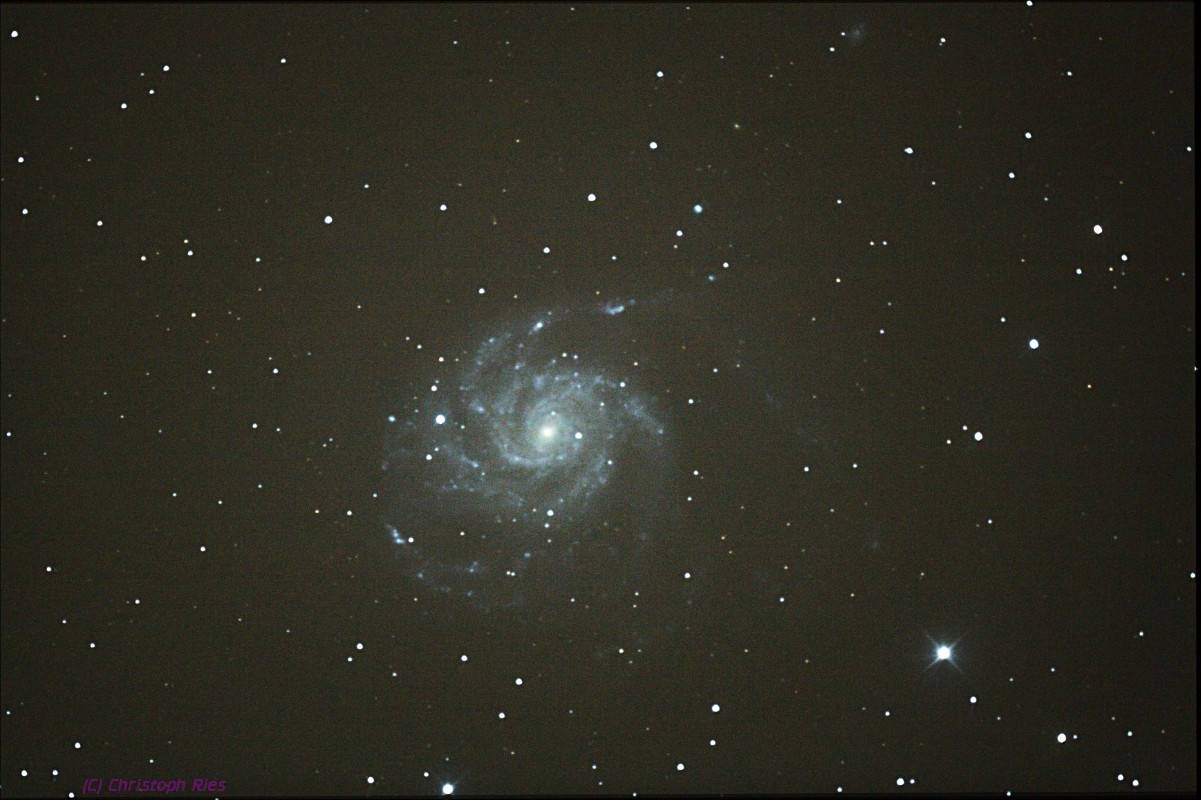 |
M101 - Jpeg stack: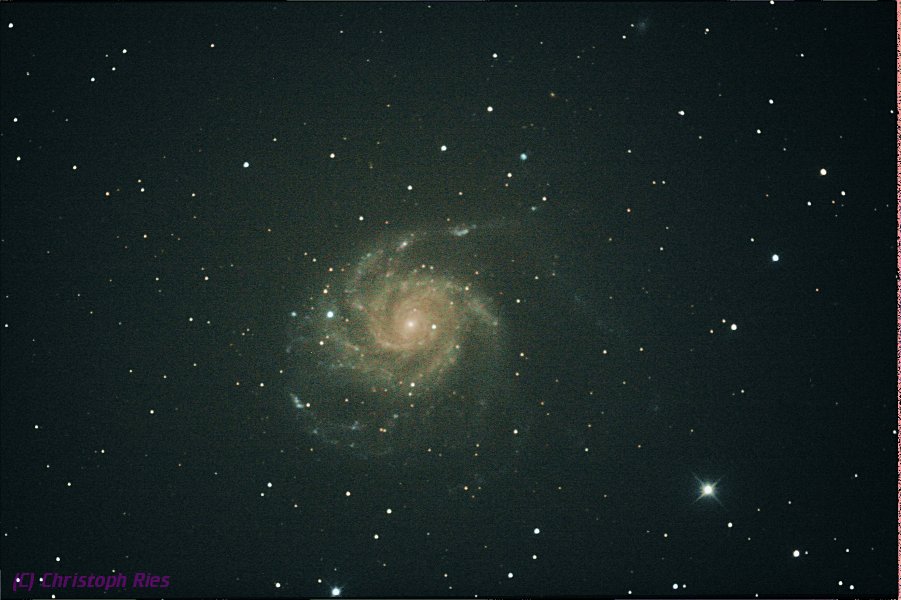 |
| This version is stacked out of raw data guide failures have been corrected after stacking. There is also a version with marked supernova from this image. | Here the guiding failures have been edited prior stacking. Sadly this was only possible by using Jpeg files. |
A few more pictures from 2008 with Supernova and also from 2009:
In spring 2008 beside the Supernova 2008ax the Siamese Twins NGC 4567/68 and the dark nebula B72 "The Snake" also have been recorded. At the old Bismarck location B72 is found pretty low inside the straw light of the southbound located industrial zone and I tried it in an extraordinary clear night. Sometimes it is possible to create the one or another pretty picture like the edge on galaxy NGC 4565 beside the scientific programme with the 16 inch Cassegrain of the Mt. Wendelstein Observatory:
NGC 4490 and 4485 with SN 2008ax: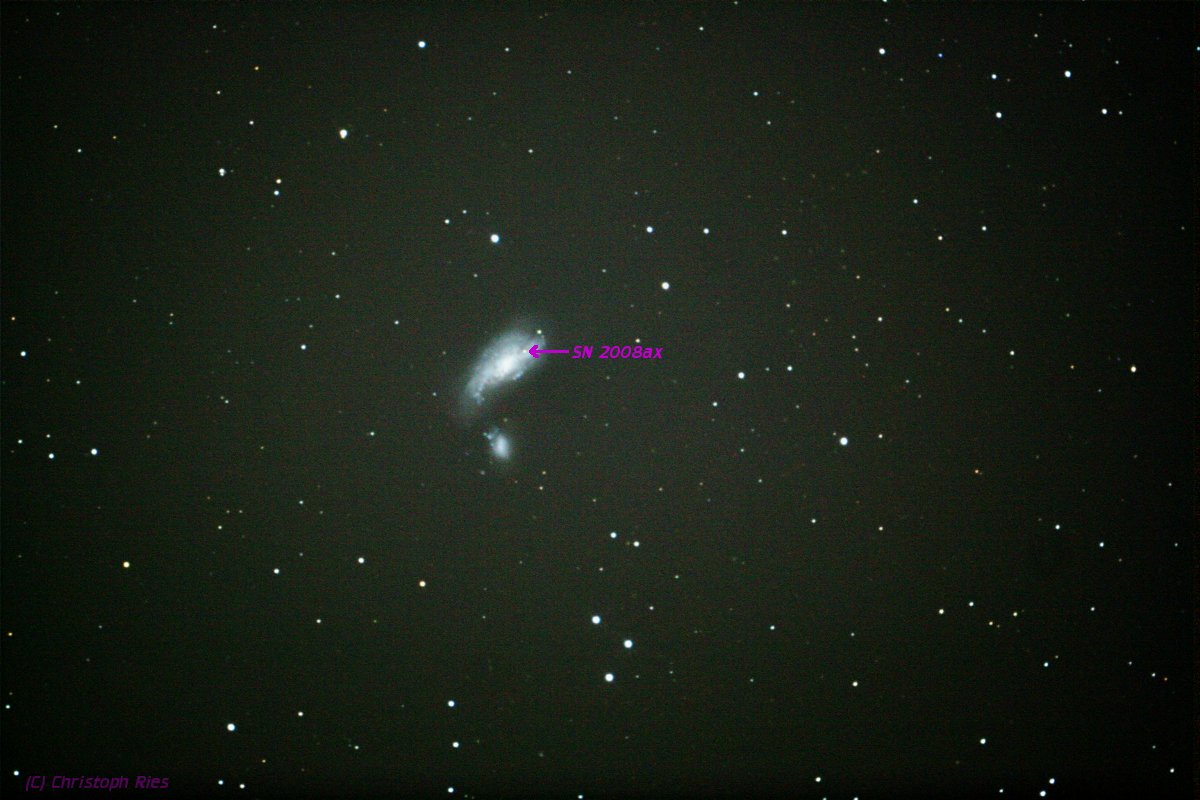 |
Siamese Twins and NGC 4564: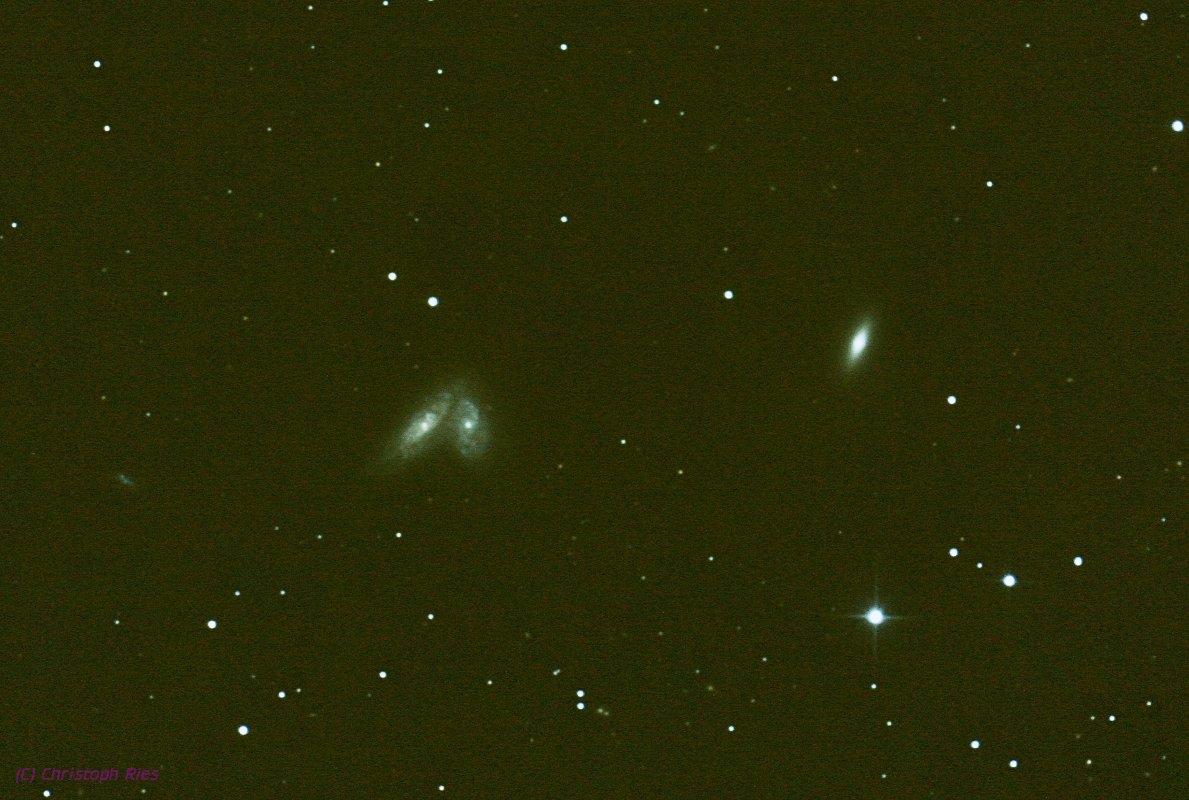 |
B72 - The Snake: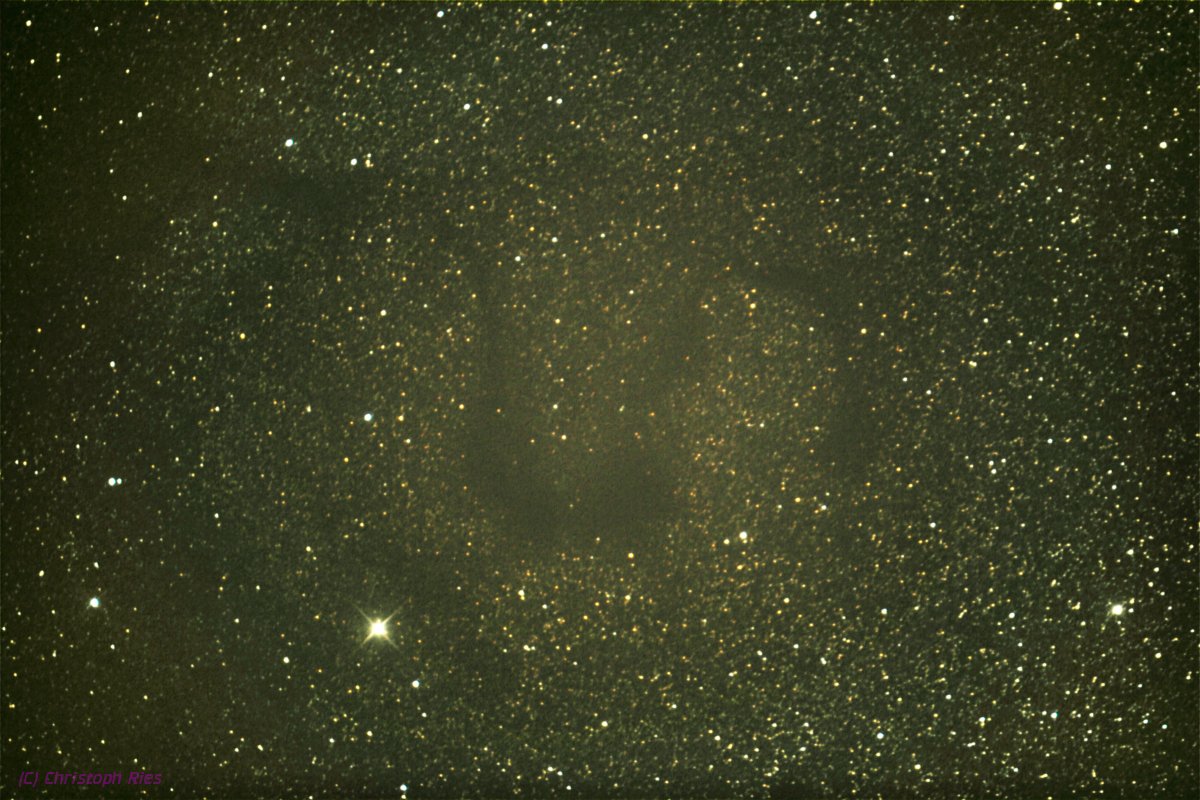 |
NGC 4565 - The Needle: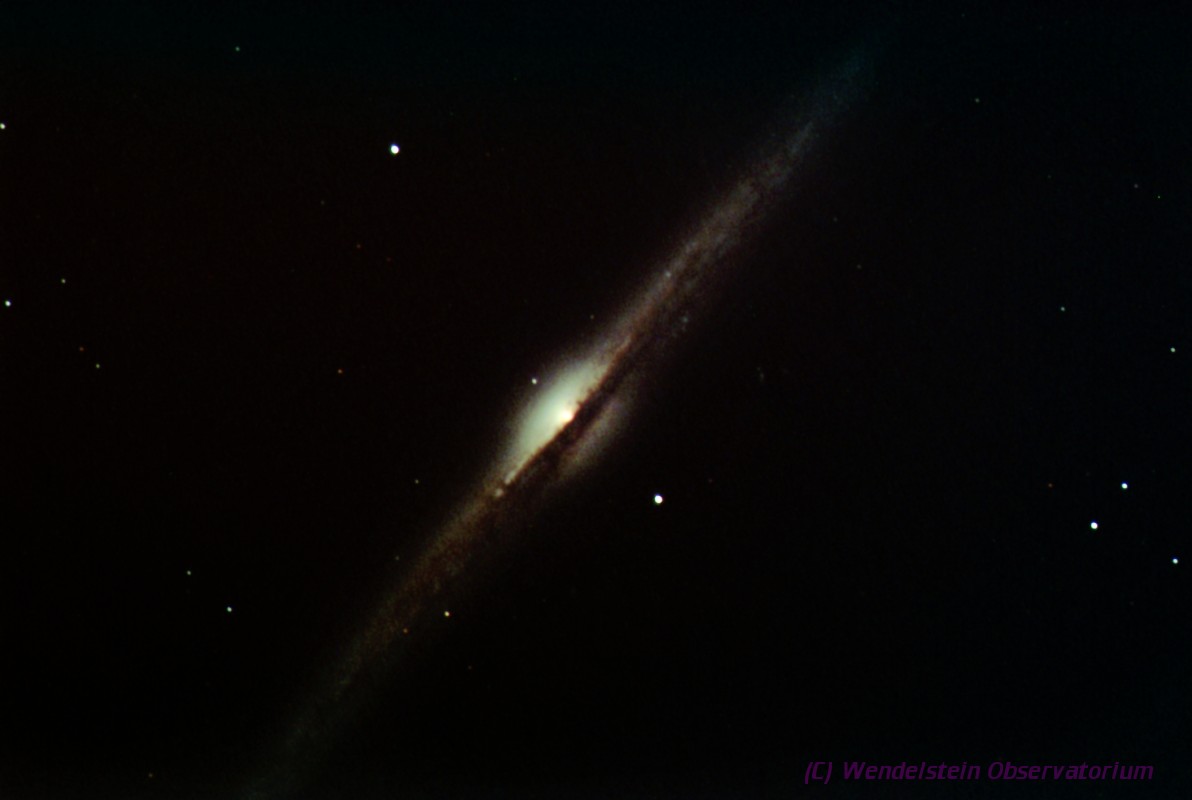
|
| Focal shot of the Cocoon galaxy with Bismarck, stacked out of 7 frames, total exposure time 24mins. | Focal shot of the pair NGC 4567/68 with NGC 4564 through Bismarck, stacked out of 8 single frames, total exposure time 28mins, light crop. | Focal shot from B72 with Bismarck, stacked out of 6 single frames, total exposure time 15mins. | Image with the 16 inch Cassegrain of the Mt. Wendelstein Observatory, f=4m. composite out of 12 shots in r g B with the ST10 camera mounted there, 300 respectively 400secs each. |
All images of this row have been stacked with Registax and edited with The Gimp. Especially at The Snake, very southern located, wich needs usually very good sky a strong reddish tinge caused by the light pollution has to be corrected. At the old and new comparison there is another version of the Cocoon galaxy with not marked Supernova.
Miky way panoramic view, taken at Mt. Wendelstein in early 2007:
Rising summer Milky way: |
Nova Scorpii: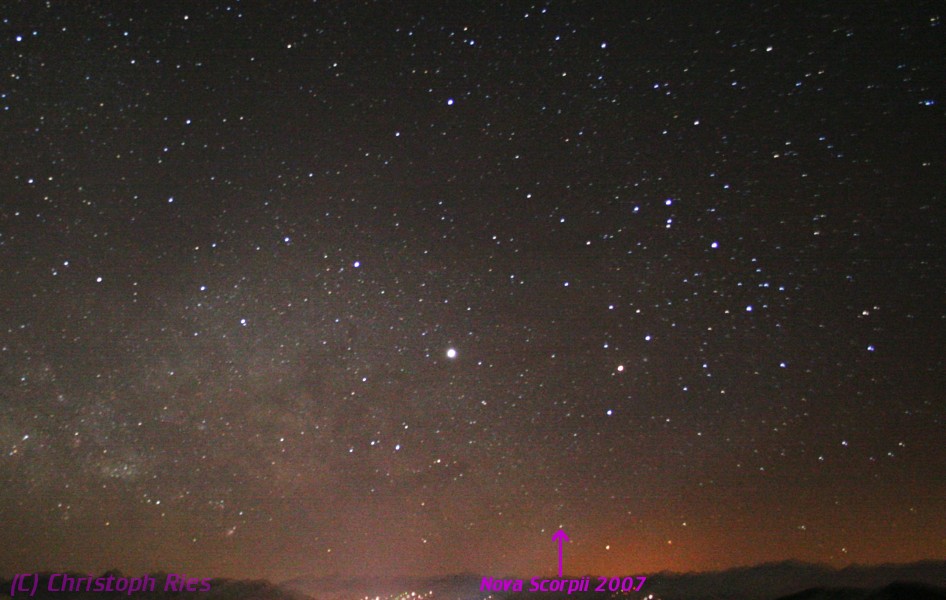 |
| Panoramic view of the rising summer Milky way, seen from Mt. Wendelstein towards the Inn valley with its light pollution. An impressive view. | Extract from the panorama with the already risen nova Scorpii with a brightness of ca 3mags. The bright object in the middle is Jupiter. |
The bulge of our own galaxy, the Milkyway, rises spectacular in the early morning of a late winter night behind the summits of the central alps. From Scorpius to Cygnus the star clouds are dwelling over the horizon. Only on remote places such an impressive view can be seen. Though Mt. Wendelstein is pretty remote the light pollution has also reached this area. Bright lights from the Inn valley illuminate the mountains and the light domes from cities more than 100km away, e.g. Salzburg at left, are clearly visible. The panorama has been created from two stacks of three images each. The movement of the stars had also to be corrected as well as the horizon line had to be processed for a natural view. This image was shot with the Canon 350D "Photonensack" again and has been processed with Gimp.
Messier81 and 82, Holmberg IX, exposed with Bismarck early 2008:
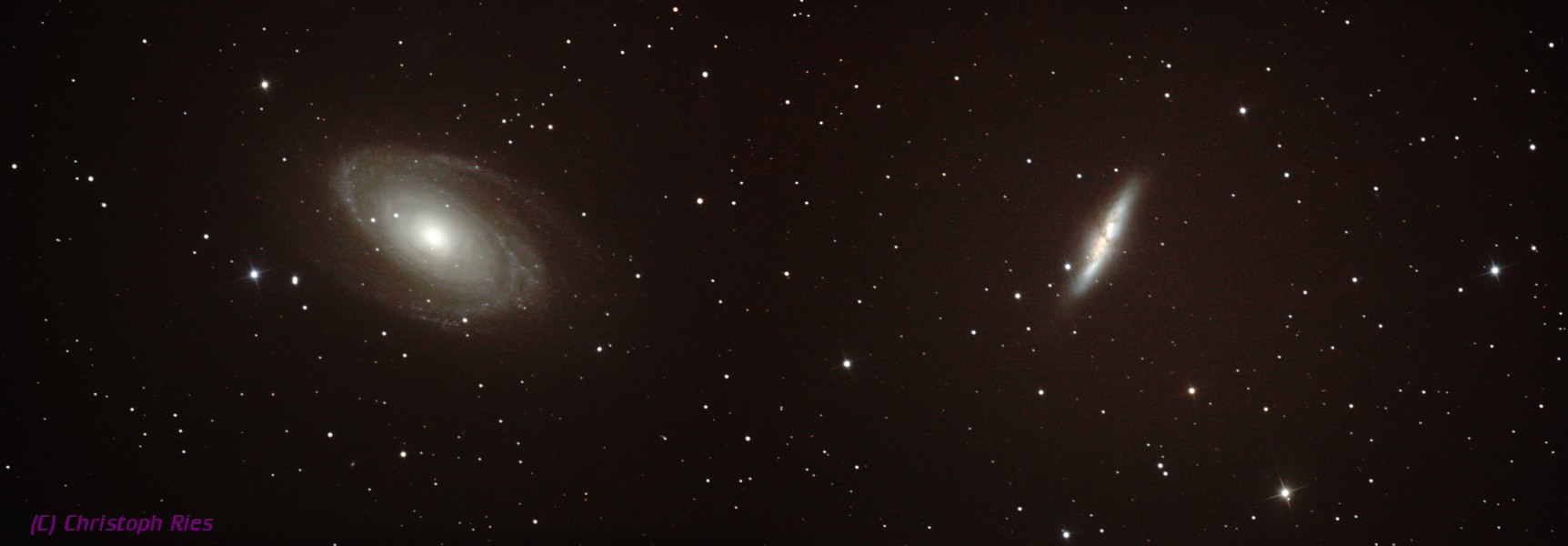
For making of the above panoramic view four single four minute shots of everey single object had to be done. These have been stacked and merged with Gimp to a complete panoramic view. By coincidence the dwarf galaxy Holmberg IX, an interesting object, looking tiny beside the giant galaxies, appeared at the M81 frames. The next row of images is showing the single frames of the panorama and the 100% crop of Holmberg IX from the M81 shot:
Messier 81: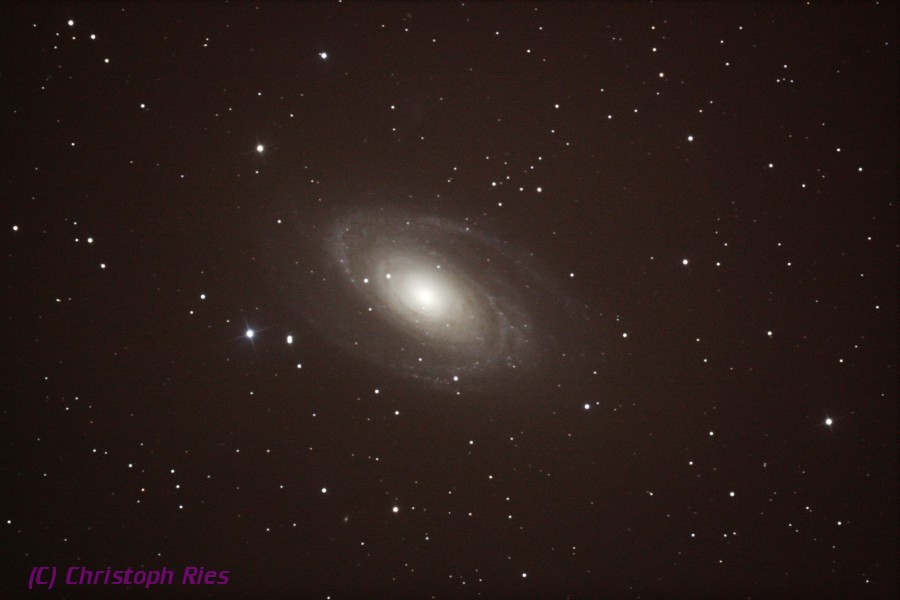 |
Holmberg IX: |
Messier 82: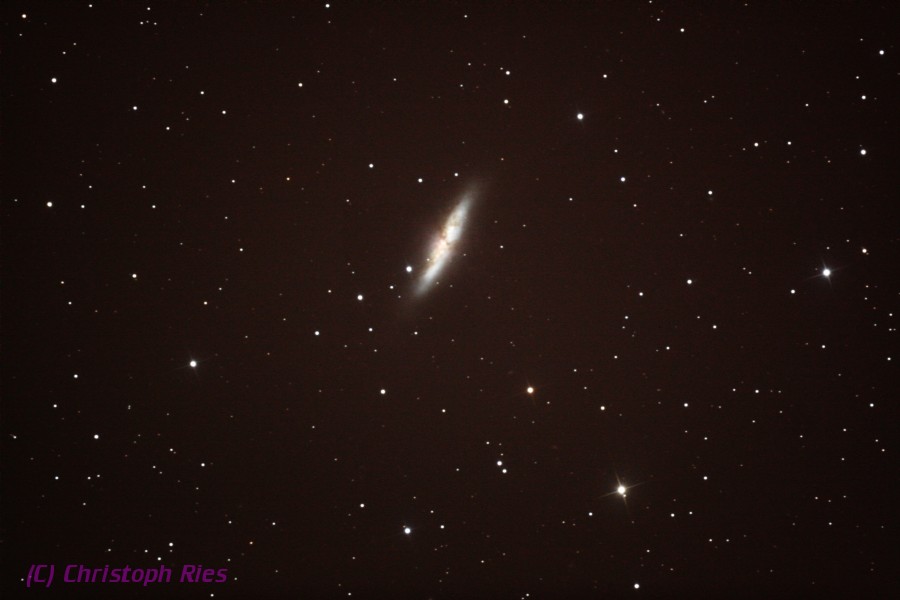 |
| Single frame of M81 the giant spiral galaxy. | Holmberg IX lies eastwards, not far from M81, an unimpressive nebular spot, it had to be enhancend in contrast. | Single frame of M82 the Galaxis with spectacular structures full of internal dynamics. |
In August 2007 two more interesting exposures of the summer sky have been made, both done with Bismarck and stacked with Registax:
Messier 22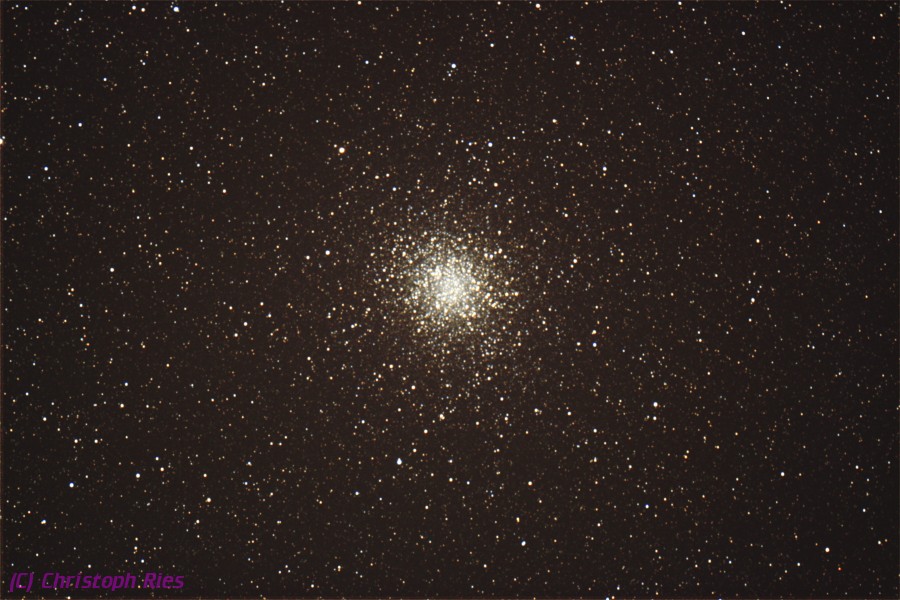 |
Cirrus nebula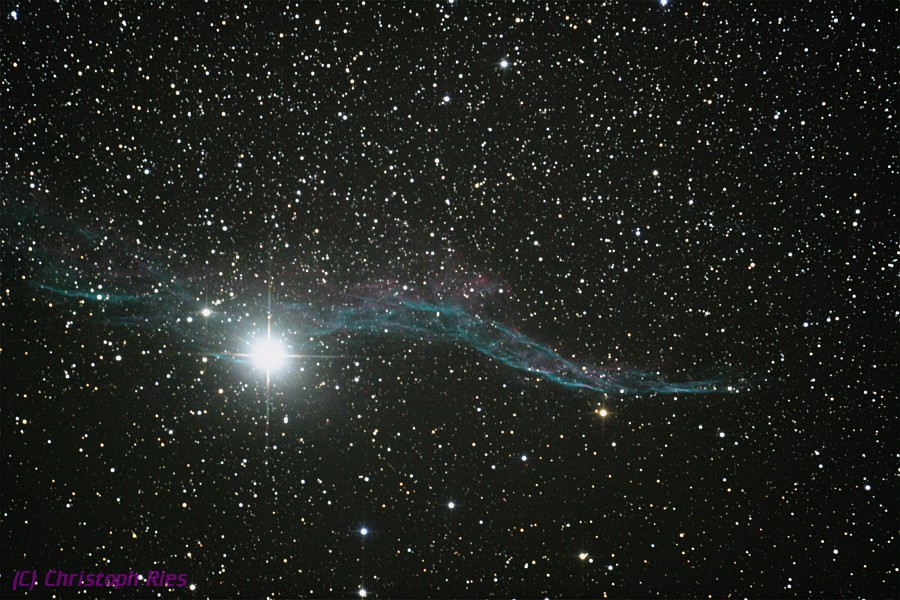 |
| the most impressive globular cluster visible from middle Europe, M 22 in the constellation of Sagittarius, taken with Bismarck, stacked out of 9 single frames 120sec each. | NGC 6960 the storm bird, also called "the Claw" by myself, taken with Bismarck, stacked out of 7 single frames 240sec each. |
Supernovae 2007, taken at Bismarck Observatory:
SN 2007sr: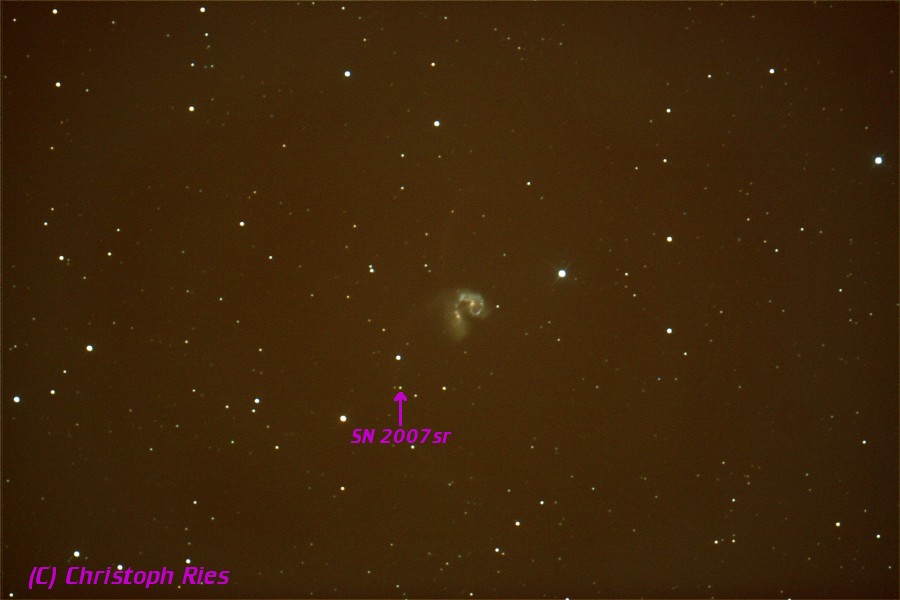 |
SN 2007gi: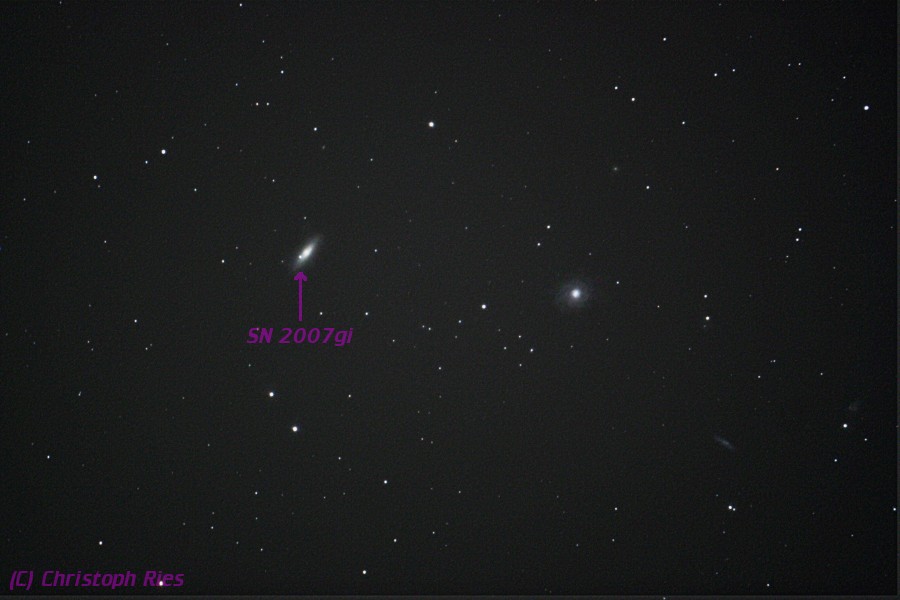 |
| There was at the end of 2007 again a pretty bright Supernova in the rat tail galaxies NGC4038/39. | NGC4036 with SN 2007gi, in the telescope also a nice constellation. |
In this row an additional comparison image from the Mt. Wendelstein Observatory of NGC 5584:
SN 2007af in...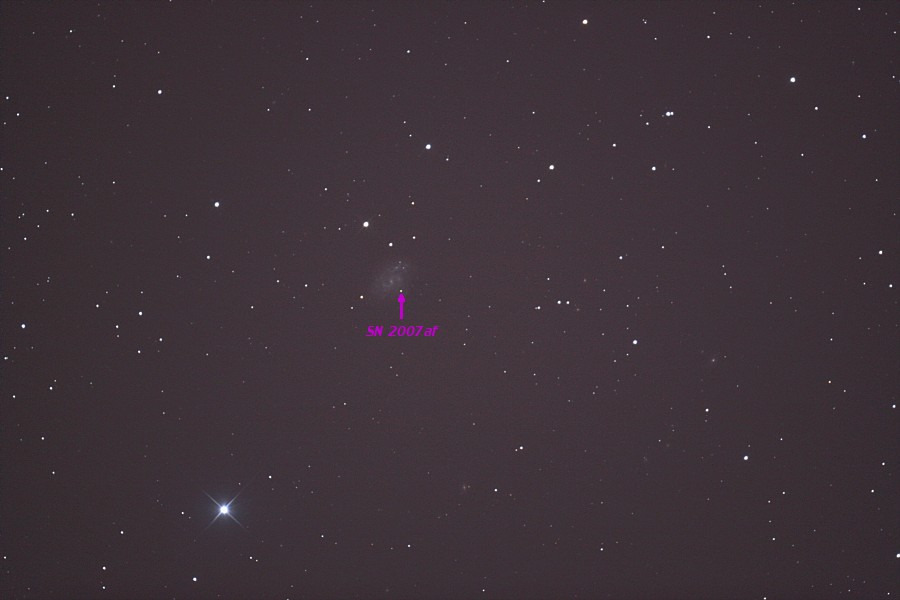 |
...NGC 5584: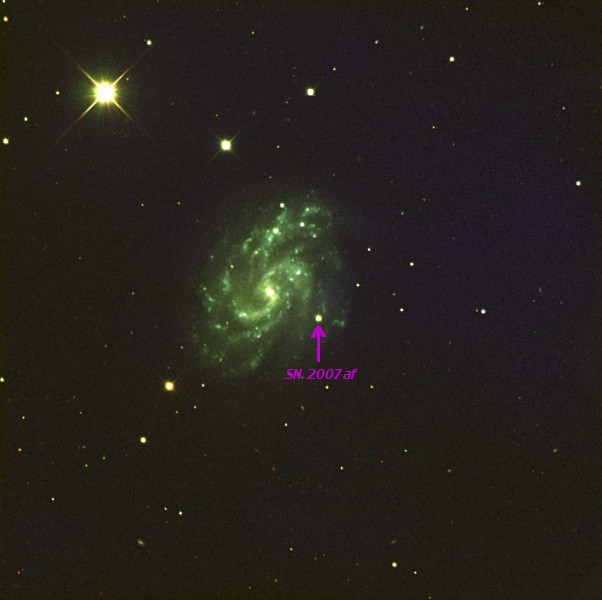 |
SN 2007Ie: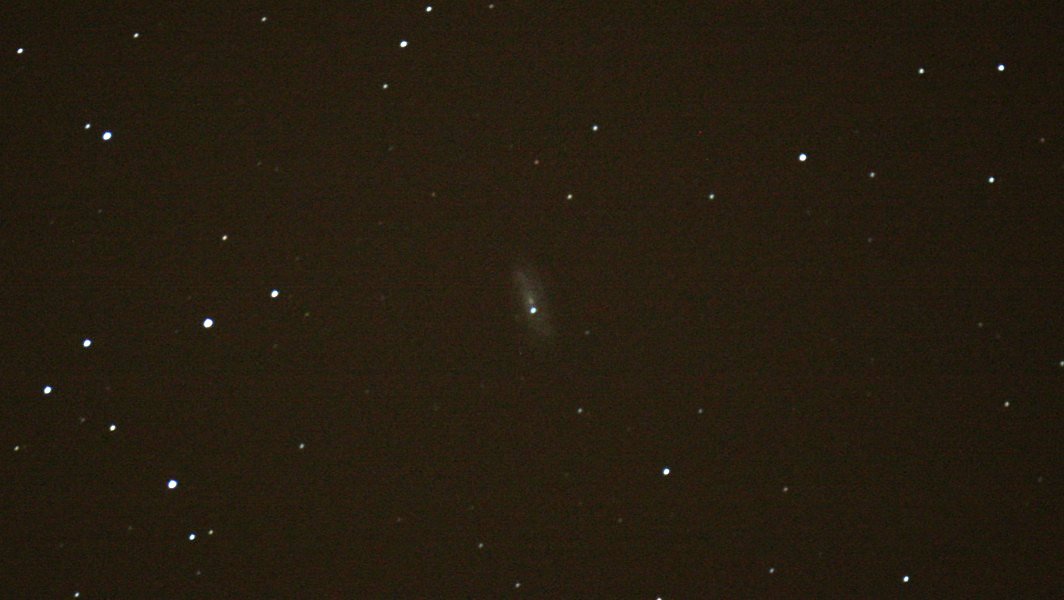 |
| The Supernova in NGC 5584 was visually good visible in spring. | For comparison a 3 colour composite with the Mt. Wendelstein camera Monica. | The Supernova in NGC 7721 is a crop of a 8x30secs stack. |
A collection of images, done with old and new technology, starting with the Lagoon nebula M8 one of the most beautyful gaseaous nebula of the summer sky. The older image was one of the first pictures, done with Schdoffal in Spain in the year 2000. At left is always the old, at right the new image:
Lagoon nebula M8: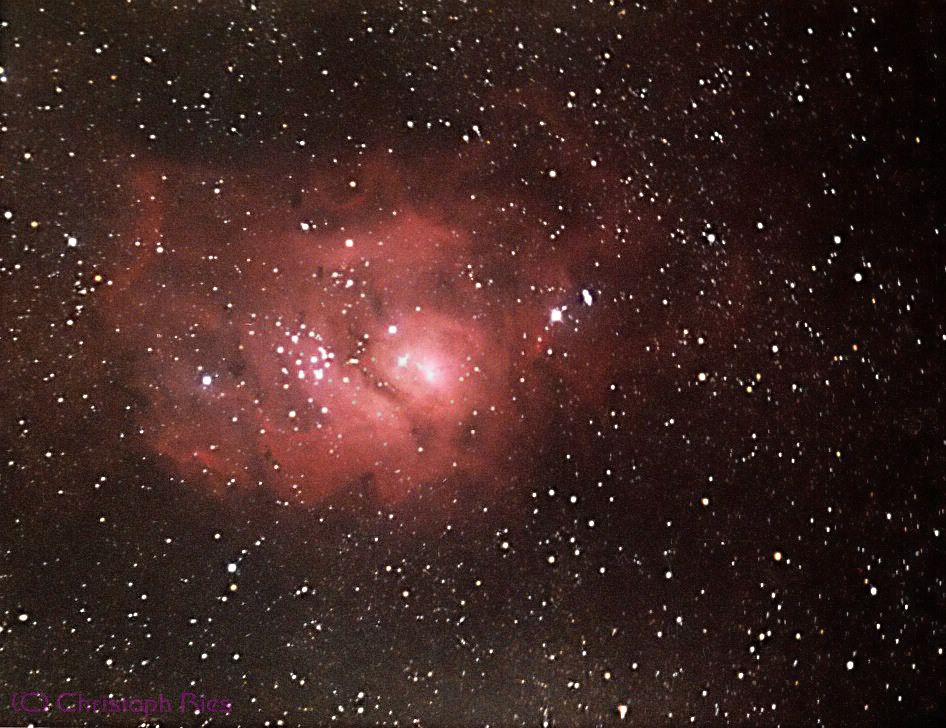
|
M8 in summer 2008: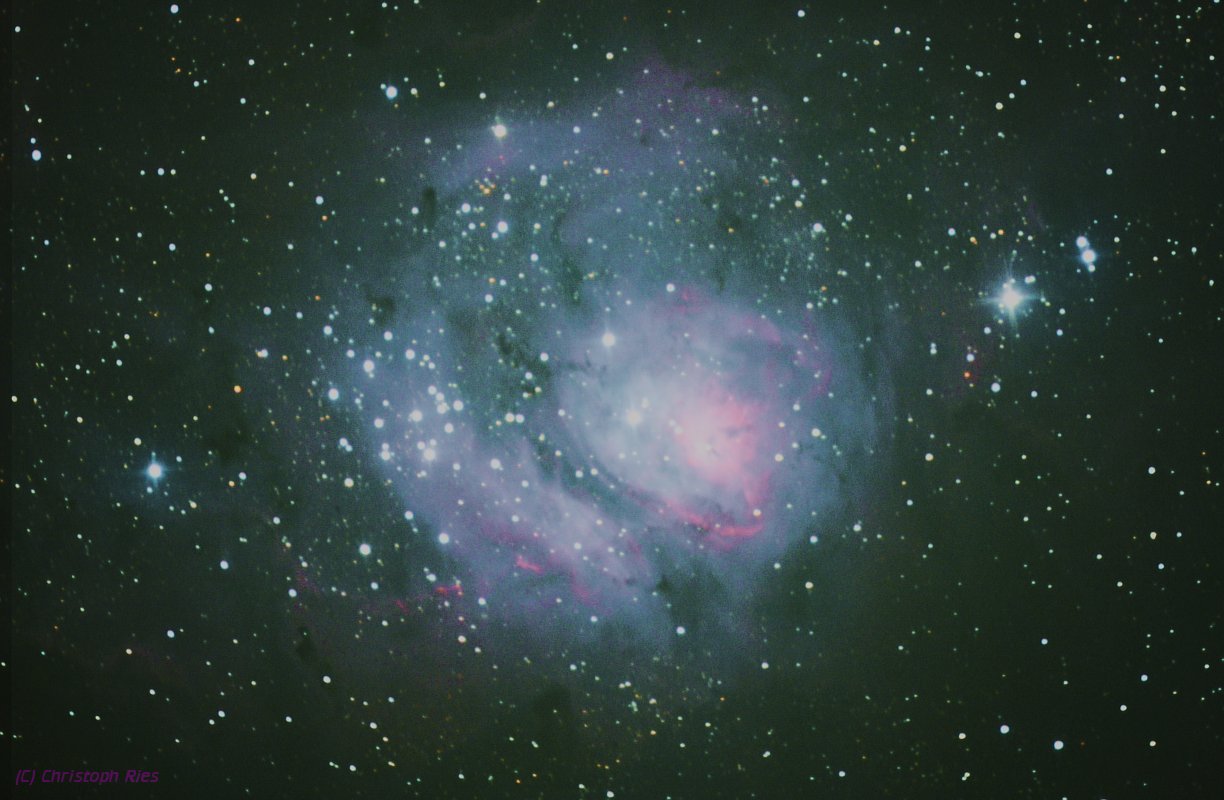
|
| The Lagoon Nebula belongs to the most awesome nebulas in the heart of the Milky Way. Image taken on film, focal through Schdoffal. | M8 focal shot with Bismarck in two consecutive nights. Stacked out of 15 single frames, total exposure time about 28mins. |
NGC 4490 and 4485: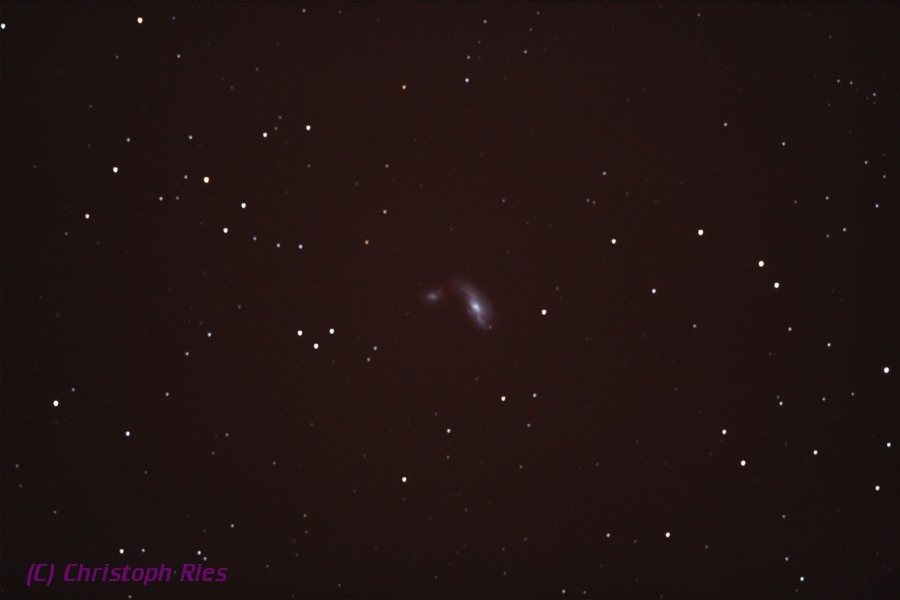
|
Cocoon Galaxy NGC 4490 with SN 2008ax: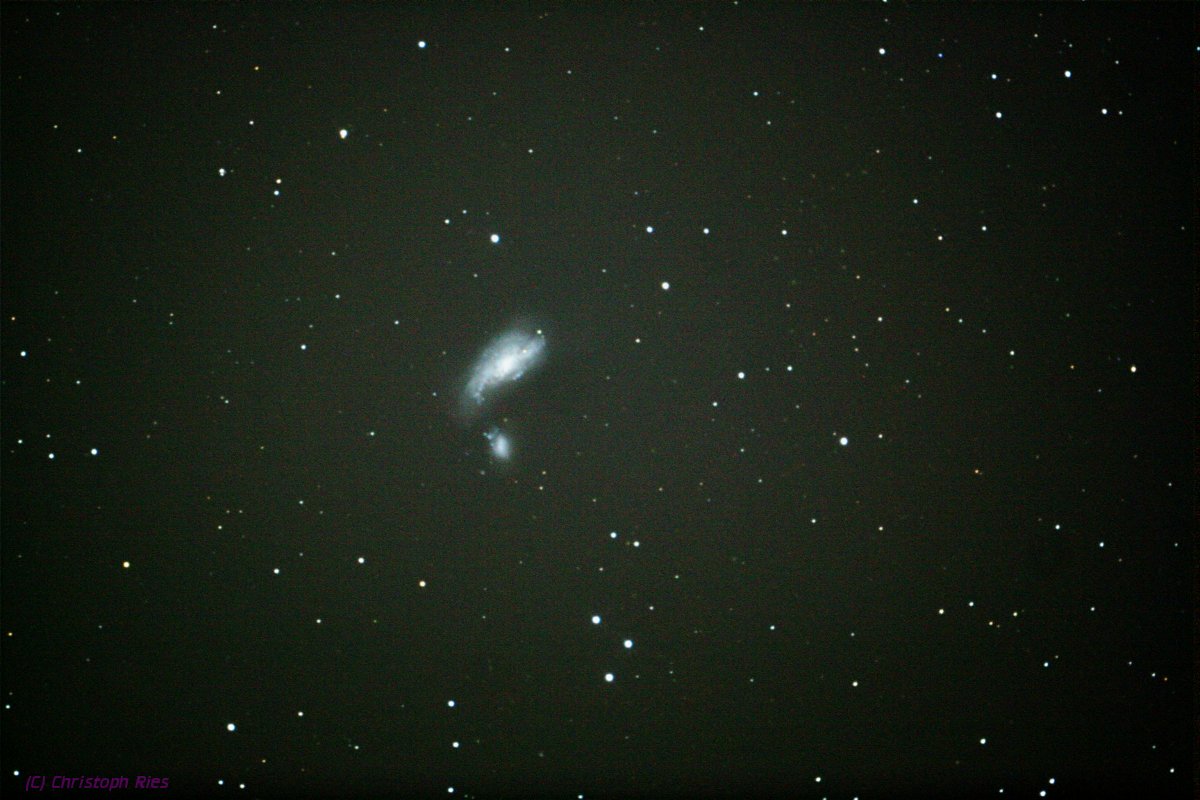
|
| The Cocoon galaxy, pretty impressive in the 10" scope. Five images 3mins each. | In the Bismarck telescope the interacting pair of galaxies looks more impressive than only one year before. Stack out of 6 Frames 240secs each. |
Galaxy NGC 891: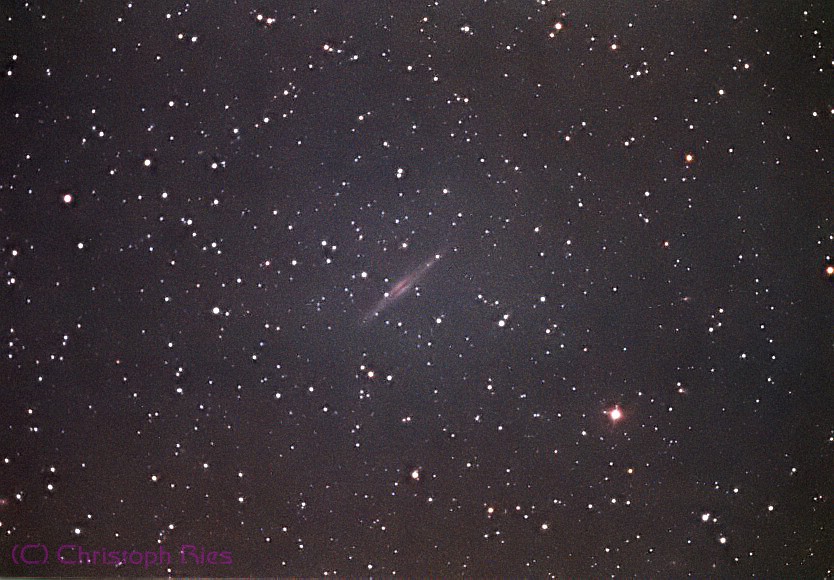
|
NGC 891, Januar 2008: |
| A popular edge on in autumn sky in Andromeda, seen here through Bismarck's optics. An image from 2003. | Composite from 4x4mins with Bismarck. Beside the spectacular galaxy a few faint galaxies can be seen. |
Dumbbell nebula M27:
|
M27, July 2007: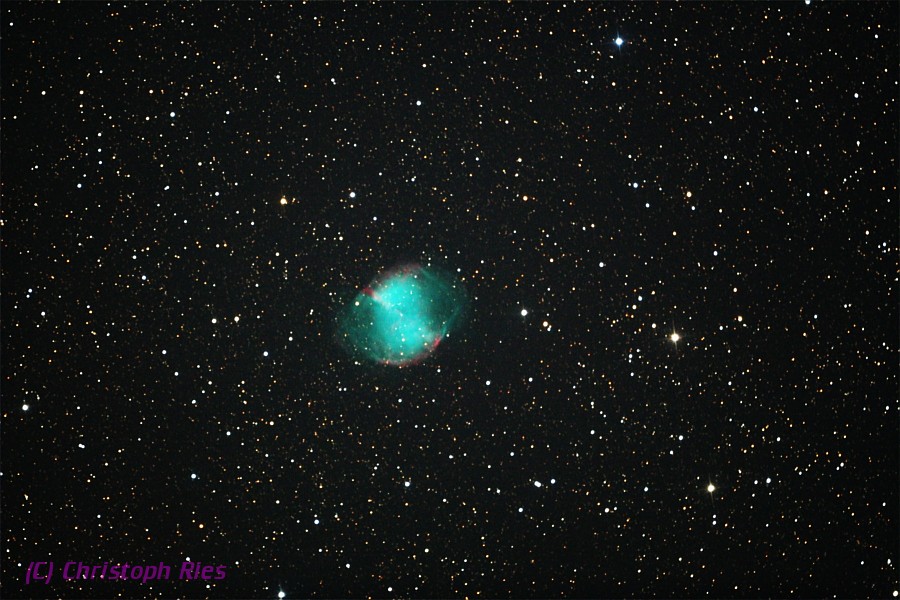 |
| The famous Dumbbell Nebula seen here through the eye of Schdoffal during the voyage to Southern Spain in spring 2000. | Composite image from 3x4min with Bismarck. During the last frame dawn just started! |
Messier 104, the Sombrero galaxy:
Sombrero galaxy M104: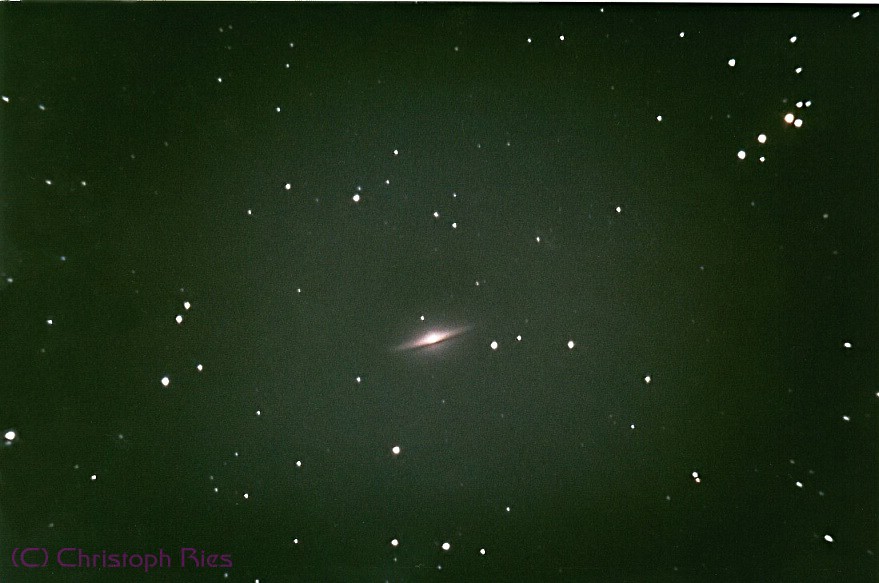
|
M104, March 2007: |
| M 104, here at the maximum focal length of 2.7 metres of the Bismarck telescope. | Schdoffal's field of view with the Photonensack shows a similar field at 12mins total exposure time. |
Messier 17, the Omega nebula, gladly named as Sphinx by myself:
Omega nebula M17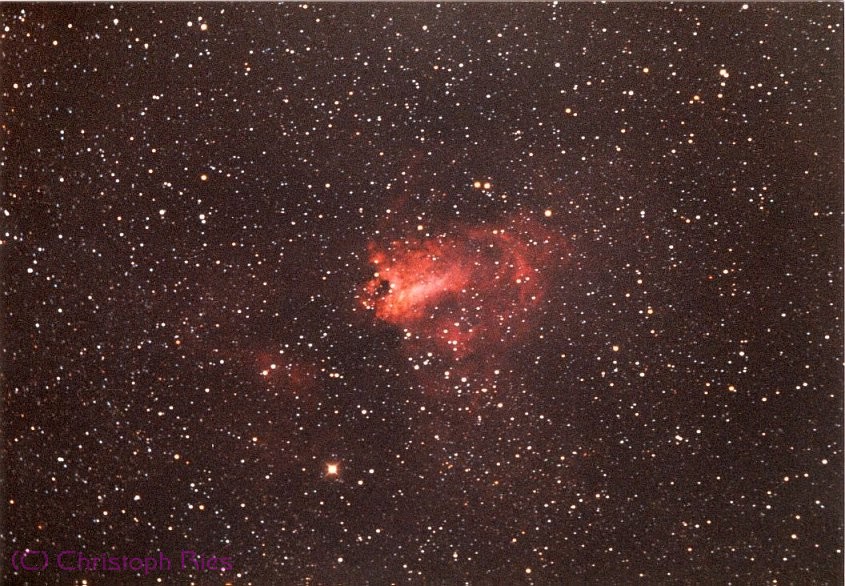
|
M17, July 2007: |
M17, August 2007: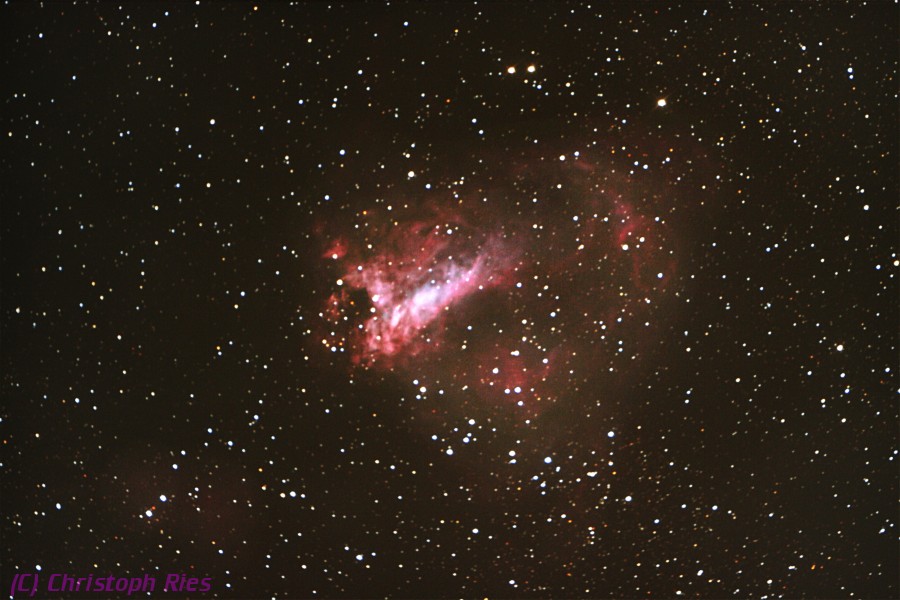 |
M17 Crop: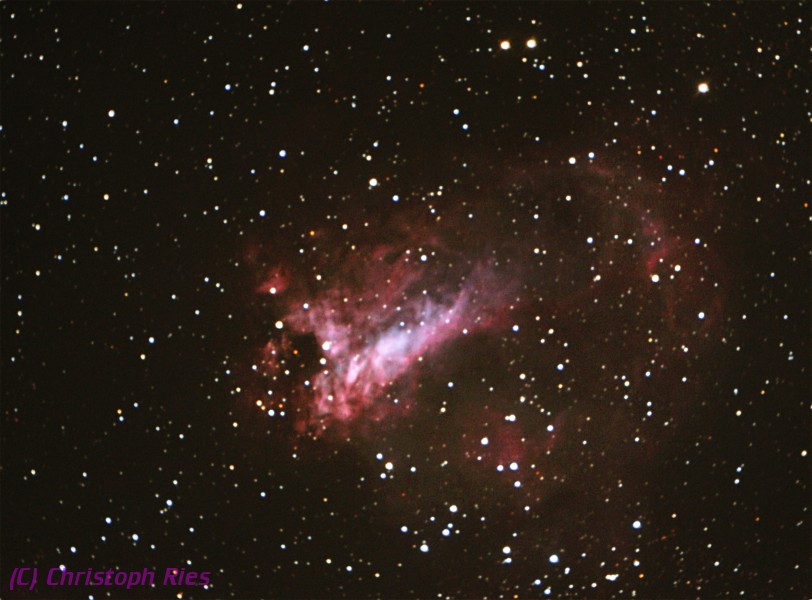 |
| The Omega Nebula is located north of the Lagoon Nebula and is coequal to it in its splendor. | Only two 4mins frames have been stacked here, during the 2nd exposure obstruction by the forest occured. | A few weeks later, with excellent conditions a 4 x 4mins shot could be done. The quality is already obviously better. | This crop has been generated from all six single shots of this summer and shows again an improvement in quality. |
Because the 2nd series of M17 was taken a few days later, the camera was mounted a bit twisted compared to the first time. To do a stack of all images it was necessary to work with a crop containing all details of the image and led to the last image in row.
The Antennae galaxies NGC 4038, also known as rat tail galaxies:
Antennae Galaxies with SN2004gt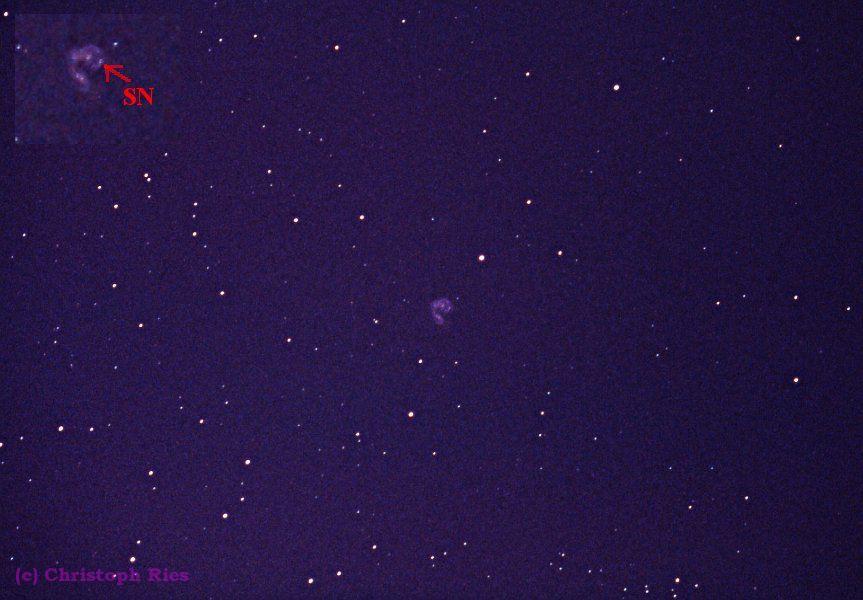 |
NGC 4038, March 2007, Andalusia: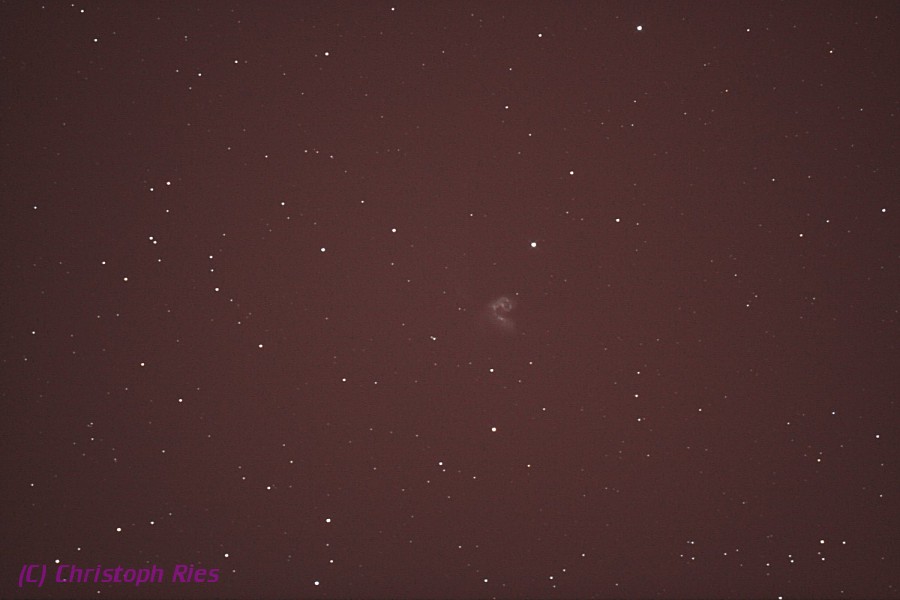 |
NGC 4038, January 2008, Bismarck: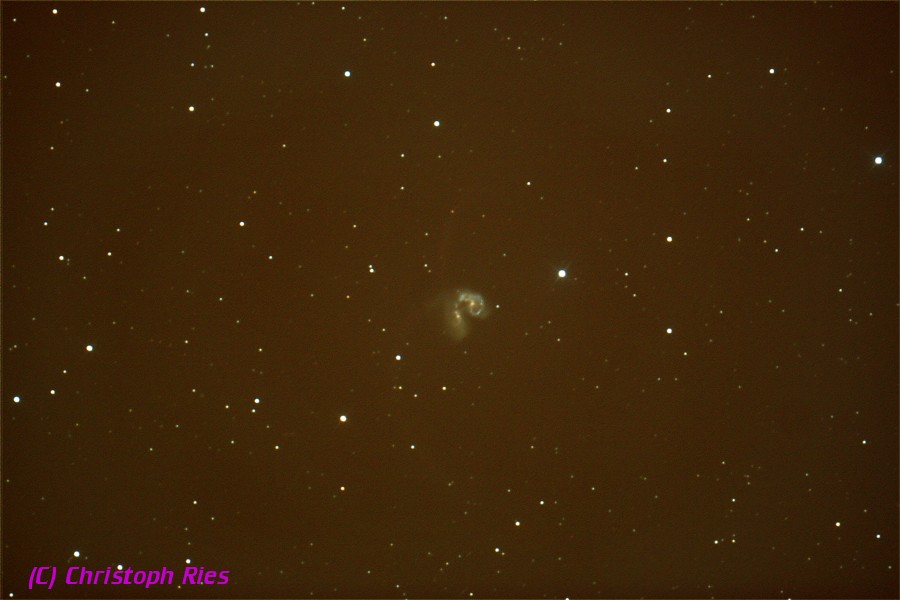 |
| The Antennae galaxies in fall 2004. The inset shows the position of the Supernova | Instead the pretty short exposure time in Schdoffals focal plane of only 5x90secs it is possible to detect the rat tails. | The Antennae or rat tail galaxies, again with a new Supernova! Also with more Details and done with the Bismarck telescope. |
Messier 83, a gorgeous southern sky galaxy:
Messier 83: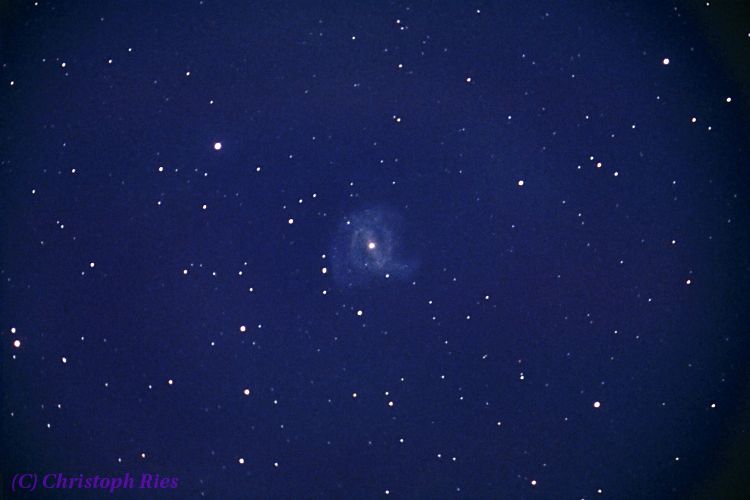 |
M83, March 2007: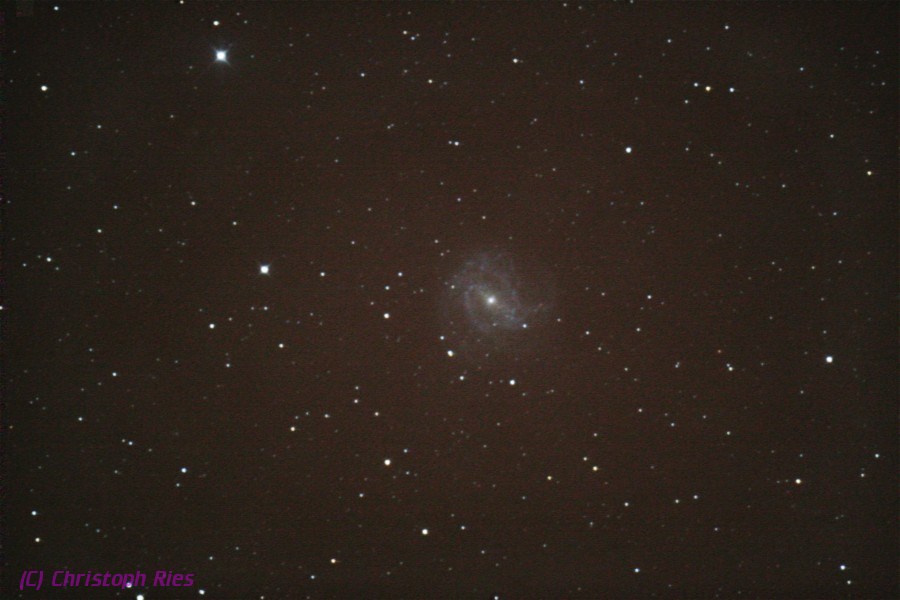 |
M83, April 2008: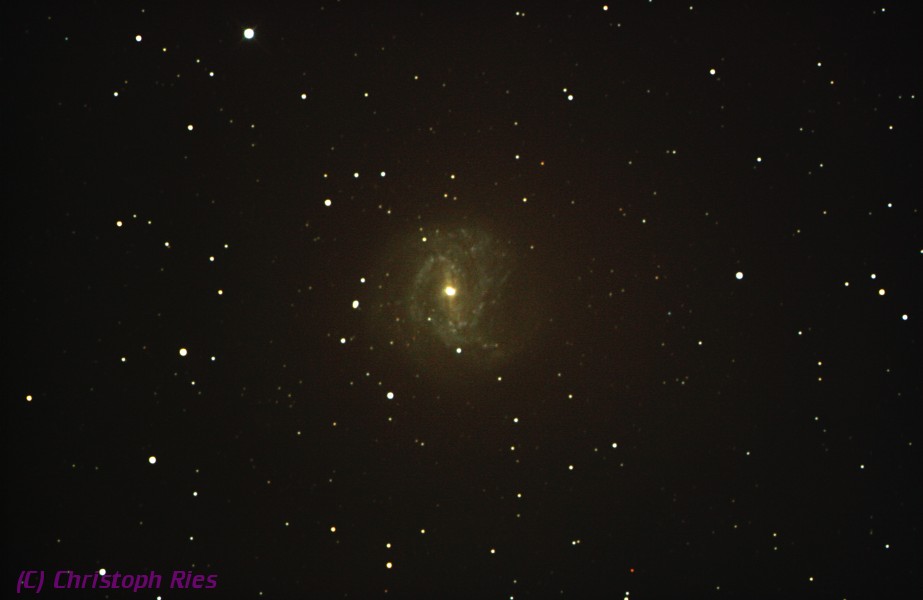 |
| At home the southern galaxy is a real challenge. This picture is a two focal analog shot composit. | Problems occured during the exposure with Schdoffal in Andalusia, so exposure time was only ca 4mins. | Again with Bismarck, 12 x 2mins with intern dark. Remarkable, because it stood only 10 degrees above the horizon. The atmospheric refraction had to be compensated also. At the end of the exposure series the object plunged into bushes at the horizon! |
Images at the Bismarck Observatory from February 2007. First tests with the new Canon EOS 350D "Photonensack":
Crab Nebula: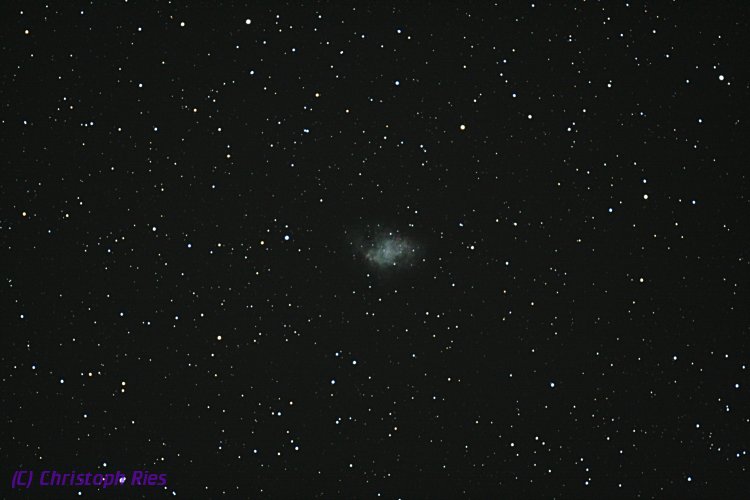 |
Messier 3: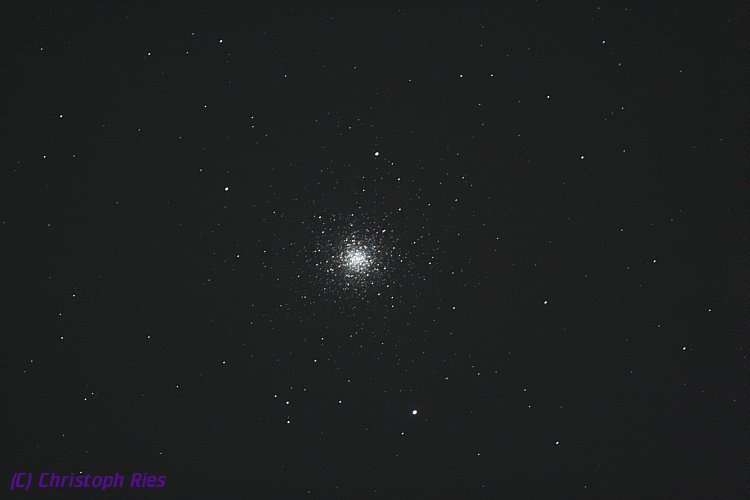 |
M46 - NGC 2438: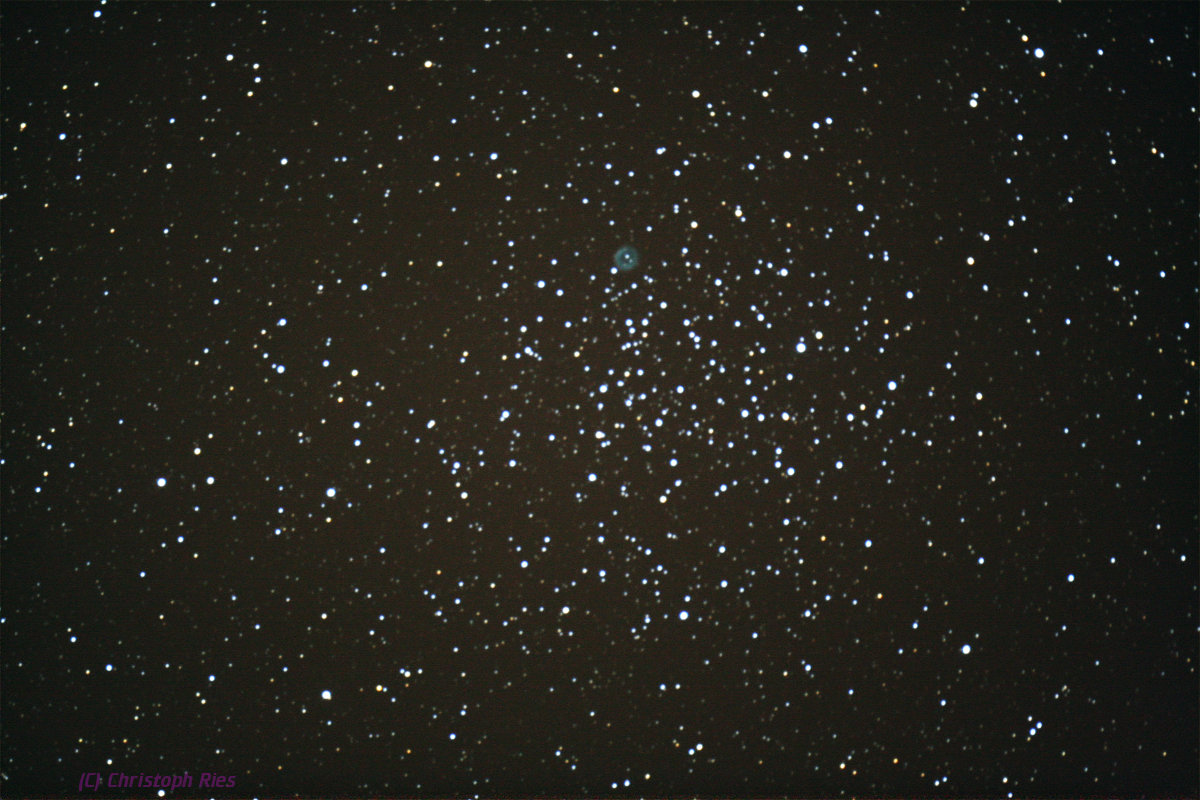 |
| The first astronomical image with "Photonensack", M1 stacked from 6 shots 30 secs each. | The globular cluster M 3 is the second object und stacked out of 8 shots 30 secs each. | The Planetary Nebula NGC 2438 is located inside the Open Cluster M 46. Stack out of 11 frames, 30secs each with Registax. |
Images from late summer 2006:
NGC 7009: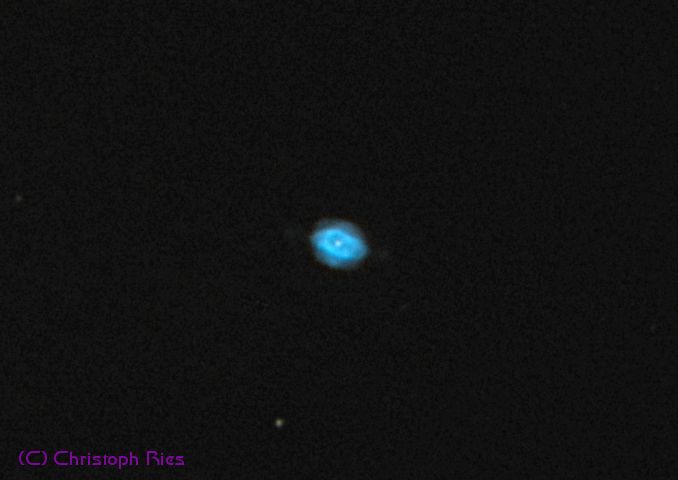 |
Messier 64: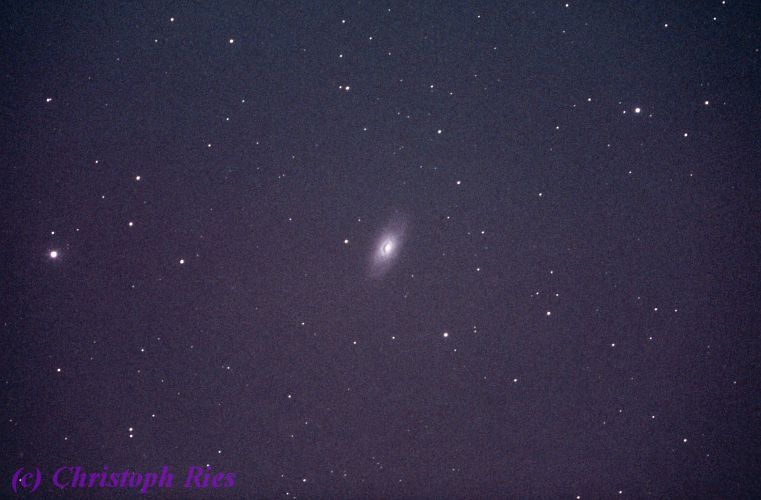 |
M13 Canon Ixus: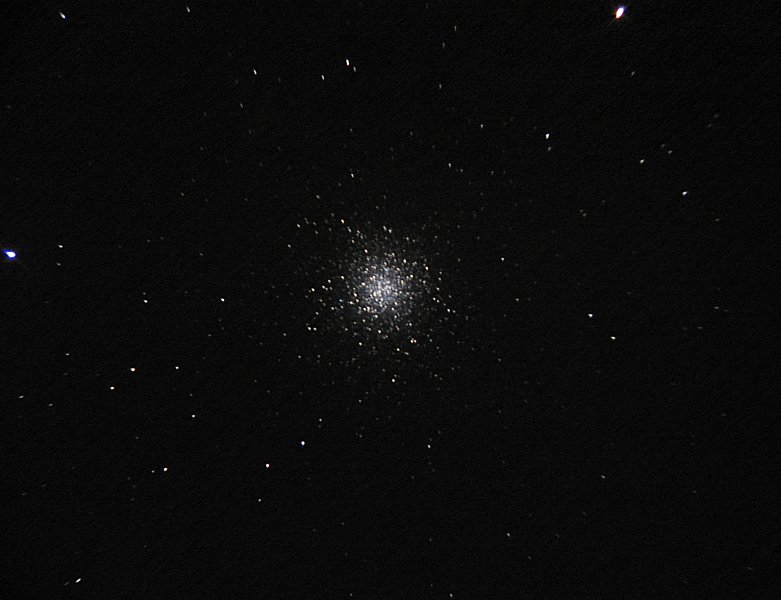 |
Eskimo Nebula digitally: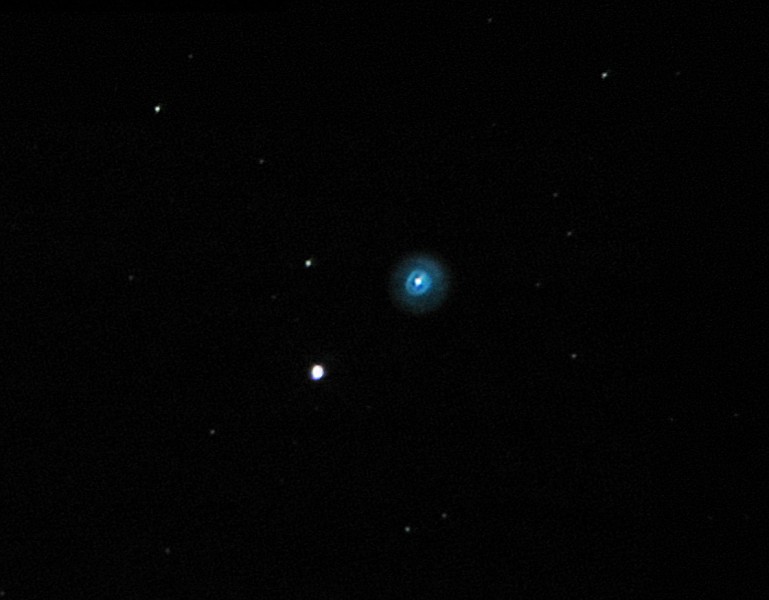 |
| The Saturn nebula in a stacked afocal exposure done with Bismarck from 34 exposures, 15 sec each. (Cutout enlargement) | The famous Black Eye Galaxy an image from 2004. | The globular cluster M 13 has been stacked from 16 exposures, 15 sec each. | NGC 2392, the Eskimo nebula, stacked from 25x15secs frames with Ixus! Bismarck focally and eyepiece projection. |
Pictures from Christina, created at the Emberger Alm:
Cocoon Nebula: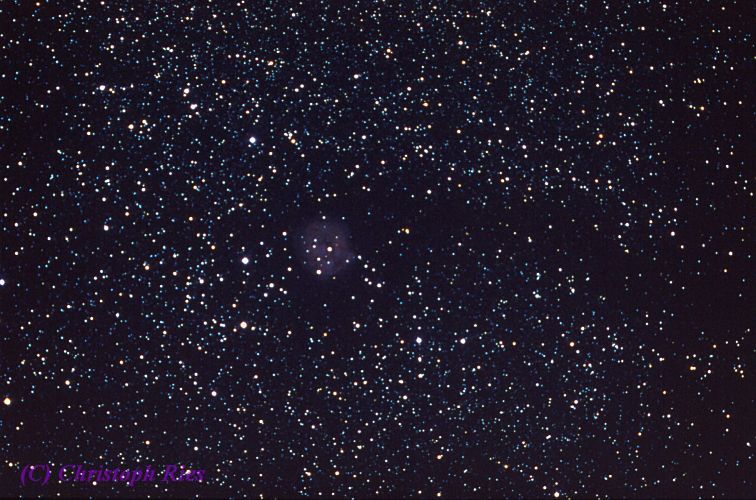 |
Crab Nebula: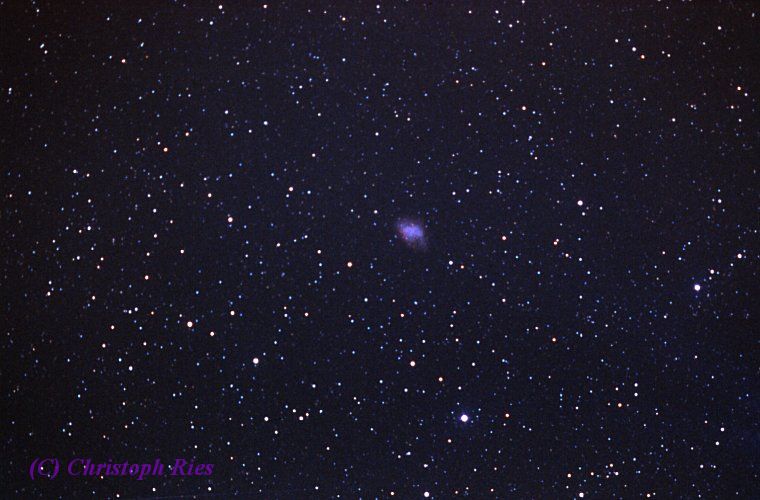 |
| Gorgeous impression of the faint Cocoon Nebula IC 5144. Exposure time 16 min. | During 15th ITT this 12 mins image of M1 was taken. |
Variations of the theme Orion Nebula:
Orion Nebula 400 Tele: |
Orion Nebula Bismarck: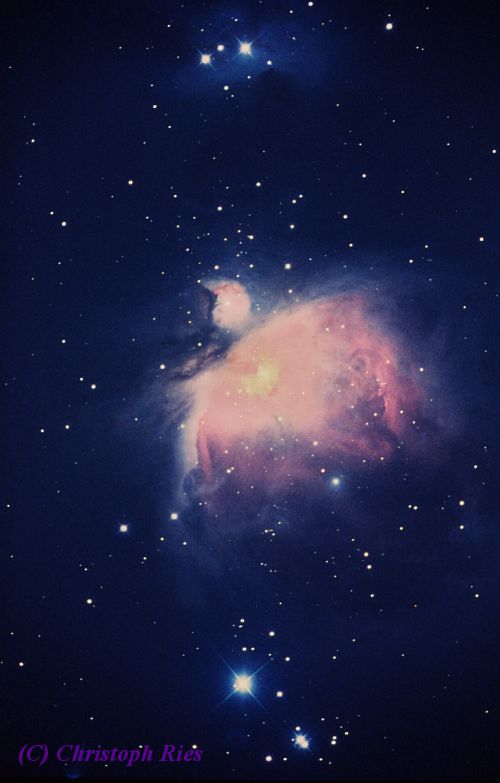 |
Orion Nebula digitally: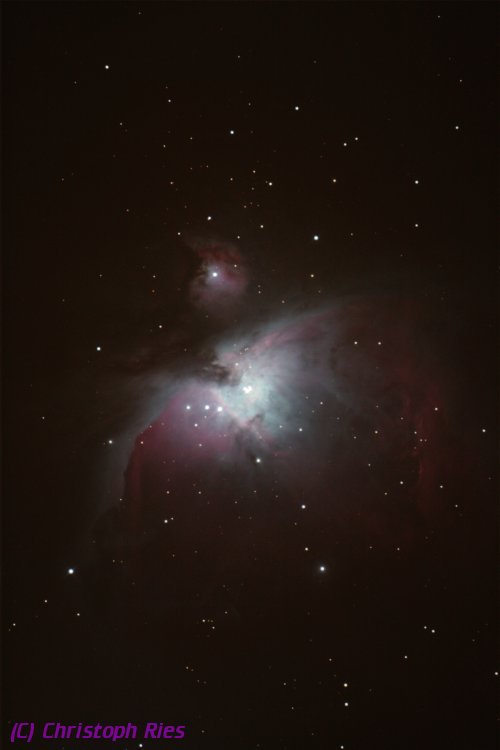 |
Orion Nebula new version: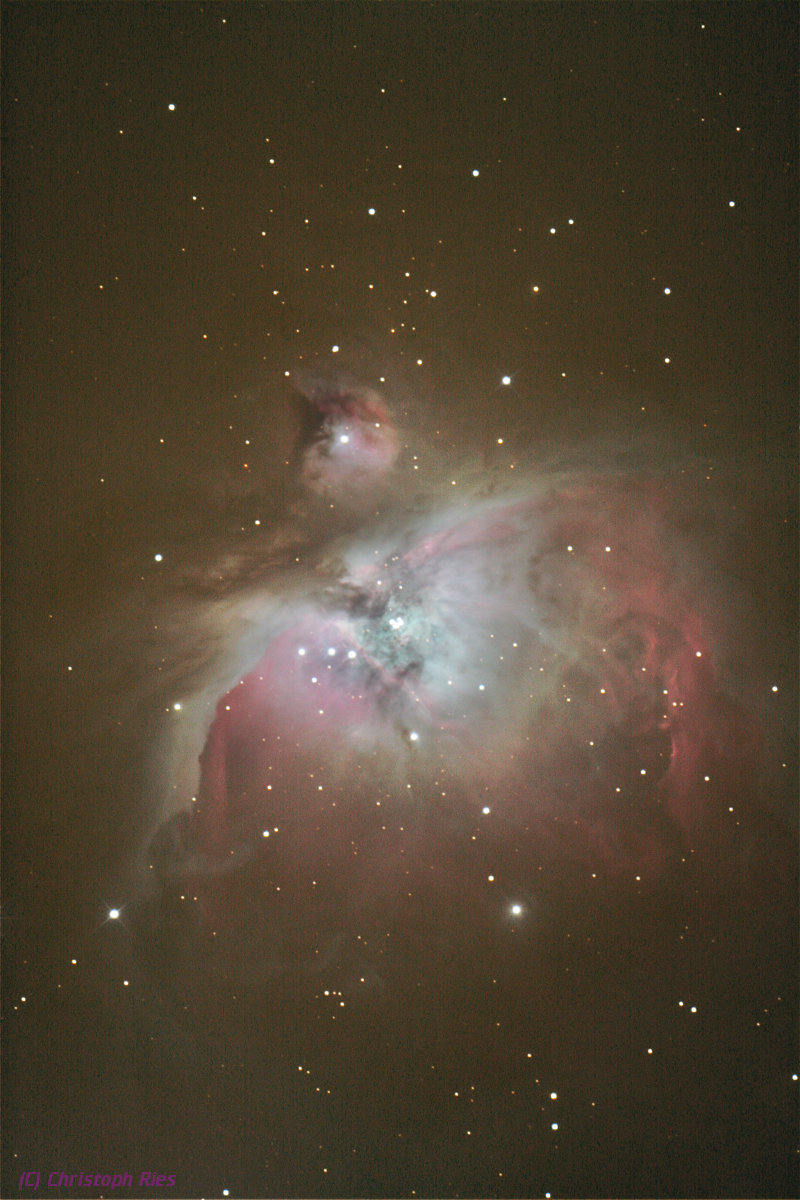 |
Orionnebel 135er Tele: |
The first image has been exposed 20 mins through an 400 mm telelens. The 2nd image is a gorgeous focal shot from the year 1998. The 3rd image is a first composite from 2007 out of Bismarck focal shots ranging from 8 to 30 secs at 800 and 1600 ASA with the new Canon Photonensack. The 4th image is a new edition of the 3rd one. The image at far right is done with the Canon and the old 135mm Telelens at the Emberger Alm. A stack out of 5 images 180secs each.
A few galaktic nebula:
The Cat Paw nebula |
Rosette nebula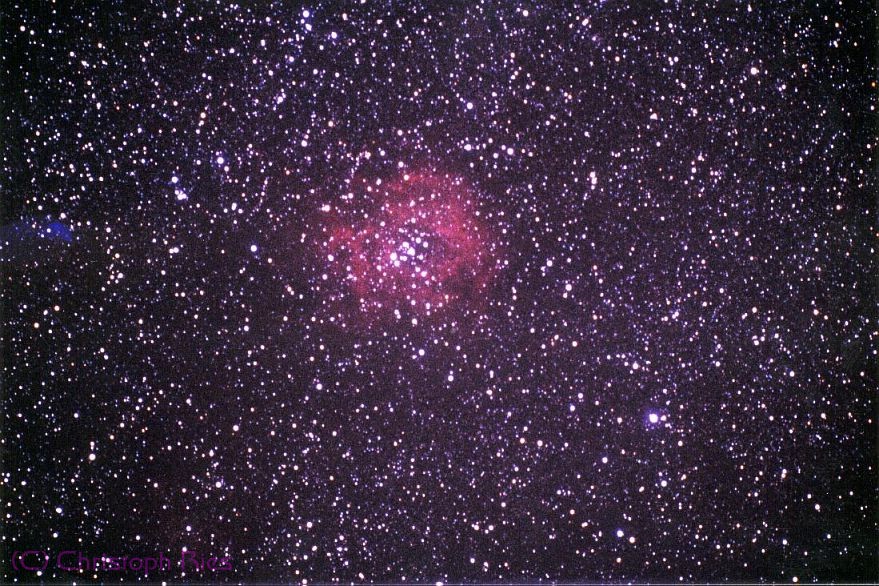
|
Plejades and NGC 1499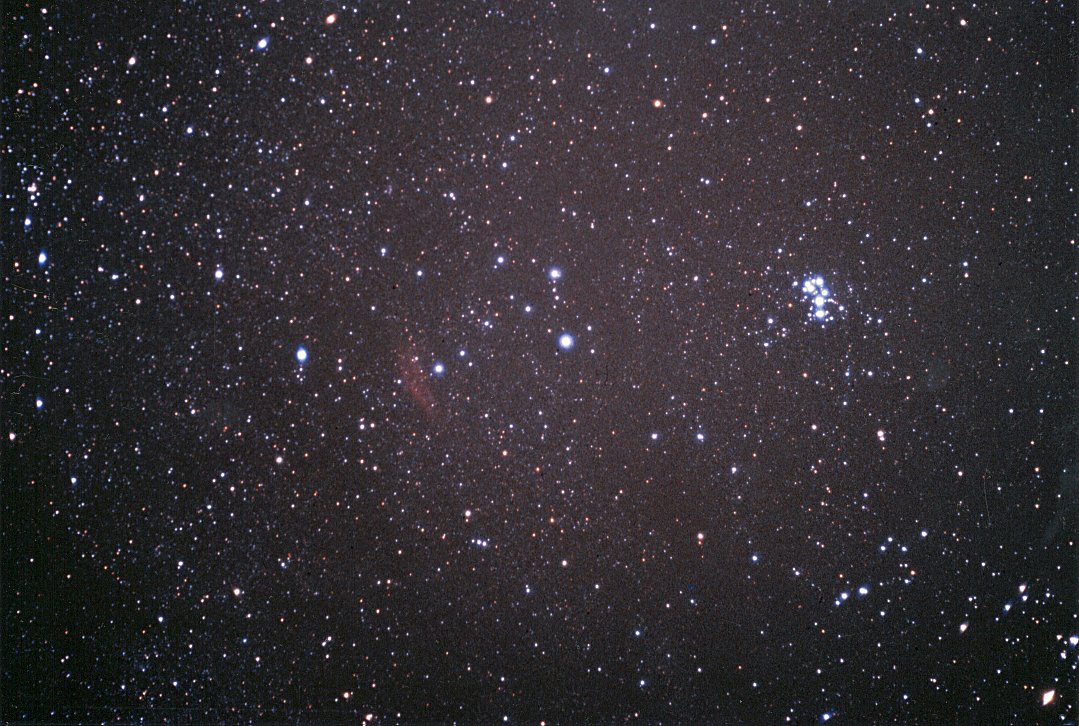 |
| With the help of a 300 mm tele lens I've taken this shot of the nice Cat Paw Nebula from the island of La Reunion. It is located in the constellation of Scorpius. | The Rosette Nebula in the constellation of Monoceros is photographed with a 300 mm f/5 tele lens in the mountains. | A nice shot from my beginner days as astrophotographer: Plejades and the California Nebula NGC 1499. |
The Ring Nebula M57 and the galaxy M51 kept me photographically busy during years. Under this link or by clicking at one of both next images one can follow the evolution during the years. There are now new images at this section:
 |
|
|---|
Our first voyage to the southern hemisphere was done in 1992 towards the island of La Reunion, located inmidst the Indian Ocean. On top of a mountain at more than 2000 metres altitude we "spechtled" with an 8 inch telescope mounted at the M1 mount. At this time Christina was still under construction and saw first light one year later.
Center of Milky Way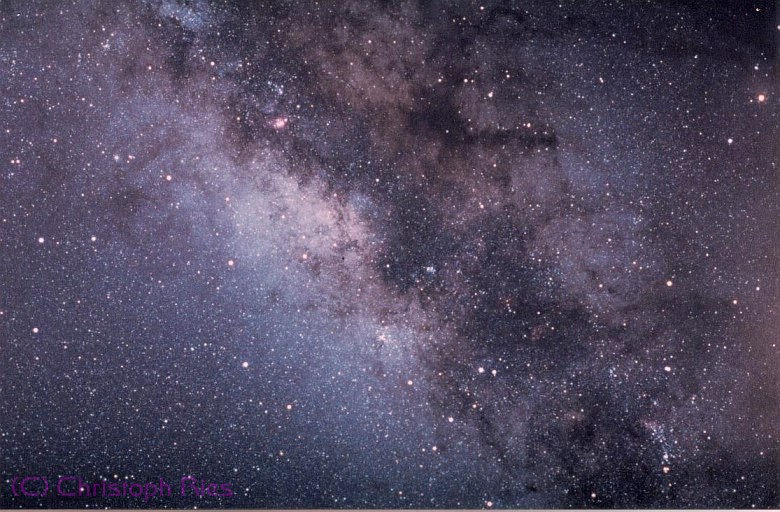 |
The Magellanic Clouds |
Small Magellanic Cloud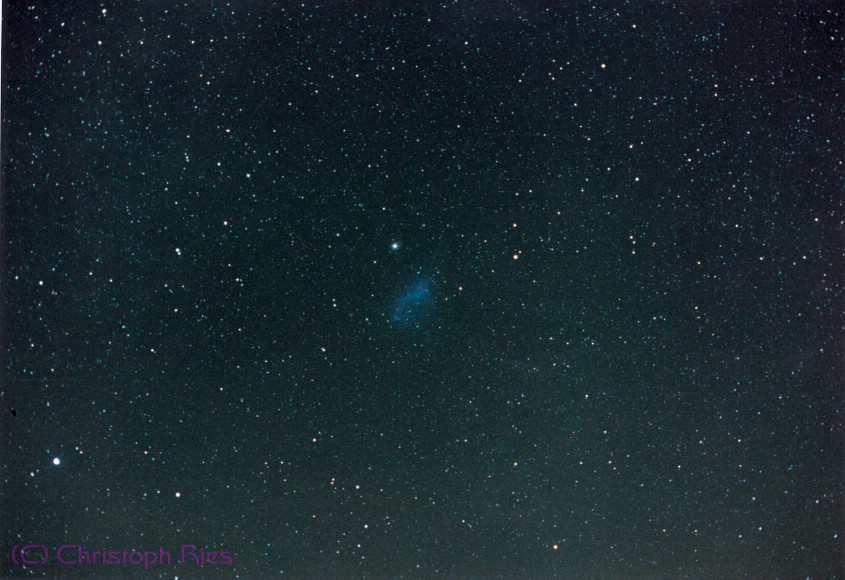
|
| The center of our Galaxy in zenith! Only at the southern hemisphere you get this feature. | This mosaic of two telephoto images shows the Magellanic Clouds, dwarf galaxies, accompanying our Milky Way . | This is the Small Magellanic Cloud. The bright spot close to the galaxy is the mighty globular cluster 47 Tucanae. |
M44 with background galaxies in spring 2002: A click in the first image of this row or here leads to further informations. The image in the middle is taken at the same time. The right exposure shows also a few of the background galaxies.
M44
|
Galaxy cluster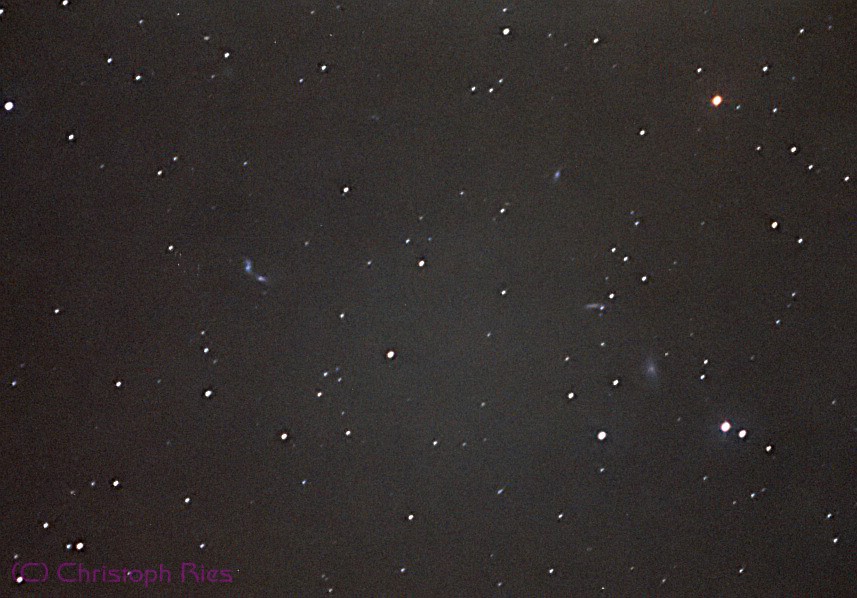
|
M44 closer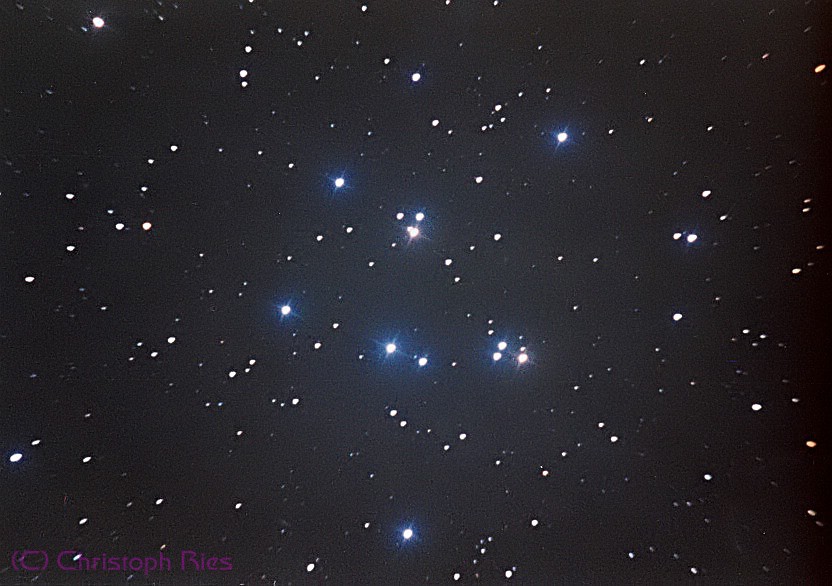
|
| A focal image of this cluster. It leads to the M44 page with observation informations about the background galaxies. | NGC 3495 and NGC 3496, on the right hand the galaxies NGC 3430 and NGC 3424. | An additional shot, taken with barlow lens and 2.7m focal length. NGC 2643, NGC 2637 and IC 2388 are visible. |
The next twelve images are astrophotographic highlights from southern sky expeditions:
Helix Nebula NGC 7293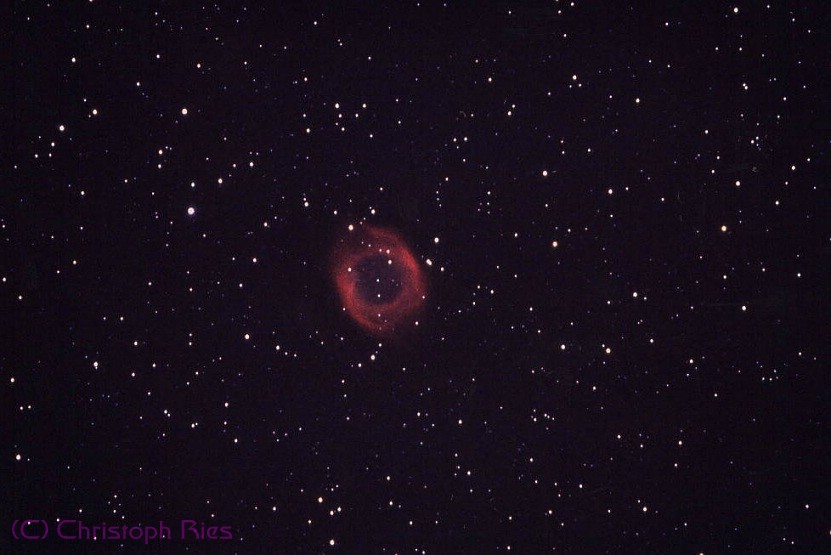
|
Trifid Nebula M20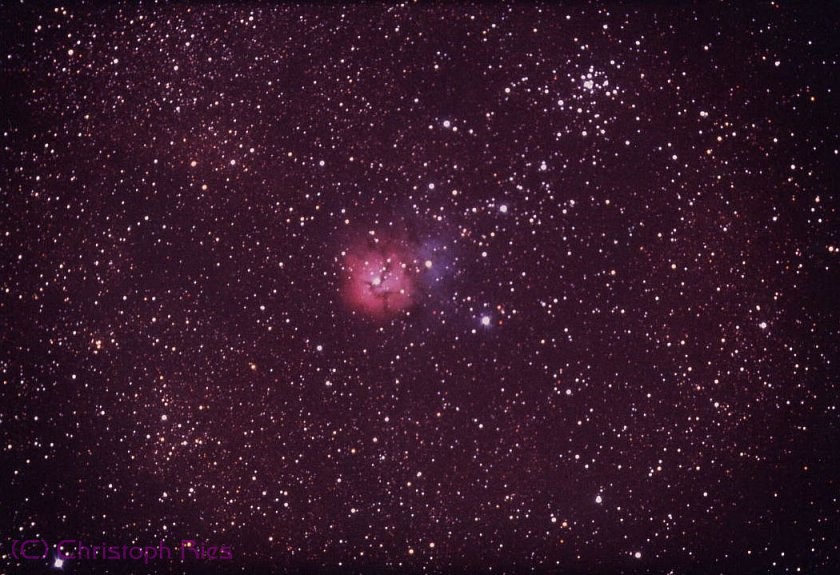
|
Omega Centauri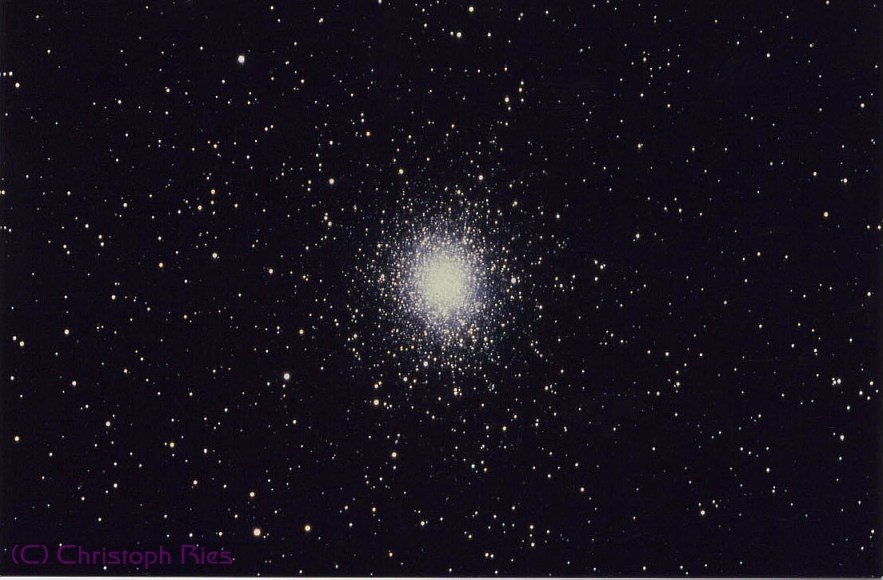
|
Silver Dollar NGC 253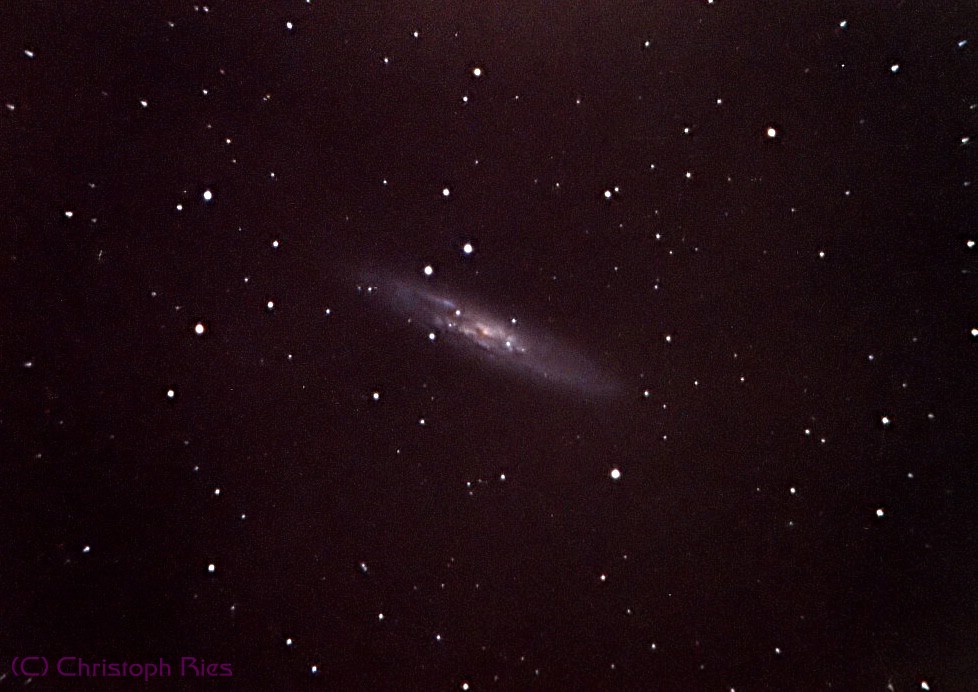
|
| The gorgeous view of the Helix Nebula is taken as focal shot with Christina 1994 in Chile close to the La Silla mountain. | This image is taken in the same night and with the same optics like NGC 7293. | This charming image of the most impressive of all clobular clusters is taken 1996 in Namibia with Christina. | The focal shot with barlow lens through the eye of Christina was exposed at the Edelweißhöhe, Austria. |
Eta Carina Nebula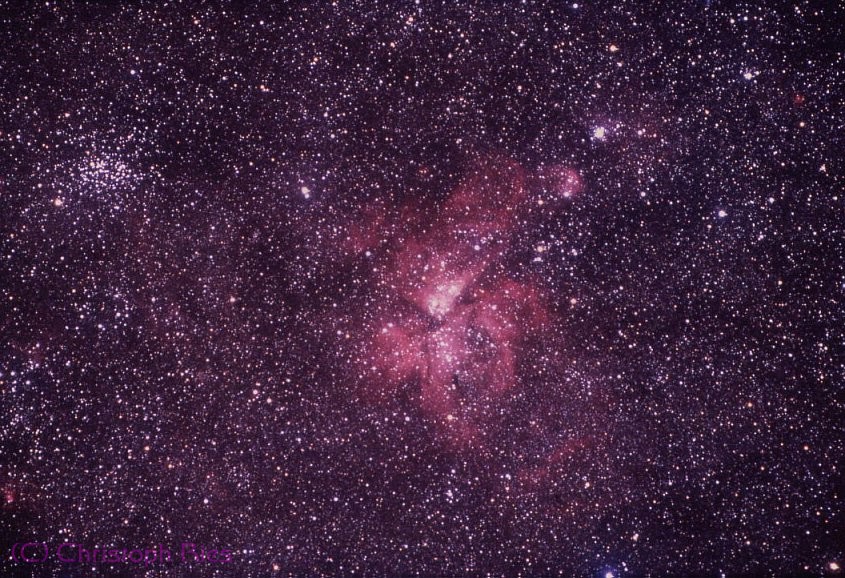
|
Centaurus A NGC 5128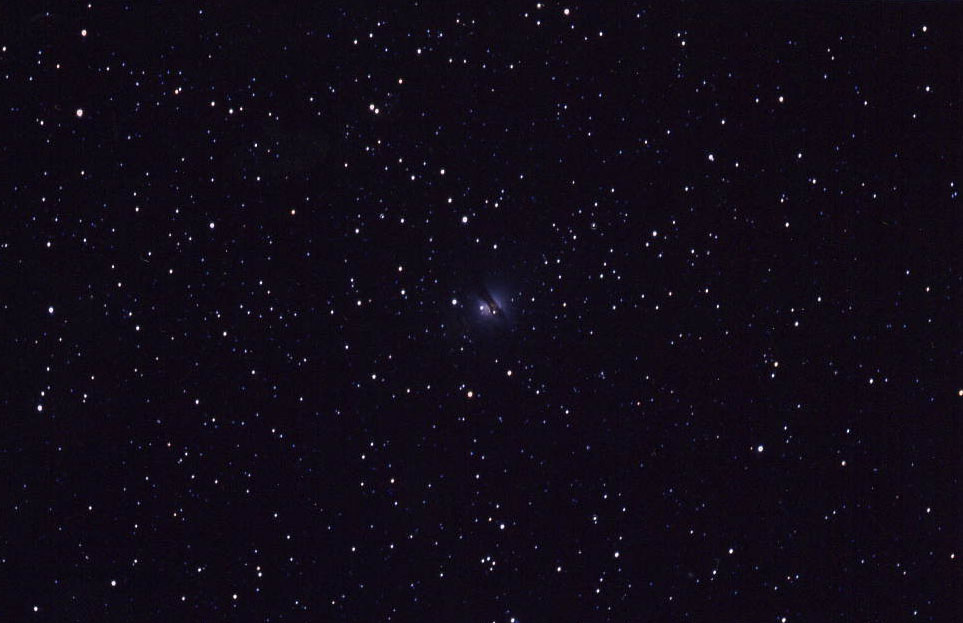
|
Southern Cross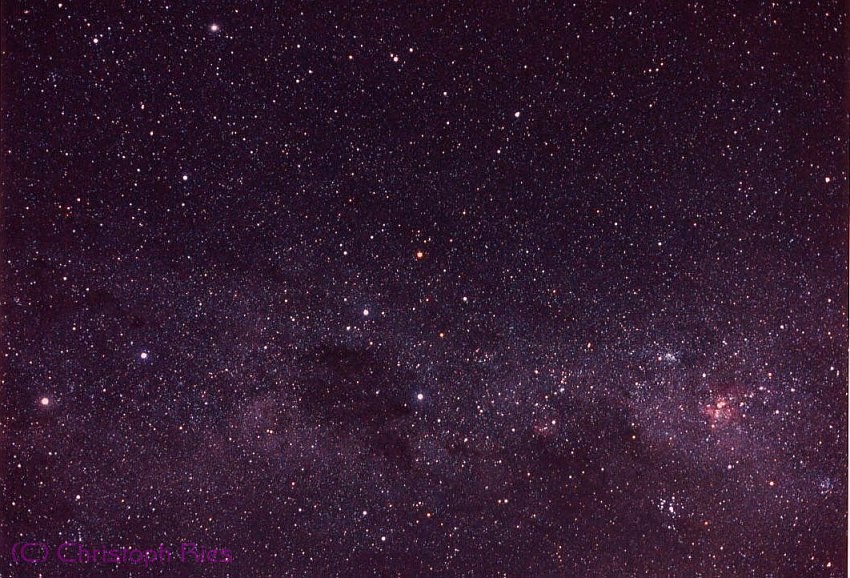
|
Stars above the tropics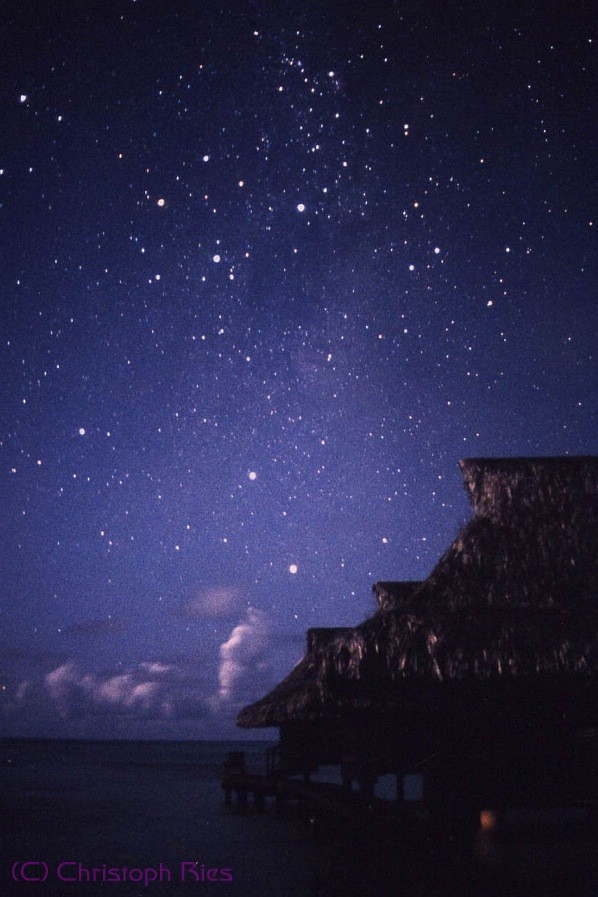
|
| One shot with an 300 mm lens, taken from the chilean Altiplano at a height of 4300 metres. | IŽve shot this view with Christina at the area of the Cuno Hoffmeister Observatory in Namibia. | This nice overview with pearls of the Southern sky is photographed with a normal lens. | The Southern Cross rises just now above the lagoon of Tahaa. |
Eta Carina nebula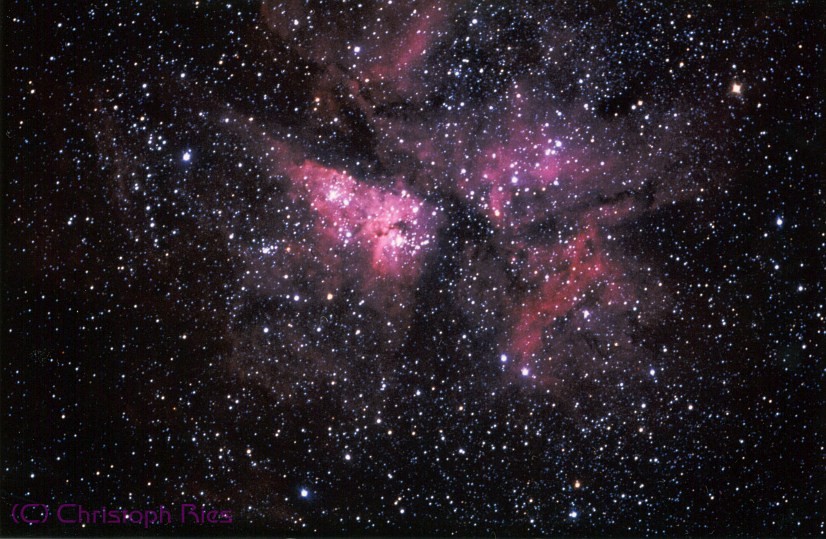
|
NGC 1365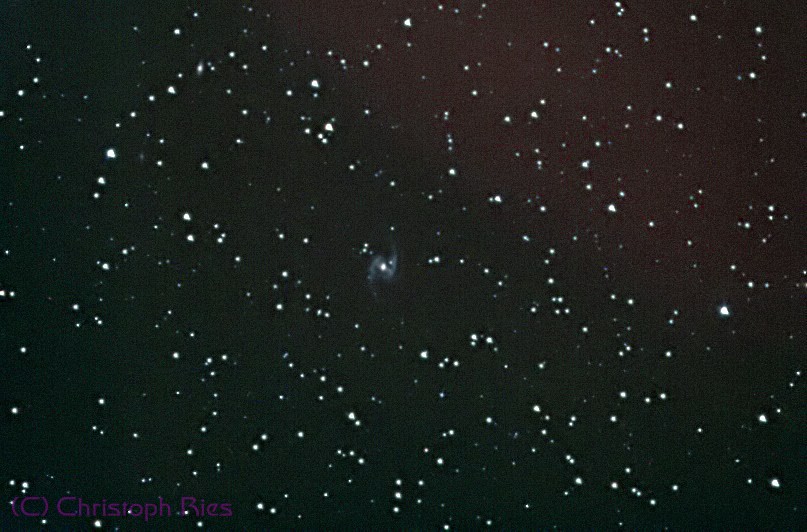
|
Shark Galaxy
|
Eagle nebula M16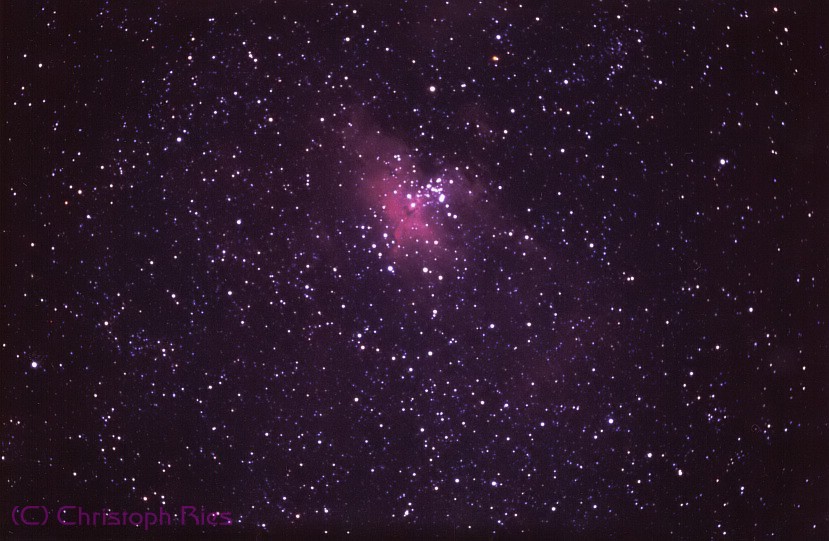
|
| The most gigantic of all gaseous nebula, seen at the splendid night sky of Namibia with Christinas optics. | At Parque Nacional Lauca NGC 1365 stood together with the Fornax Cluster in Zenit. | The so called Shark Galaxy is located close to NGC 5128 | In southern countries the Eagle nebula is flaunting much more brilliant then at home! |
The rows with southern sky images are mostly from the nineties, done mostly during two expeditions with Christina towards Chile and Namibia after the installation of The Bismark Observatory.
The ULT Schdoffal has been inaugurated in the Year 2000 in southern Spain. March 2007 there was another travel to this place. Many images from Schdoffal, also from this "spechtling" campaigns can be watched at the Christina and ULT page . Landscape imaging not only from there can be watched by now here.
M65 and M66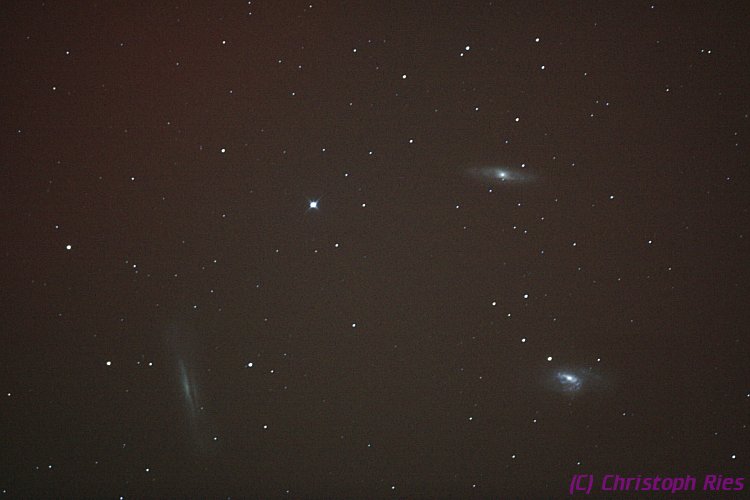
|
Milky Way above Spain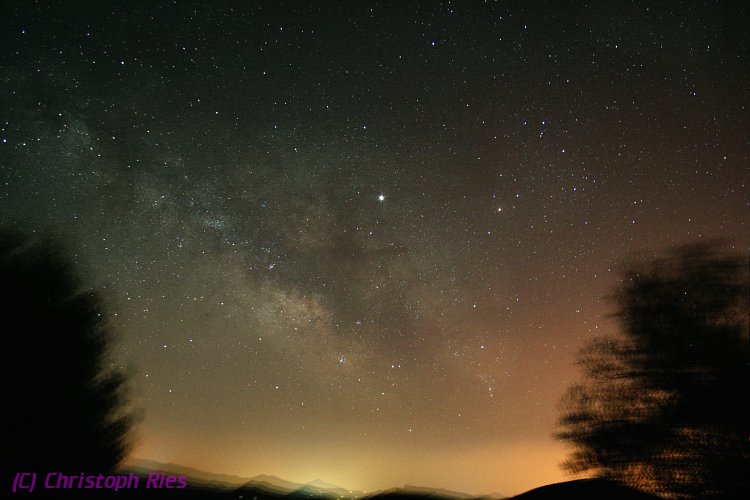
|
Omega Centauri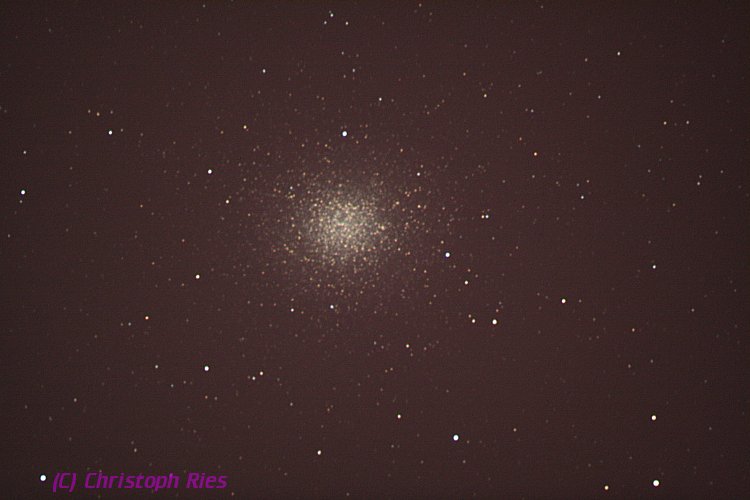
|
Hickson 61, The Box:
|
| M65, M66 and NGC 3628 have been shot at the mountain Los Reales. 3 frames at 2min each. | The summer Milky Way has risen above the bright lights of the coastline. | The king of globular clusters rises in Andalusia only five degrees above the horizon. 6 frames at 30sec each. | If all four galaxies of Hickson 61 can be viewed the visual transparency is pretty good. 5 frames at 3mins each. |
Our space was located far enough inside the country to have an acceptable sky. A few very clear and cold nights presented us a good transparency, so a time lapse movie of the rise of the Milky Way could be created. (ca 1Mb) The image on the right shows a few exotic galaxies, exposed behind our rental finca.
The next row of pictures shows extracts of the world of Galaxies:
This line of images shows a few nice galaxy shots taken with Christina and Bismarck:
NGC 4565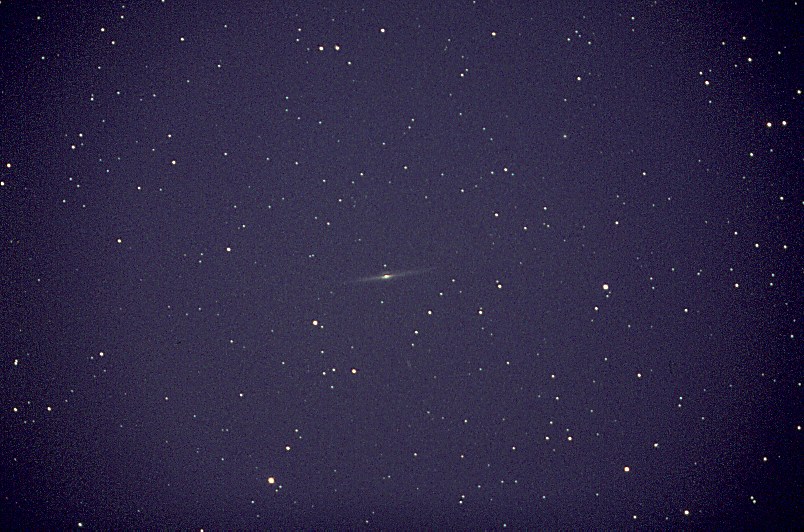
|
NGC 2903
|
Hickson 44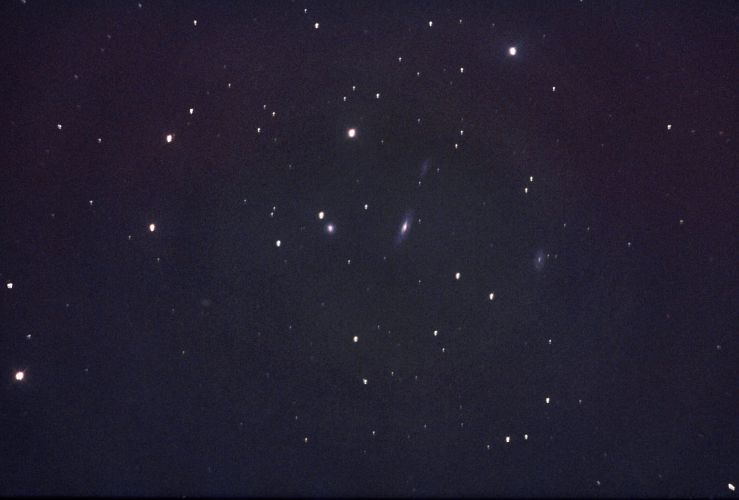
|
NGC 2683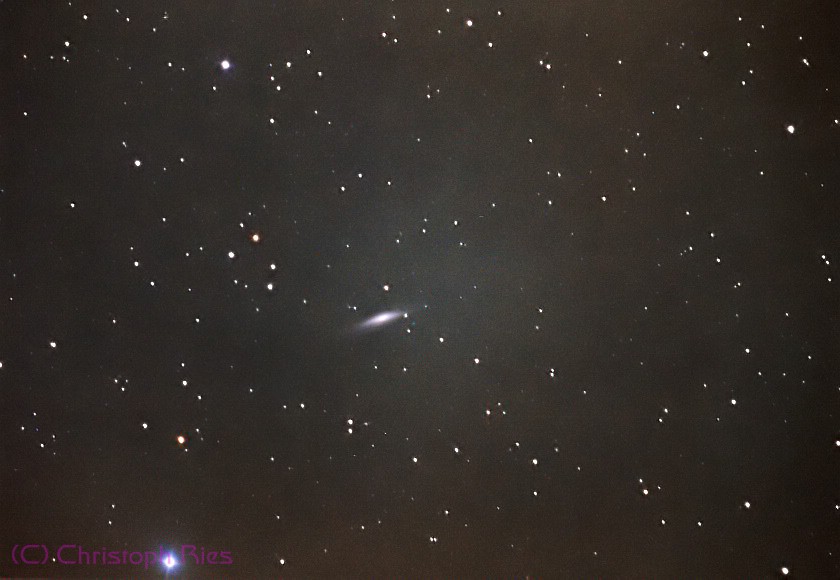
|
| Christina shot of this exquisit edge on galaxy in the constellation of Coma Berenice. | You can find this beautiful galaxy already with smaller scopes in Lion. Another Christina shot. | A pretty new image of the galaxy group Hickson 44 around NGC 3190 in the constellation of Lion. | This is a remarkable galaxy at the spring sky. Another newer Bismarck shot. |
Row of older images from The Bismarck Observatory, It shows the summer milky way at the old observatory location at good conditions but also the light pollution at that place:
NGC 7332 and 7339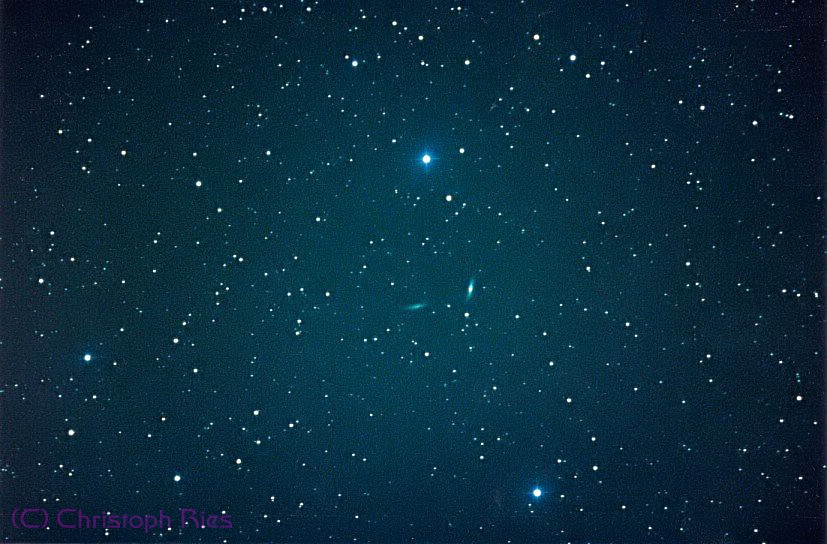
|
M13 and NGC 6207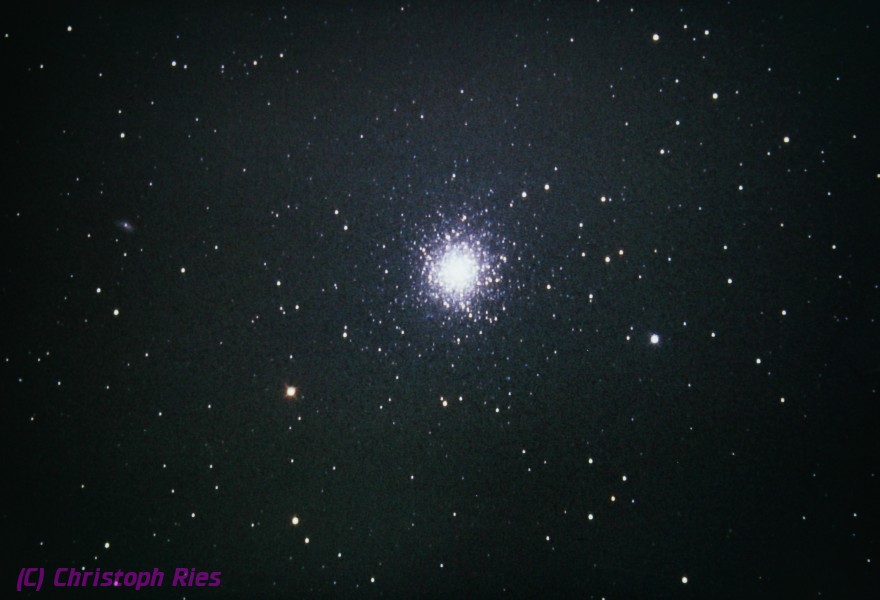
|
Summer Milky Way
|
| You can find this nice pair nearby to the legendary Stephan's Quintet. Focal shot with Bismarck at 1.5 metres focal length. | A historic but pretty good image of the famous M13 together with the galaxy NGC6207, created at the end of the eighties. | The Milky Way at Bismarck Observatory, seen in April 2007. Due to the horizon widenings more can be seen also from the light pollution. |
 To the Bismarck main page
 |
To the Bismarck Gallery. |
To the
Christina and ULT page |
To the start page |
|---|