xtalk_nonlin
Table of Contents
+title: Correcting for Non-Linear Crosstalk
previous results
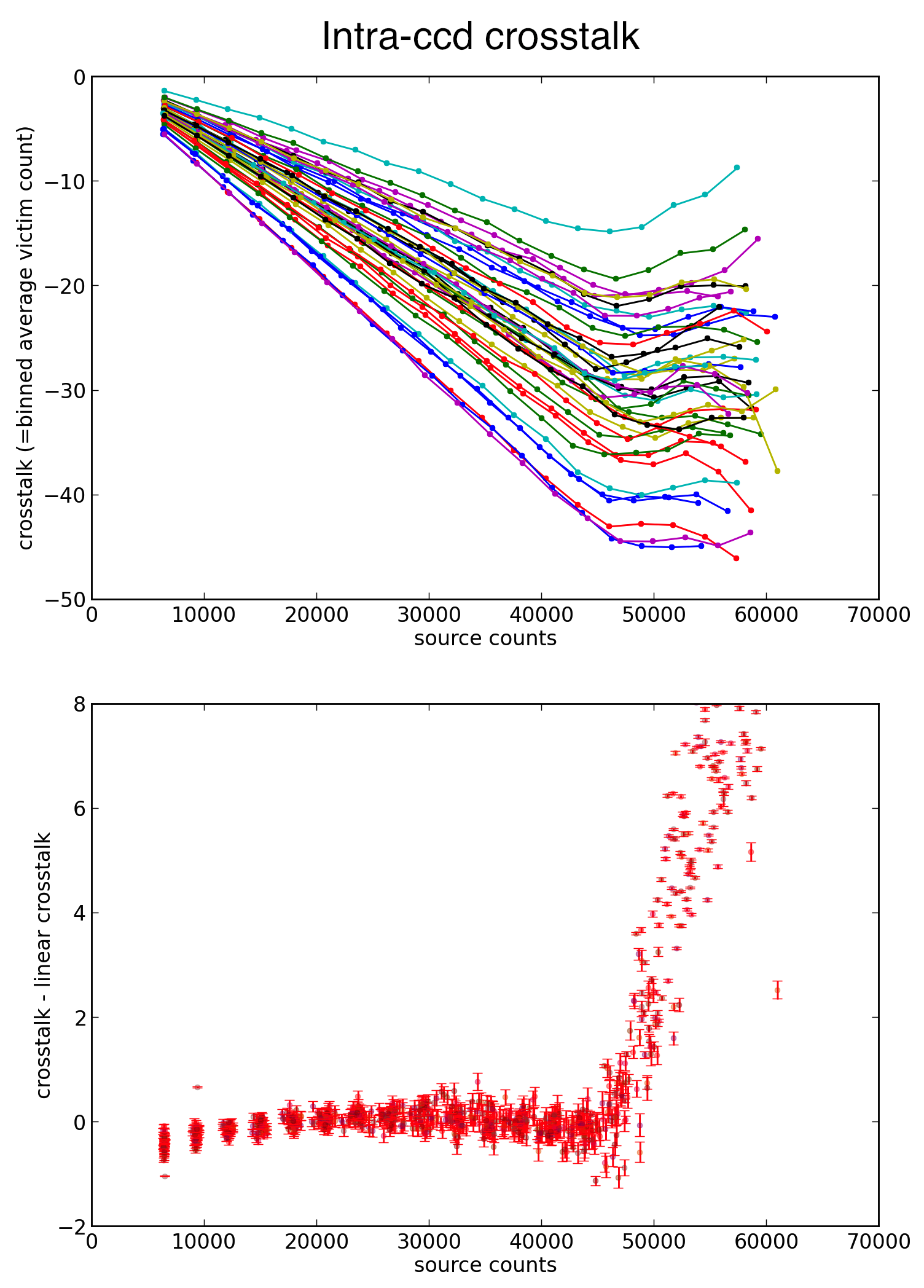
first results, negative crosstalk and first hint of non-linearities
crosstalk was determined by measuring the coefficients on single exposures and then averaging over those coefficients
closer look at non-linearities
- crosstalk was determined by using multiple exposures and extracting coefficients from a fit to the binned average (of src-vic counts)
- checking for crosstalk on same DA, and for some inter DA (very low to no crosstalk), much cleaner results
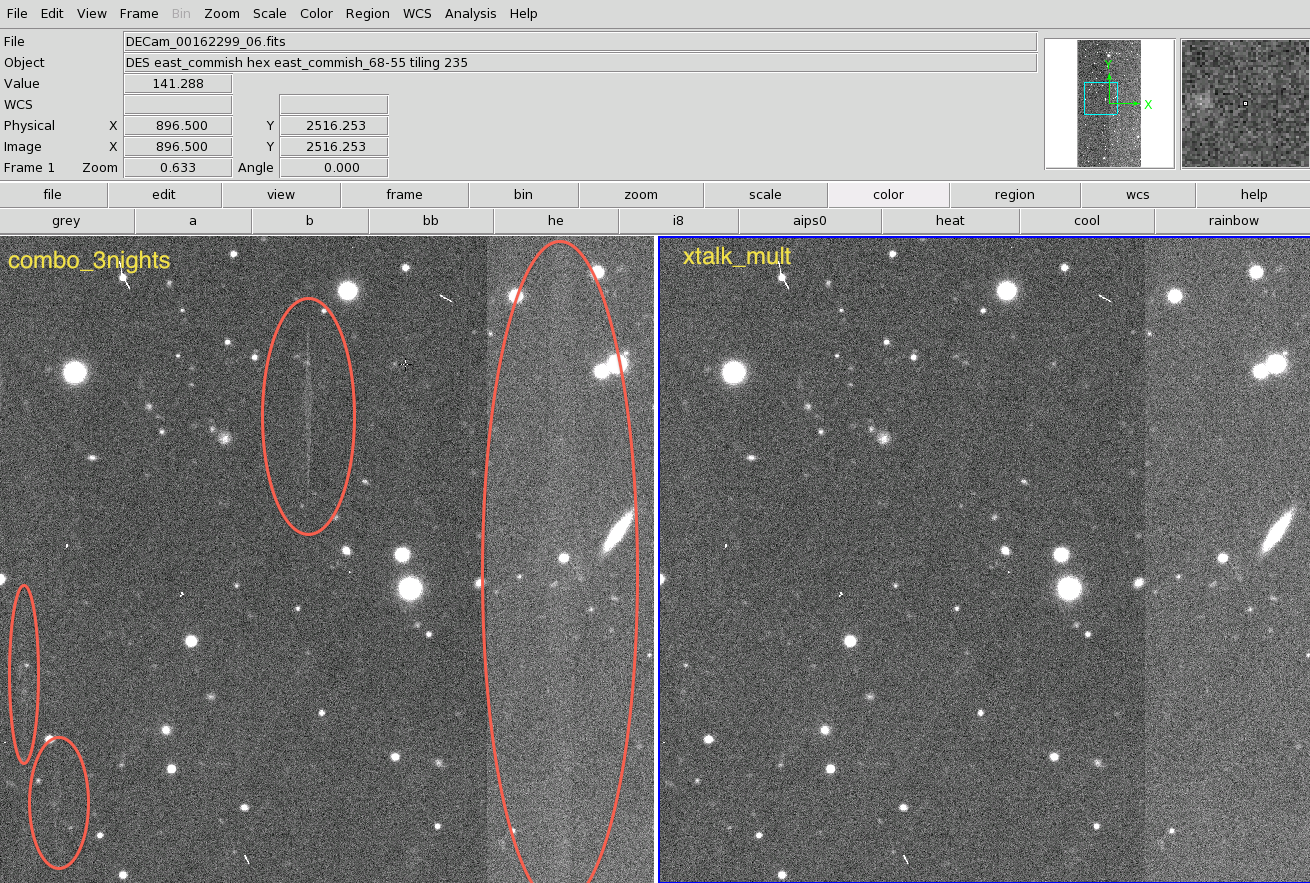
Improvments from new matrix compared to the previous matrix
- old matrix: combo_3nights.txt
- new matrix: xtalk_mult.txt
not talking non-linearities into account yet
less overcorrection, especially for inter-ccd
DECam_00162299 (ccd06)
showing overcorrections where there is no visible crosstalk
DECam_00151743 (ccd06)
showing overcorrections as well as undercorrection of crosstalk
files_xtalk_nonlin/xtalk_oldnew3.small.png
talking into account the saturation of negative crosstalk
Brian Y. and Robert G. have come up with a recipe to account for the crosstalk saturation. See https://desdb.cosmology.illinois.edu/confluence/display/DESTCN/Astronomy+Group+Updates+-+2013-03-13 for details. Results are very promising, but more cases need to be checked. Brian found crossatthres=1.2 worked best, but it may be ccd-dependent
another example: DECam_00162875 (ccd53 and ccd52)
Two different sources and their inter-ccd crosstalk are shown. Plots show ccd 21 and 22, from to to bottom: no correction, old combol_3nights, new xtalk_mult (not accounting for saturation effect), xtalk_mult for crossatthres = 1.1 (first image in addition shows crossatthres = 1.2)
files_xtalk_nonlin/xtalk_oldnew5.small.png
files_xtalk_nonlin/xtalk_oldnew6.small.png
crossatthres 1.1 seems to work best for this ccd.
Inter-ccd negative crosstalk is very low (hard to tell if it is negative crosstalk at all - noise is very large) and using the saturation for inter-ccd crosstalk should be okay.
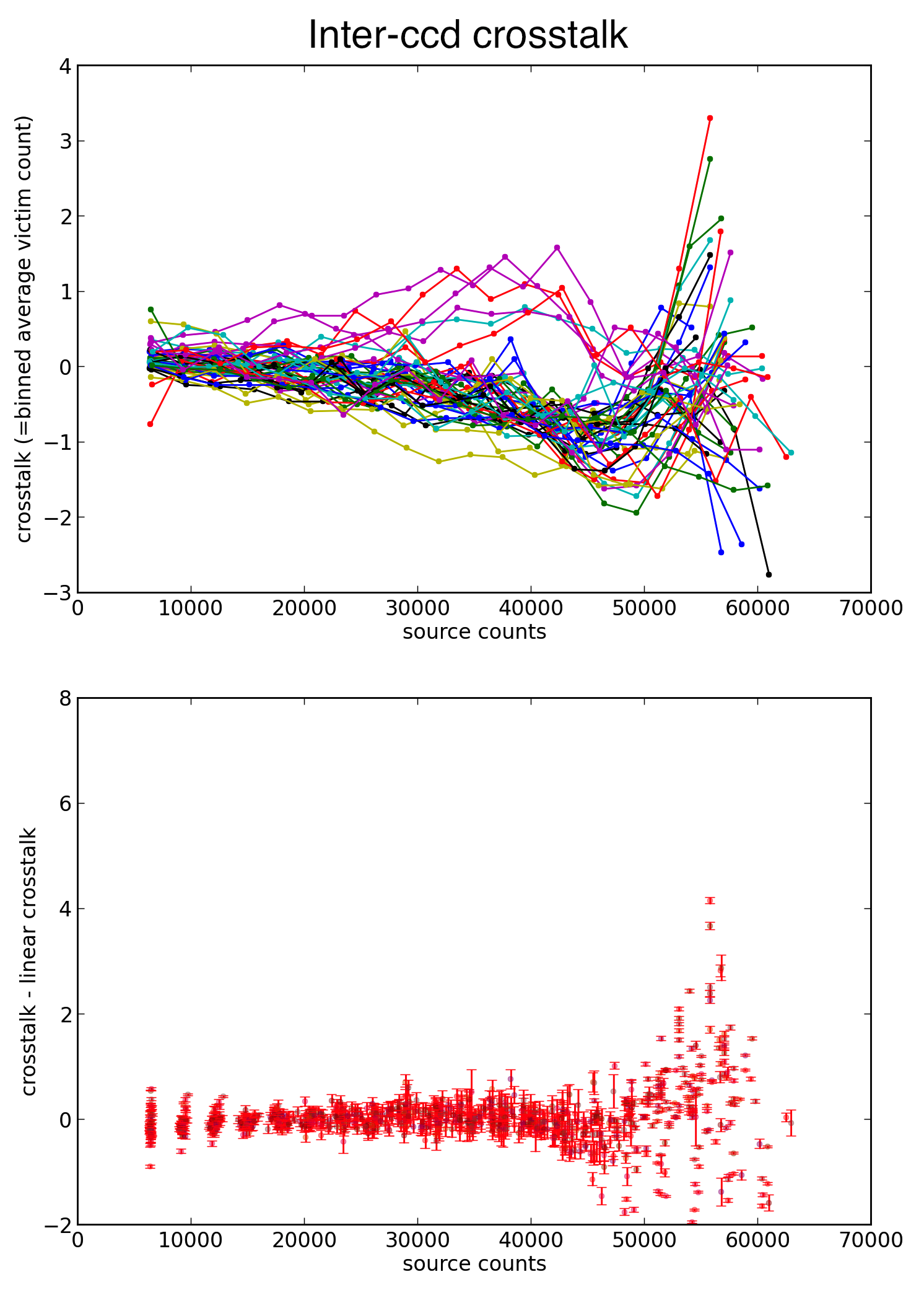
taking into account the crosstalk enhancement for positive crosstalk
For positive crosstalk, there is an enhancement above saturation level, but seems to occur only for intra-ccd crosstalk. No strong effect can be seen for inter-ccd crosstalk. The enhancement does not strictly correlate with the saturation value of a given amplifier (some amps have saturation as low as ~35k), but seems to occur around 45k counts.
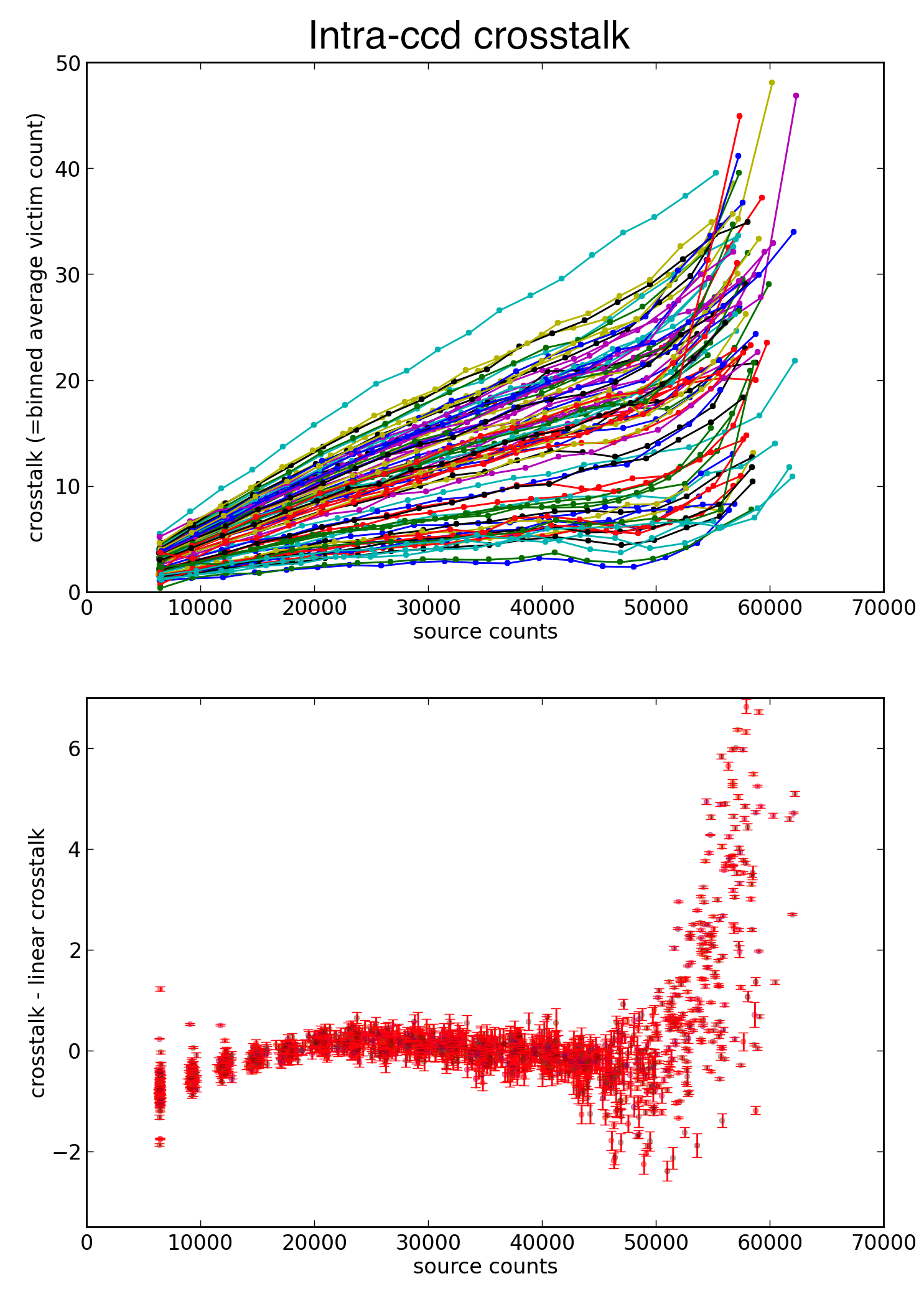
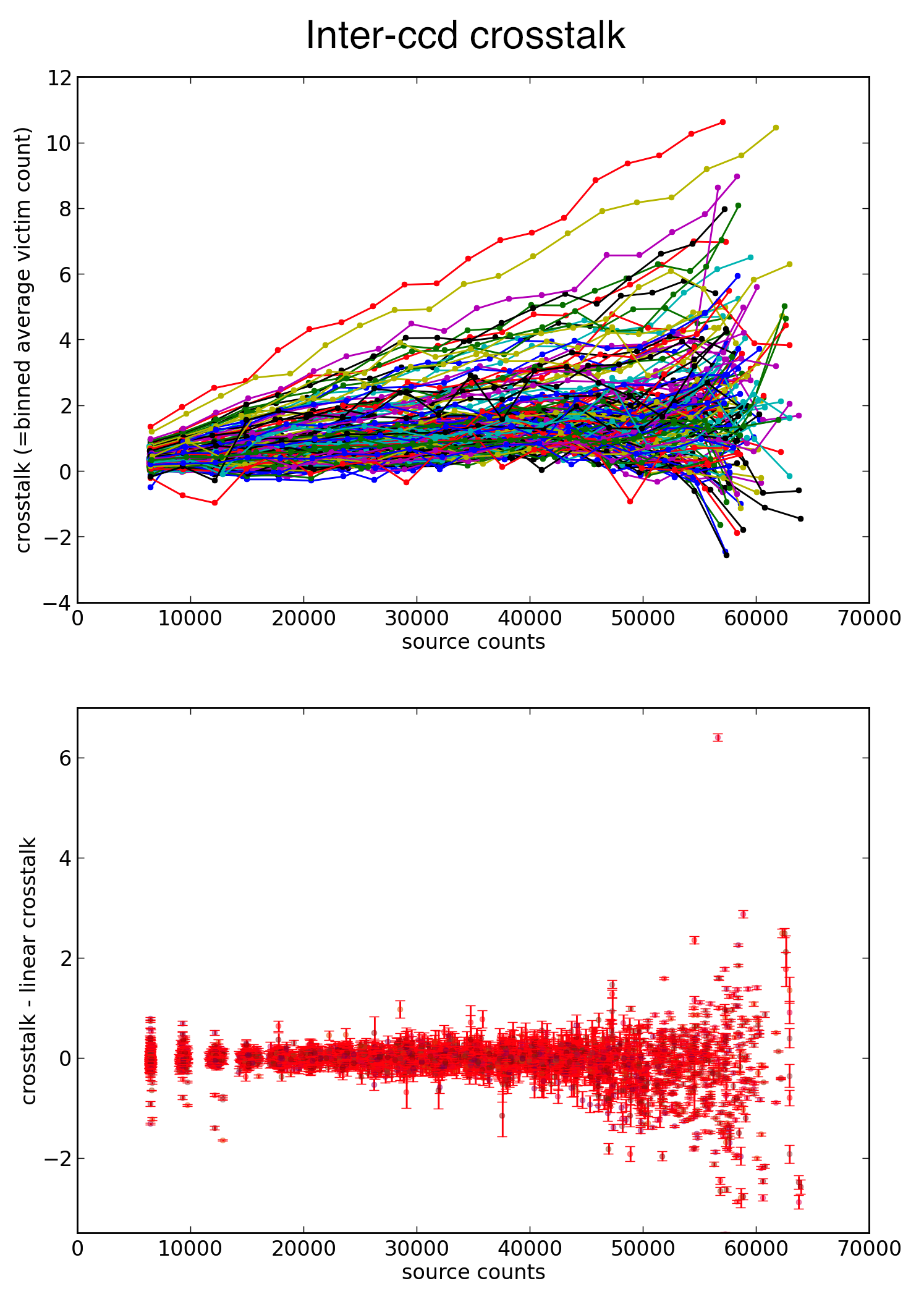
BUT there is at least one case of intra-ccd crosstalk that does not show strong (if at all) enhancement even for large counts (see below), i.e. very likely amplifier dependent. It's difficult to get a good estimate of the enhancement as for large counts the crosstalk signal is difficult to separate from actual very faint sources.
To take into account the enhancement try the following form
for counts > saturation:
xtalk = xtalk_lin + crossenhance*(count-47000)**2
example DECam00135211 (ccd 21 and 22)
Superbright source (hitting the chip edge) on ccd 21 causes inter ccd crosstalk (left) and intra-ccd crosstalk on ccd22 (right)
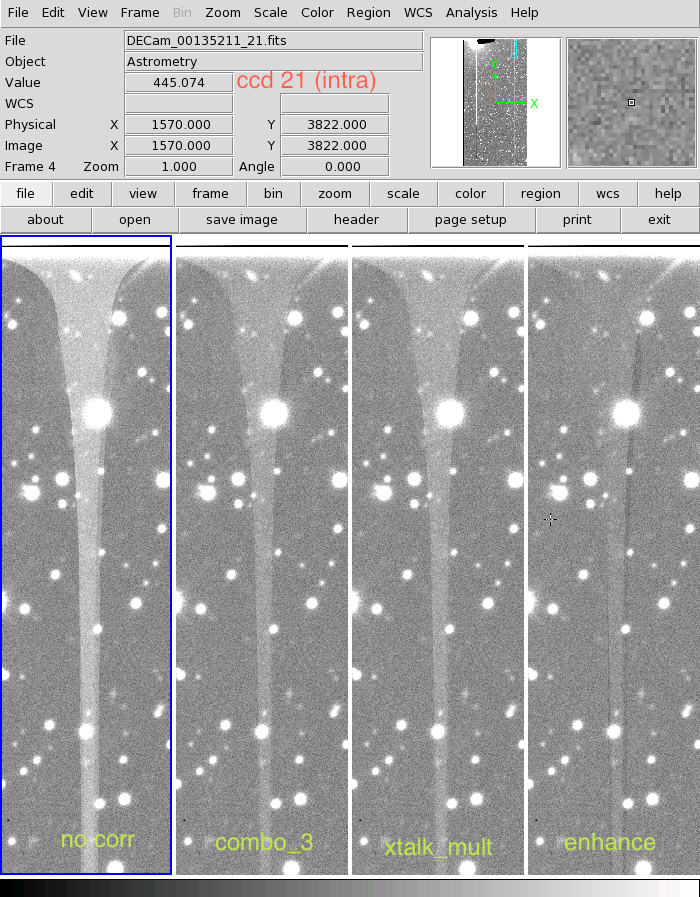
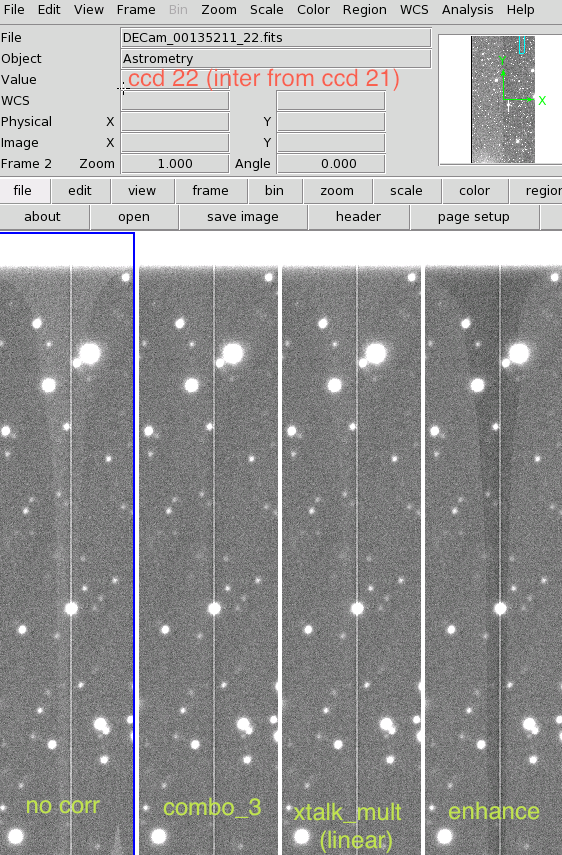
crossenhance = 5e-8 does okay - but there is still the issue of varying crosstalk for very large sources although the source counts are approximately the same (see Texas collaboration meeting talk)
example DECam00145335 (ccd 38)
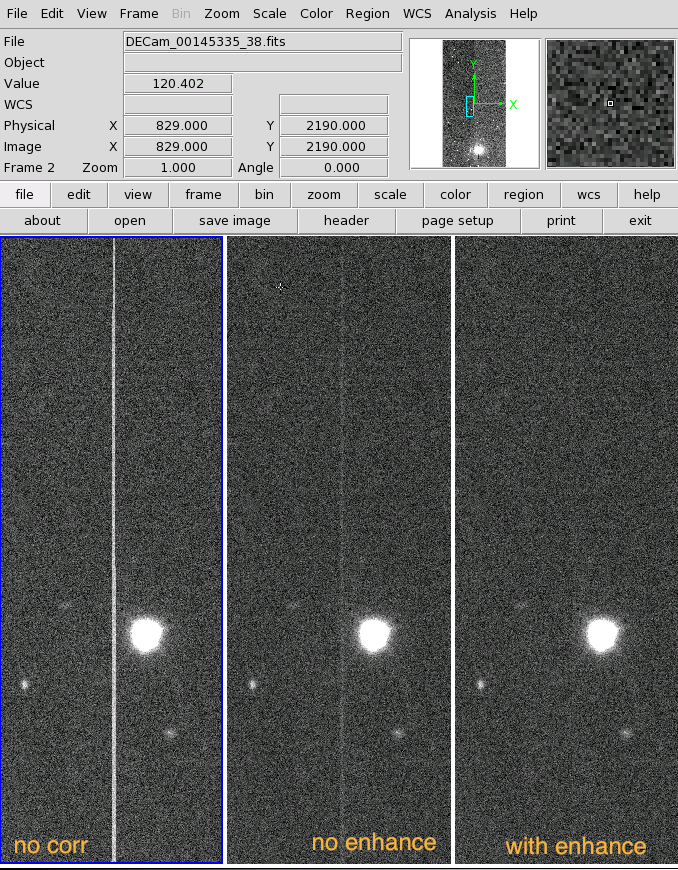
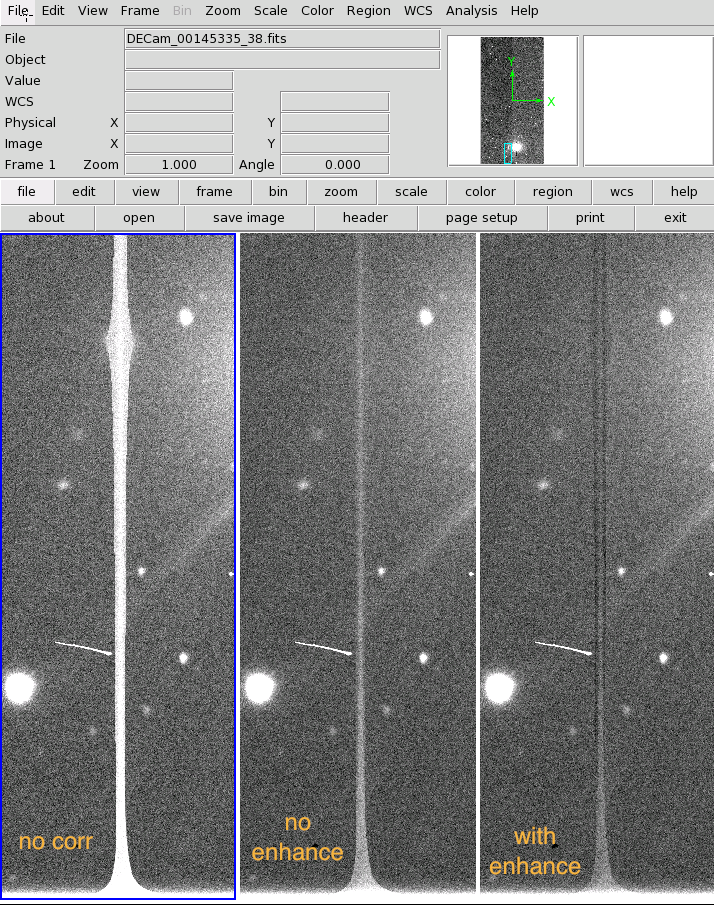
crossenhance = 3.5e-8 does very good on bright source, but not so good on superbright source.
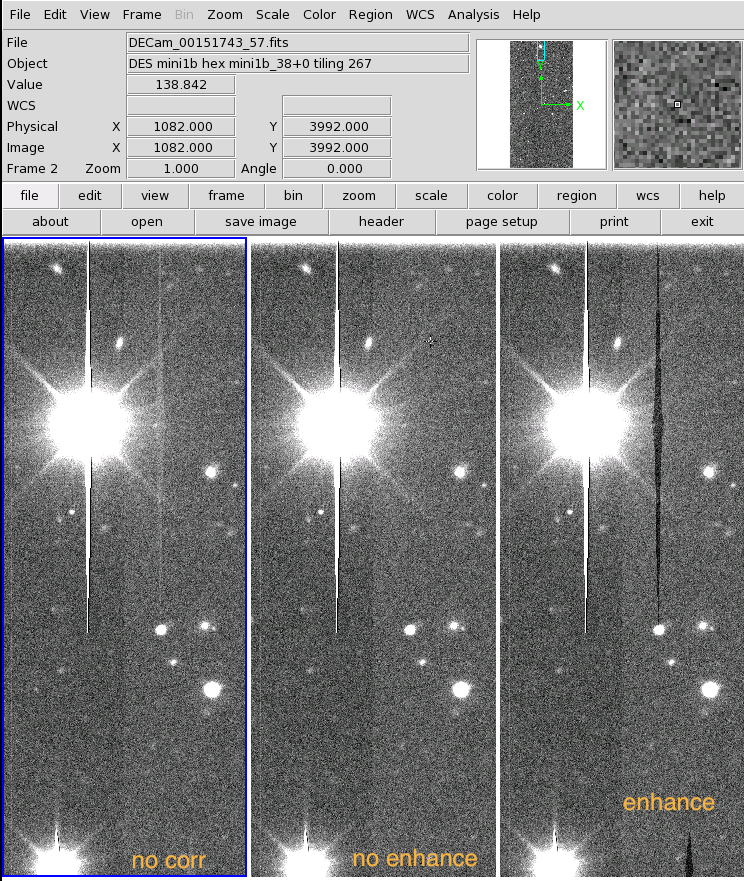
example DECam00151743 (ccd 57) where no enhancement is visible (or very small).
no visible enhancement, and if crossenhance = 3.5e-8 is used, it's badly overcorrected.
roundup
- xtalk_mult is the newest version and (much better than) combo_3night should not be used anymore
- negative crosstalk non-linearities (saturation) look very promising
- positive crosstalk non-linearities (enhancement) are a bit more tricky and need to identify the amplifiers without enhancement, may need amplifier dependent enhancement factor.
- superbright sources (where the bleedtrail hits the chipedge) are still an issue
(residuals still need to be quantized).
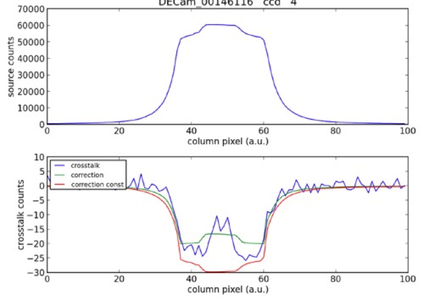
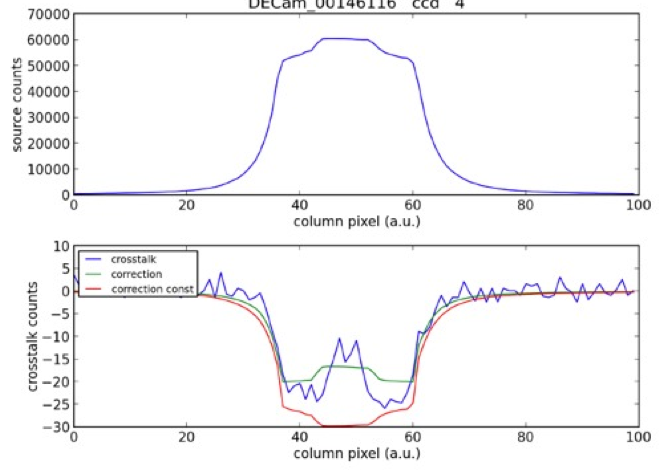
Although the source profile is almost flat, the crosstalk signal (blue line) is not and experiences some edge effect. On top of that, the crosstalk signal looks like is enhancing as you move toward the edge, i.e. their is a position dependency for superbright sources. It may be very difficult (if possible) to quantify and may need to be masked on the same ccd and a small number of inter-ccd amplifier pairs