| Lehre / Teaching | List of Publications | Co-PI in the DFG Research Unit FOR 2634/1 |
| Selected Presentations | Planet Formation Witnesses and Probes: TRANSITION DISKS |
I am a Professor for Astronomy at the Universitäts-Sternwarte München (USM), which is part of the Faculty of Physics at Ludwig-Maximilians-Universität München, where I lead the Young Stars & Star Formation Group since October 2008.
I observe Young
Stellar Objects (YSOs) with infrared and
X-ray observations, in order to investigate
the properties and the evolution of protoplanetary disks around the young stars,
and to study the stellar populations and star formation histories of young clusters and OB associations.
I also investigate the feedback effects of massive stars on the surrounding clouds
(i.e. cloud dispersal and triggering of star formation)
in various star forming regions, in particular the Carina Nebula
and the Scorpius-Centuarus OB association.
Another important topic concerns environmental effects (in particular external UV and X-ray irradiation
from neighboring stars) on the protoplanetary disks around young stars and their possible effects
on the planet formation process.
I have been
principal investigator of numerous projects using the X-ray satellites
ROSAT,
Chandra,
and XMM-Newton,
the far-infrared satellite Herschel,
a visiting astronomer at the
Calar Alto Observatory
and the Anglo-Australian Observatory,
and a principal investigator of numerous observing projects using the
ESO Very Large Telescope (VLT),
the ESO VLTI,
and the APEX sub-mm telescope.
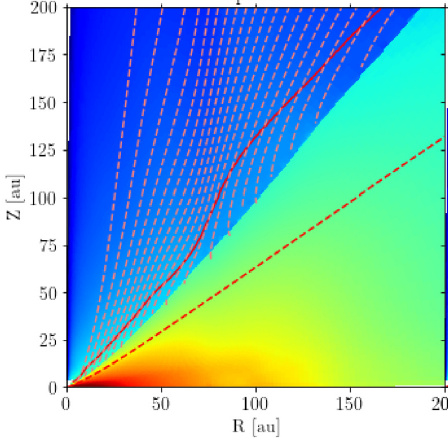
I have been involved in the DFG Research Unit FOR 2634/1 Planet Formation Witnesses and Probes: TRANSITION DISKS , where we studied the properties and the temporal evolution of protoplanetary disks, and in particular the influence of the strong X-ray emission from young stars on the evolution of the disk via the process of X-ray driven photoevaporation, which can have far-reaching consequences for the planet-formation processes occurring in these disks.
Since the year 2021 I am one of the Founding Survey Members for the Twinkle space mission. Twinkle will deliver visible and infrared spectroscopy of exoplanets, stars and protoplanetary disks. These data will be used to connect the results of observational and numerical studies of protoplanetary disk evolution to the properties of the planets.
From the year 2010 until 2014 I served as the German Representative in the ESO Users Committee. From 2007 to 2010 I was involved in the sub-project "The birth and influence of massive stars" in the EU FP6 Marie Curie Research Training Network "CONSTELLATION: The origin of the IMF". In the year 2012 I co-organized the conference "Planet Formation and Evolution 2012".
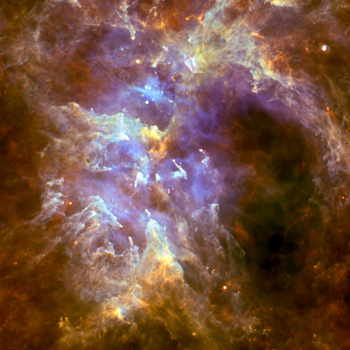
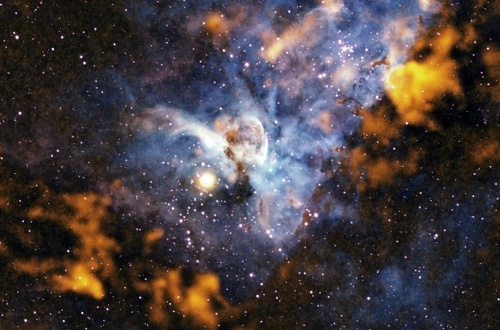
The following images illustrate some important aspects of my recent research.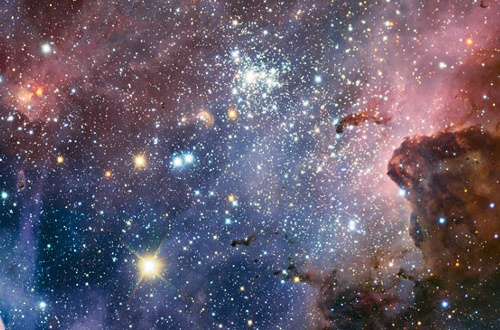
| 
| 
|
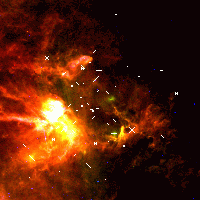
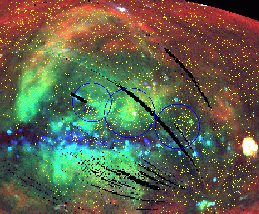
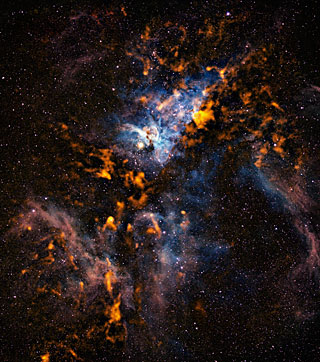
| HAWK-I near-infrared image of the Carina Nebula | Carina Nebula: Herschel far-infrared | LABOCA sub-mm image of the Carina Nebula |
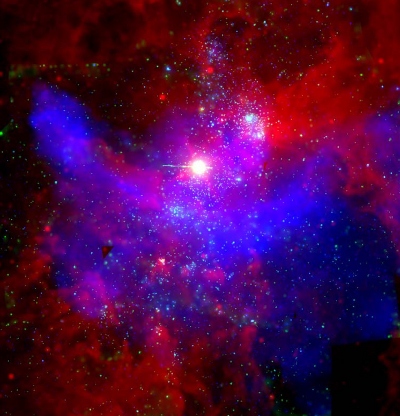 Chandra Carina Complex Project |
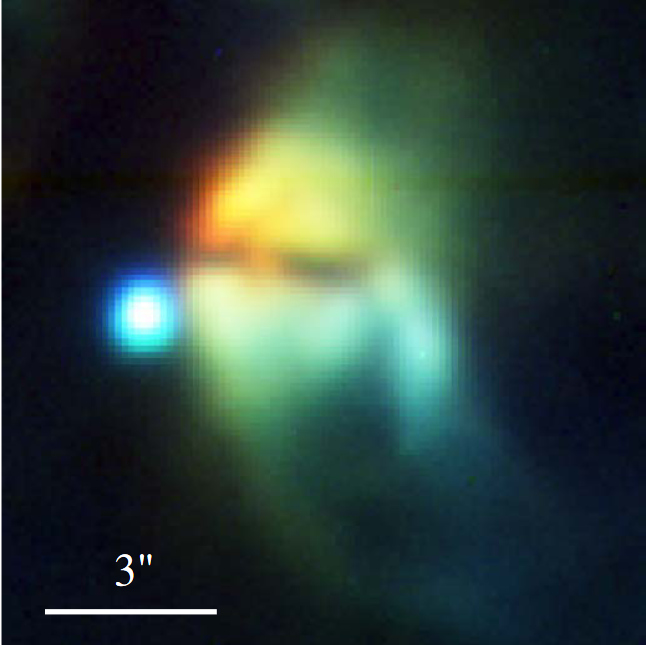
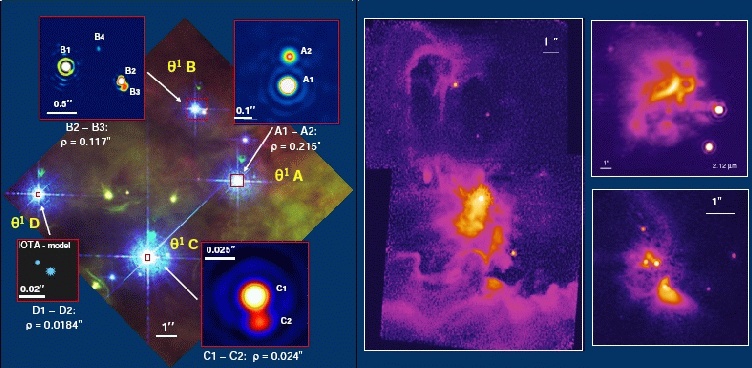 High resolution infrared images of Young Stellar Objects |
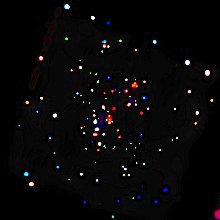
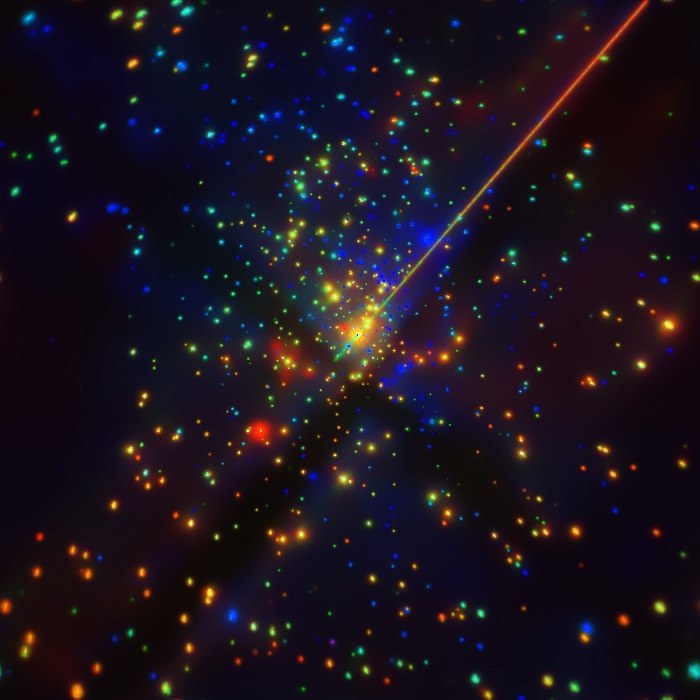 COUP X-ray image of the Orion Nebula Cluster |
My current main research projects are as follows:
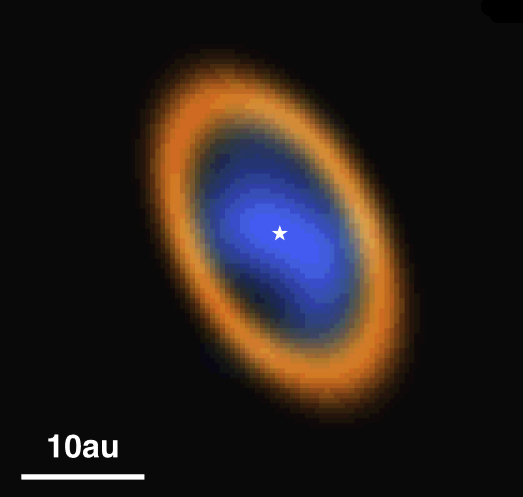
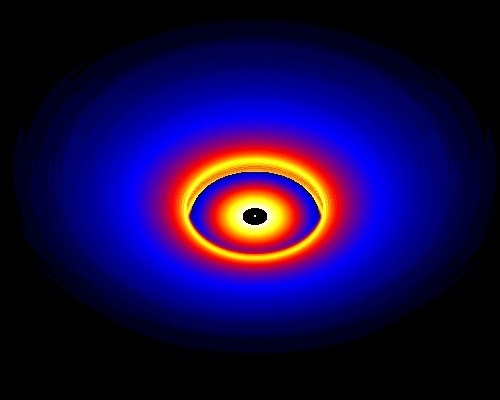
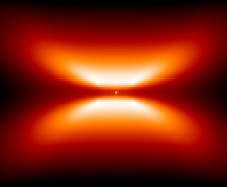
Properties and Evolution of Young Stellar Objects and their Protoplanetary Disks
I study the circumstellar environment of selected Young Stellar Objects (YSOs) with various techniques, including infrared imaging, interferometry, and spectroscopy, in order to investigate the structure and properties of their protoplanetary disks. One important aim is to get new insight into the conditions for planets forming in these disks.
In a close cooperation with my colleague Prof. Barbara Ercolano, we work on numerical simulations of the impact of the stellar X-ray emission on the surrounding protoplanetary disk. The models suggest that the X-ray driven photoevaporation of disk material plays a crucial role in the temporal evolution of the disk mass and the disk structure, and can have far-reaching consequences for the formation and early evolution of planets. Large parts of this work were done within the context of the DFG Research Unit FOR 2634/1 Planet Formation Witnesses and Probes: TRANSITION DISKS , where I was one of the Principle Investigators.
Relevant publications include: B123, B117, B115, B114, B112, B110, B109, B107, B106, B105, B104, B102, B91, B81, B79, B64, B56, B43, B41, B31, B28
Stellar Populations, Massive Star Feedback, and Triggered Star Formation in OB Associations
The largest current project in this context is my multi-wavelength investigation of the Carina Nebula. The April 2013 issue of the Star Formation Newsletter contains an article in which I described the background of this project. Further information can be found at my Carina project page.
I also lead a long-term project to explore the full stellar population of the Upper Scorpius OB Association, the most nearby region of recent massive star formation. Following large multi-object spectroscopic surveys to identify a representative sample of low-mass members, our studies of the mass function and the age distribution of the members allowed a rather detailed reconstruction of the star formation process of this association. The results suggest that the star formation process in Upper Sco was triggered, most likely by the shock-wave of an expanding supernova- and wind-driven superbubble from the nearby Upper Centaurus Lupus association. In a project funded in the context of the DFG Priority Program 1573: Physics of the Interstellar Medium we studied the interaction of the winds and ionizing radiation of the massive stars with the surrounding interstellar medium in detail.
Relevant publications include: A5, A2, A1, B122, B119, B116, B111, B108, B103, B101, B99, B98, B97, B95, B94, B93, B92, B90, B88, B87, B86, B85, B84, B78, B77, B75, B74, B71, B70, B69, B29, B22, B16, B12, C29; several presentations are also available
X-ray studies of Young Stellar Objects
Young stars generally show very strong X-ray emission. A good knowledge of the X-ray properties of YSOs is of paramount importance not only for the understanding of the physical mechanisms that lead to the X-ray emission and their relation to the magnetic activity; the X-ray irradiation of protoplanetary disks has also far-reaching implications for the formation of planetary systems, and the evolution of protoplanetary atmospheres. Furthermore, since X-ray radiation is much less affected by extinction than optical light, X-ray observations can penetrate though extinctions of up to AV ~ 500 mag into dark clouds and allow a deep look at embedded YSOs. Since X-ray activity is particularly effective in discriminating YSOs from unrelated fore- and background field stars, X-ray studies are also a very important tool for the investigation of the stellar populations of star-forming regions.
I have performed numerous X-ray observations of young stellar clusters
(in particular IC 348, NGC 1333, and the Serpens
dark cloud) and investigated the flares and X-ray spectra of YSOs.
I have been deeply involved in the
Chandra Orion Ultradeep Project (COUP),
a unique 10-day
long observation of the Orion Nebula Cluster,
that provided the most comprehensive dataset ever acquired on the X-ray
emission of young stars.
Another large X-ray project where I was deeply involved is the
Chandra Carina Complex Project.
Recently, I contributed to the Chandra HETG Orion VeryLargeProject.
Relevant publications include: A3, B121, B118, B113, B100, B94, B83, B82, B80, B77, B76, B75, B74, B73, B72, B69, B63, B60, B59, B53, B51, B50, B49, B48, B47, B46, B42, B40, B36, B33, B32, B27, B24, B17, B15, B14, B13, B11, B10, B8, B7, B6, B3, B2; several presentations are also available.
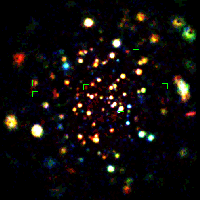
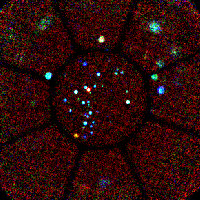

The following links lead to a (recently updated) collection of some of my X-ray images and infrared images of star forming regions.
A growing number of new X-ray, infrared, and sub-mm images of the Carina Nebula Complex is available since March 2011 on the webpage describing our Carina Multiwavelength Project.
Prof. Dr. Thomas Preibisch
Universitäts-Sternwarte München
Ludwig-Maximilians-Universität
Scheinerstr. 1
81679 München
Germany

preibisch at usm.uni-muenchen.de
TEL: +49 (0)89-2180-6016