OB associations are large aggregates of hundreds to several thousand young stars. Since they are the dominant birthplaces for stars in our galaxy, a good knowledge of their properties and their formation history is essential for our understanding of the galactic structure and evolution. However, our knowledge of the stellar content of even the nearest OB associations is quite poor, especially for the low mass stars. Unlike stellar clusters, which can be easily recognized on the sky, OB associations are often very inconspicuous: since they extend over huge areas in the sky (often several hundred square-degrees) its is very hard to "see" them, because most stars in the area actually are unrelated foreground or background stars. Finding the association members among these field stars is therefore like finding needles in a haystack.
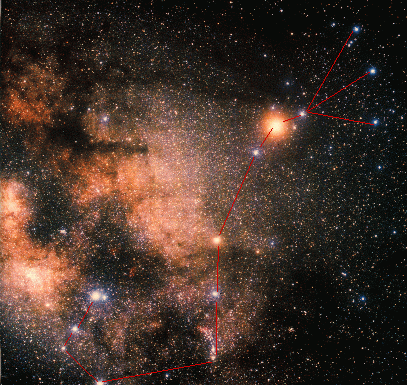
One of my main research topic is a detailed study of the Upper Scorpius association. The image below shows the constellation Scorpius; the Upper Scorpius association is located in the upper right part of the image and includes the "head" of the Scorpius.
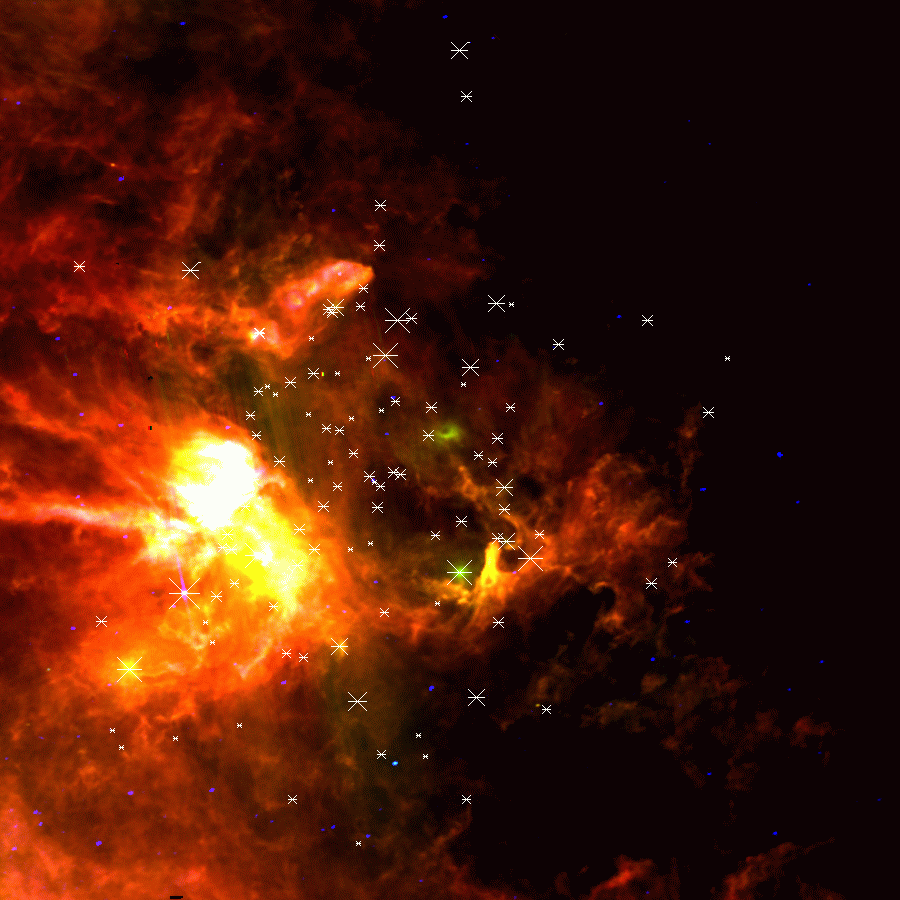
With a distance of about 470 lightyears, Upper Scorpius is one of the nearest OB associations, and with an age of only about 5 million years it is very young (5 million years might sound quite old; however, when translating the 5 million years for a solar-like star to human timescales, it corresponds to an age of only about two weeks). During the last couple of years, enormous progress has been made in the identification of the association members. The astrometry satellite Hipparcos identified about 30 high-mass (more than 3 solar masses) members by their characteristic space motions. The next image is a true color infrared image (12 micrometer emission is shows in blue, 60 micrometer in green, 100 micrometer in red) contructed from IRAS data. The asterisks mark the positions of the massive stars which belong to the association. The bright region left of the center is the rho Ophiuchus molecular cloud, a well known site of ongoing star formation.
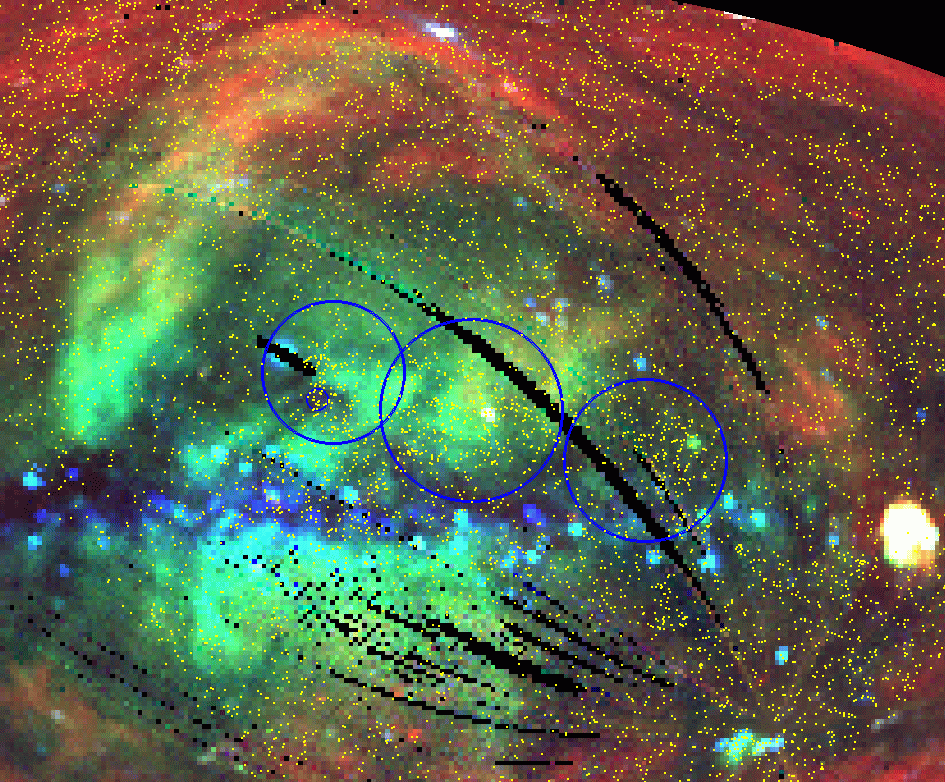
Young low-mass stars are known to be strong X-ray emitters. Thus, X-ray observations are a good way to find the stellar members of a young association like Upper Scorpius. The next image shows a wide field X-ray image of the full Scorpius Centaurus association, of which the Upper Scorpius association is the youngest part. It is a true color X-ray image constructed from the data of the ROSAT All Sky Survey background maps. The yellow dots mark the positions of bright X-ray sources detected in the ROSAT All Sky Survey (note that we hav plotted only the about 10% brightest X-ray sources). The blue circles mark the three subgroups Upper Scorpius, Upper Centaurus Lupus, and Lower Centaurus Crux (from left to right). One can see a clear enhancement in the density of X-ray sources associated with these three subgroups of the association. The association is embedded in a large roughly circular structure; this is a huge bubble of hot gas created by the stellar winds of the numerous massive stars in the association and by several super-nova explosions, which happened in the Scorpius Centaurus association during the last few million years.
We have performed a survey for young stars among the ROSAT detected X-ray sources in a huge 160 square-degree area in Upper Scorpius and could identify numerous previously unknow young associaton members (for more detailed information see this paper).
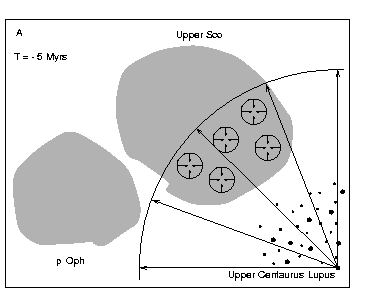
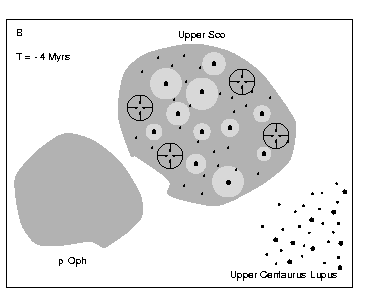
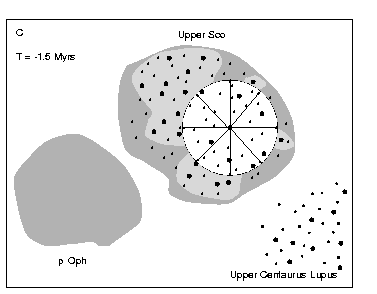
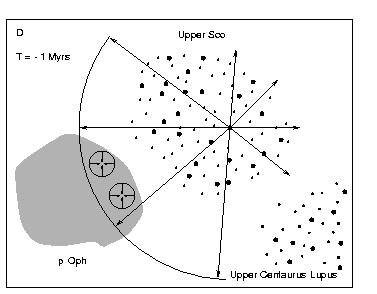
In the next step of our study we have determined the ages and masses of about 100 low-mass members in Upper Scorpius. This allowed us to construct a rather detailed picture of the star formation history of the association (for details see our second paper ). The general picture of the star formation history of the Scorpius-Centaurus association can be outlined as follows: (see illustration below): The star formation process in Scorpius-Centaurus started in the Upper Centaurus-Lupus association some 15 Myr ago. About 12 Myr ago the most massive star in Upper Centaurus-Lupus exploded as a supernova, creating a large shock wave. The shock wave from this supernova passed through the Upper Scorpius cloud about 5 million years ago (A), and triggered the star formation process there. Shortly thereafter, the strong winds of the numerous massive stars in Upper Sco started to disperse the molecular cloud and halted the star formation process (B). About 1.5 Myr ago the most massive star in Upper Sco exploded as a supernova (C). This shock wave fully dispersed the Upper Scorpius molecular cloud and now passes through the rho Oph cloud, where it might well have started the star formation process about 1 million years ago (D).