Research

CLASSIFICATION OF ASTRONOMICAL OBJECTS
02.02.18
Realistic synthetic observations can help to develop classification schemes for astronomical objects (e.g. circumstellar discs, YSOs):
• Circumstellar discs around low-mass stars
The evolution and dispersal of circumstellar discs are essential to understand because they are the smallest link in the chain of star formation. Their evolution sets the scene for star and planet formation and represents the link between the two. By means of extensive radiative transfer modelling, I have developed a new set of diagnostic diagrams in the infrared. I showed that the evolutionary stage of the transition discs around low-mass protostars can be classified in the infrared two-color space (K - 8 μm vs. K - 24 μm, Koepferl et al. 2013) and the hole sizes can be approximated (K - 12 μm vs. K - 70 μm, Ercolano et al. 2015). By comparison with observed photometrical data, in Koepferl et al. 2013, I showed further that the dominant disc dispersal mechanism is inside-out clearing (forming a hole which grows in size) rather than homogenous draining of the disc material onto the protostar. I estimated the typical disc dispersal time as some 10^5 years which sets a constrain for planet formation.
• Young stellar objects in high-mass star formation
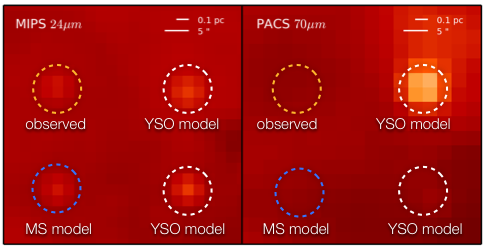
Before forming stars clear their circumstellar discs, they are embedded in a dense envelope. These objects are called young stellar objects (YSOs). In the extreme environment of the Galactic centre, the central molecular zone (CMZ), point-source catalogues have been used to classify extremely young high-mass YSOs using 24 μm emission. These young objects have been used to calculate star-formation rates of the CMZ which disagreed with other estimates up to a factor of 10. In Koepferl et al. 2015, I investigated whether estimates based on YSOs could be heavily contaminated by more evolved objects such as main-sequence stars. I found that many of the YSOs, selected at 24μm and used to measure the SFR, do not have counterparts in Herschel observations and are extended in 24 μm, suggesting they may not be as young as previously assumed. I computed radiative transfer models (using the FluxCompensator to produce realistic synthetic observations) which show that main-sequence O/B stars in a constant ambient medium can indeed mimic YSOs at 24μm, while being faint or undetected at Herschel wavelengths (Fig. 1). Using these modelling results, I estimated the fraction of misclassified “YSOs” to be at least 63% and up to 90%, which could explain the discrepancy to other estimates of the star-formation rate.
Figure 1:
MIPS 24 micron (left) and PACS 70 micron (right) observation with embedded realistic synthetic models of YSOs and evolved stars (MS).

